Make talent quality your leading analytic with skills-based hiring solution.
The AI skill gap is quickly becoming the biggest workforce challenge heading into 2026 and 2027. But the capability-building challenges underneath it are more complicated than most leaders want to admit.
We put two questions to our community on the Talented podcast. The results were striking, not because they were surprising, but because of how clearly they exposed the tension sitting at the heart of most organisations right now.
Everyone knows the skills problem is getting worse. Fewer people know what to actually do about it.
Here is what the data showed, and what it means for how HR and L&D leaders should be thinking heading into the next planning cycle.
The first question asked which skill gap organisations are most worried about heading into 2026 and 2027.
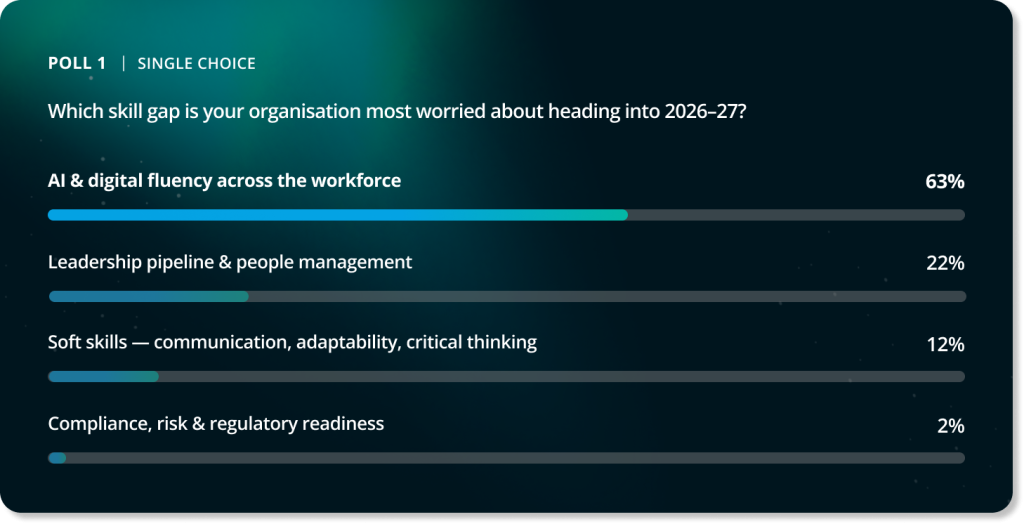
63% percent of respondents pointed to AI skill gap and digital fluency across the workforce. That number is not just a plurality. It is more than double the next closest answer.
Leadership pipeline and people management came in second at 22%. Soft skills, covering communication, adaptability, and critical thinking, came in at 12%. Compliance, risk, and regulatory readiness trailed at just 2%.
The message from the data is clear. Organisations are not broadly anxious about skills. They are specifically anxious about one thing. The workforce is not keeping pace with the technological shift happening around it, and leaders are increasingly aware that this gap is widening faster than their current L&D infrastructure can close it.
What makes the 63% figure worth sitting with is what it implies about everything else. Leadership development matters. Soft skills matter. Compliance matters. But if the majority of an organisation’s workforce cannot operate effectively alongside AI tools, cannot make sense of data, and cannot adapt to digitally transformed workflows, then none of those other investments work as well as they should.
AI fluency is not a standalone capability. It is increasingly the foundation on which every other capability sits.
The second question asked what the biggest capability-building challenge is right now, and this is where the data gets more textured.
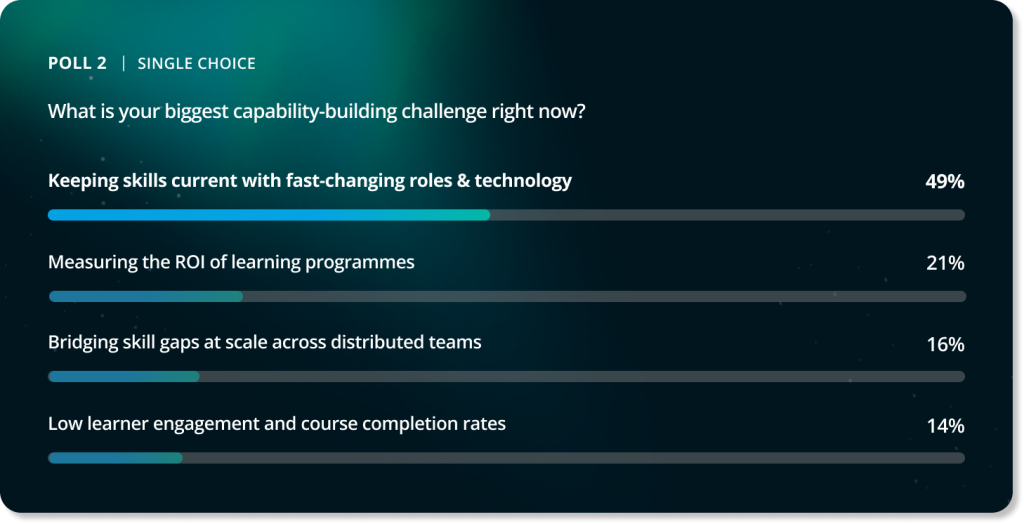
49% of respondents said keeping skills current with fast-changing roles and technology. That is the dominant answer by a wide margin, and it connects directly to the first poll. Organisations are not just worried that skills are missing. They are struggling with how quickly the target is moving.
The next two answers are worth reading together. Twenty-one percent said measuring the ROI of learning programmes. 16% said bridging skill gaps at scale across distributed teams. Low learner engagement and course completion rates came in at 14%.
Put these four answers next to each other and a picture emerges. Organisations are running learning programmes that people are not completing, that are hard to prove the value of, that are difficult to deliver consistently across geographies and teams, and that cannot keep pace with how fast the roles themselves are changing.
That is not a skills problem. That is a systems problem.
The two polls, read together, point to something worth naming directly.
Most organisations are trying to solve a 2026 problem with a 2019 L&D model. The programmes exist. The intent is there. But the architecture underneath, how skills are identified, how learning is delivered, how progress is measured, how content stays current, was not built for this pace of change.
When half your respondents say keeping skills current with fast-changing technology is their biggest challenge, and nearly two-thirds say AI skill gap is their top priority, the implication is that the two are connected. The reason AI fluency is not improving fast enough is partly because the systems meant to build it cannot move quickly enough to keep up with what AI itself is doing.
The ROI measurement challenge makes this harder. L&D teams that cannot demonstrate impact struggle to secure the investment needed to redesign their approach. It becomes a cycle that is genuinely difficult to break without senior leadership support and a willingness to rethink what capability building actually looks like.
A few things stand out from this data as practical starting points.
The first is that AI fluency needs to be treated as infrastructure, not a topic. A one-off digital skills course does not address a 63% worry. What addresses it is embedding AI literacy into the flow of everyday work, role by role, function by function, so that capability builds continuously rather than in discrete learning events.
The second is that the ROI measurement problem is solvable, but it requires starting with business outcomes rather than learning metrics. Completion rates and satisfaction scores measure activity. What organisations need to measure is whether skills are actually changing behaviour on the job, and whether that behaviour change is connecting to results.
The third is that scale and distributed delivery are infrastructure problems before they are content problems. Getting the right learning to the right person at the right time, across a global or hybrid workforce, requires investment in the underlying systems, not just the curriculum.
And the fourth, perhaps the most underrated insight from both polls, is that the problem organisations are facing is not a lack of awareness. 63% know what they are worried about. 49% know where they are stuck. The gap is between knowing and doing something structurally different about it.
The data from our community reflects what practitioners across HR and L&D are experiencing on the ground. The skill gap is real, it is specific, and it is accelerating. The capability-building systems most organisations have in place were not designed for the speed at which both technology and work are now moving.
The organisations that close this gap over the next two years will not be the ones that add more learning content. They will be the ones that redesign how capability building works at a structural level, measure what actually matters, and treat AI fluency as a baseline rather than an advanced skill.
The rest will keep trying to solve a moving target with a static solution.
These findings are drawn from live audience polls conducted as part of the Talented podcast community. If you want to be part of future conversations on workforce capability, talent strategy, and the future of HR, follow the Talented podcast wherever you listen.
Organisations are prioritising AI and digital fluency above all other skill gaps for 2026–2027. While leadership, soft skills, and compliance remain important, the data shows a clear shift toward technical adaptability, as businesses need employees who can work effectively alongside AI-driven tools and data systems.
The biggest challenge is keeping skills current with rapidly evolving technology and job roles. As AI continues to change workflows and expectations, traditional learning programmes struggle to keep pace, making it difficult for organisations to continuously update workforce capabilities in real time.
Traditional L&D models often rely on static courses, periodic training, and completion-based metrics, which are not suited for fast-changing AI environments. These models fail because they cannot continuously update content, embed learning into workflows, or measure real-world skill application effectively.
Organisations can measure ROI by linking learning outcomes to business impact rather than completion rates. This includes tracking behaviour change on the job, improvements in productivity, faster adoption of AI tools, and measurable outcomes such as revenue growth, efficiency gains, or reduced operational costs.
AI assessment tools with the highest user satisfaction like Glider AI typically offer intuitive interfaces, accurate skill validation, and strong candidate experiences. High-performing platforms focus on real-world simulations, fast feedback, and seamless integration with hiring workflows, ensuring both recruiters and candidates benefit from a streamlined evaluation process.
Skills assessment platforms like Glider AI reduce hiring bias by focusing on objective, standardised evaluations rather than subjective judgments. By using anonymised assessments, structured scoring, and AI-driven insights, these platforms help organisations make fairer hiring decisions based on actual skills and performance instead of background or personal characteristics.

Hiring fraud isn’t coming. It’s here, and it’s already inside the building. From North Korean operatives impersonating U.S. tech workers to “professional interviewers” using deepfakes and AI tools to cheat hiring systems, enterprises are now on the frontlines of a new kind of cybersecurity threat: candidate fraud. And the problem is exploding: While digital hiring […]
Real-Time Chat Skills Matter—And You Need a Communication Skills Test Live chat is now the front line of customer experience. Whether it’s a quick support question or a high-stakes sales inquiry, the quality of your chat interactions impacts satisfaction, loyalty, and revenue. The challenge? Many companies fail to use a communication skills test that accurately […]

How to Use Phone Screening Questions to Identify Top Talent In today’s competitive job market, identifying top talent quickly and efficiently is crucial. One of the most effective tools at your disposal is the phone screen. When done correctly, phone screening can help you sift through a large number of candidates, narrowing down the pool […]