Make talent quality your leading analytic with skills-based hiring solution.
Hiring has moved almost entirely online, and that shift has created an opening for a new kind of risk: candidates who are not who they claim to be. Remote interviews, digital document uploads, and virtual onboarding make it easier than ever for an impersonator to sit in for a real applicant, submit someone else’s credentials, or use an AI generated face to pass a video screen. The Federal Bureau of Investigation has publicly warned that state sponsored actors, including operatives linked to North Korea, have used stolen identities and proxy interviewees to land remote IT jobs at legitimate US companies, then used that access for espionage, data theft, or extortion, as detailed in the FBI’s alert on North Korean IT workers. The US Department of Justice has since brought criminal cases tied to these same remote work fraud schemes, confirming this is not a rare edge case.
Recruiting teams across staffing, technology, healthcare, and financial services are reporting more attempted impersonation, credential swapping, and interview to hire mismatches, where the person who interviews is not the person who shows up for the job. The financial and security stakes are significant. A fraudulent hire can expose sensitive systems, violate sanctions and export control rules, damage client trust for staffing firms, and create legal liability for the hiring company. Yet many organizations still rely on hiring workflows that were designed for a world where identity fraud was rare, not a scaled, tool assisted threat.
A common misconception is that a background check already covers this risk. It does not. A background check confirms facts about a person’s history, such as employment dates, education, or criminal record, but it does not confirm that the person sitting in the interview is the same person those records belong to. Background checks are also typically run late in the process, sometimes after an offer has already been made, and they rarely repeat throughout onboarding.
Identity verification asks a different, more fundamental question: is this candidate really who their resume and application say they are, right now, at this stage of the process? Closing that gap is the specific job of a purpose built identity verification solution, and it is why identity checks and background checks should be treated as separate, complementary steps rather than one substituting for the other.
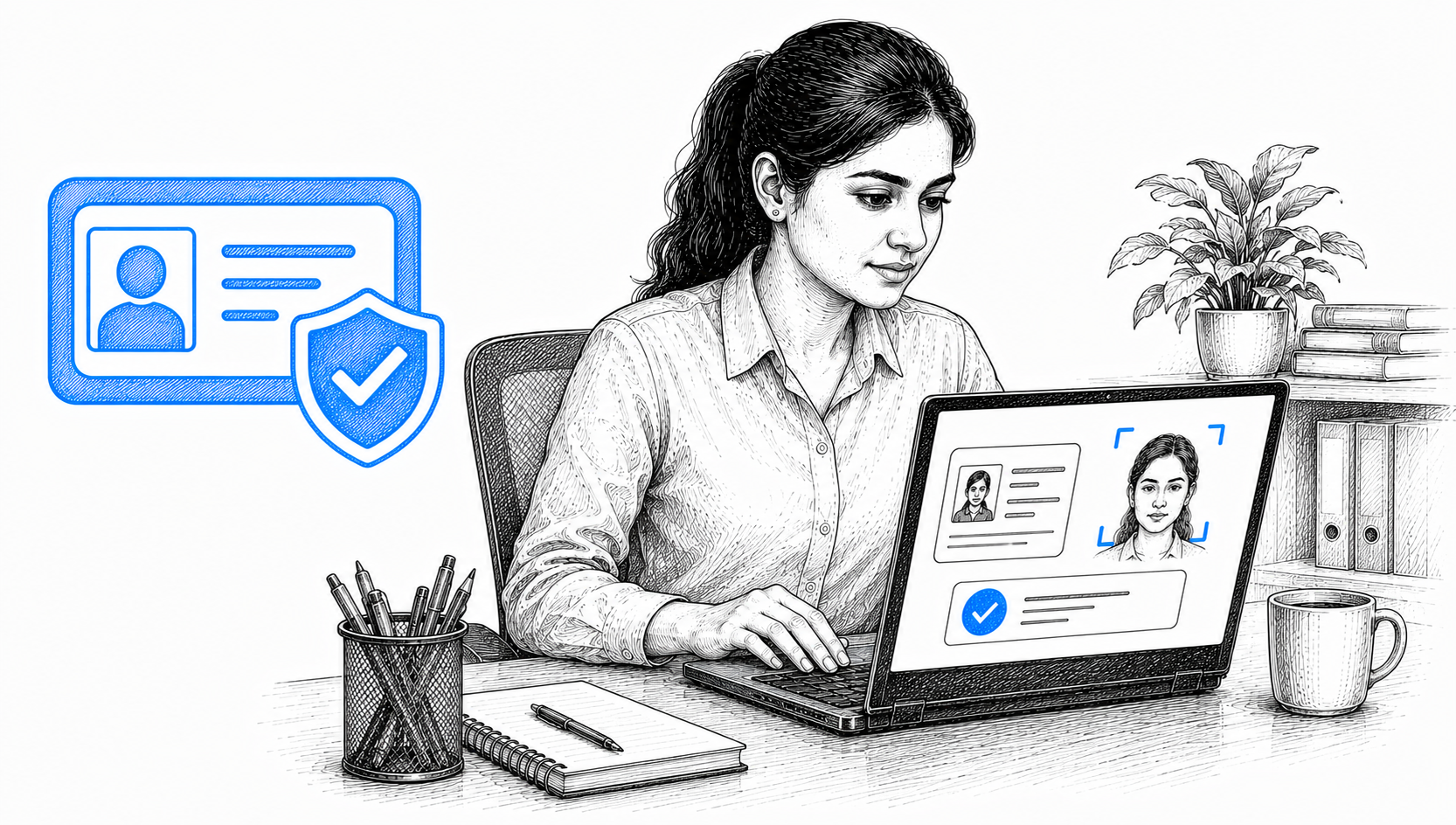
ID Verify by Glider AI was built to answer that question before, during, and after the interview to hire process. Rather than checking a candidate once at the start, ID Verify validates identity at multiple checkpoints, so a hiring team can catch impersonation whether it happens at application, interview, or final onboarding.
At a high level, ID Verify combines document verification, biometric matching, and liveness and deepfake detection. Candidates present a government issued ID, which the system checks for authenticity against document databases spanning more than 150 countries. A live selfie or short video is then matched against that document using facial recognition, and the system screens for signs of digital manipulation, including AI generated faces, face swaps, and other deepfake techniques that a human reviewer could easily miss. Because the checks run in real time and plug into the existing applicant tracking and interview workflow, recruiters get a clear pass or flag without adding friction to the candidate experience.
This layered approach matters because fraud tactics keep evolving. Glider AI’s own research into deepfake technology and candidate fraud found that AI generated video and voice tools have made proxy interviewing far more convincing than it used to be, which is exactly why identity checks need to be continuous rather than a single gate at the top of the funnel.
For high volume recruiters and staffing firms, the benefit is straightforward: fewer fraudulent hires reach the payroll, and the ones that slip through are caught faster. Staffing firms placing contractors across many clients carry outsized reputational risk if a fraudulent worker is placed at a customer site, and enterprise talent teams face similar exposure when a role involves access to code, financial systems, or customer data.
Verified identity also protects candidates themselves, since a hiring process that can prove who was interviewed is a hiring process that can defend its decisions if a dispute ever arises. Finally, catching a mismatched identity before an offer is extended is dramatically cheaper than untangling the aftermath of a fraudulent hire, which can include security incidents, wasted onboarding costs, and legal review.
Not every ID check is built for hiring. When evaluating a solution, look for:
Hiring used to be a talent problem. Today it is also a security problem, and the two are converging fast. Treating identity verification as a core part of the hiring stack, alongside skills assessments and interviews, is quickly becoming standard practice rather than an extra step.
For a closer look at how ID Verify handles rollout, consent, and data questions, see the ID Verify FAQs. Teams evaluating broader fraud prevention across enterprise hiring programs can see how identity verification fits alongside proctoring and skills validation in a single, connected workflow.
Candidate identity verification is the process of confirming that a job applicant is genuinely the person they claim to be, using tools like document checks, biometric face matching, and liveness detection. It goes beyond confirming facts about someone’s history and instead confirms who is physically present in the hiring process.
A background check reviews a candidate’s history, such as employment, education, or criminal records, but it assumes the person named in those records is the person applying. Identity verification confirms that assumption directly, by matching a live photo or video against a government issued ID, so the two checks answer different questions and work best together.
Yes. AI generated video and voice tools have advanced enough that a skilled operator can use a synthetic or altered face during a live video interview, and a human interviewer may not notice. That is why identity solutions increasingly include dedicated liveness and deepfake detection rather than relying on a recruiter’s judgment alone.
AI based identity tools compare a live selfie or video against a candidate’s submitted identification, check the document for signs of tampering, and analyze the live footage for markers of digital manipulation such as unnatural blinking, lighting mismatches, or face swap artifacts. These checks happen in seconds and flag anomalies for human review.
In most jurisdictions, employers can verify candidate identity as part of a lawful hiring process, provided candidates are informed and consent is obtained where required, and the data collected is handled securely and only for that purpose. Requirements vary by country and by role, so hiring teams should confirm their specific obligations with legal counsel.
Roles that grant remote access to source code, financial systems, healthcare records, or customer data carry the highest exposure, which is why technology, staffing, healthcare, and financial services organizations have moved fastest to adopt identity verification. High volume remote and contract hiring also raises risk simply because more interviews happen without any in person contact.
Ideally, identity should be checked at more than one point, including at application, before or during the interview, and again at offer or onboarding, so an impersonator cannot swap in after the first check passes. A single check at the very start of the funnel leaves the rest of the process unprotected.
Employers should look for broad document and country coverage, genuine liveness and deepfake detection rather than a simple photo match, fast turnaround, integration with existing hiring systems, and clear audit trails for compliance. The tool should also handle candidate data with strong privacy and security practices.
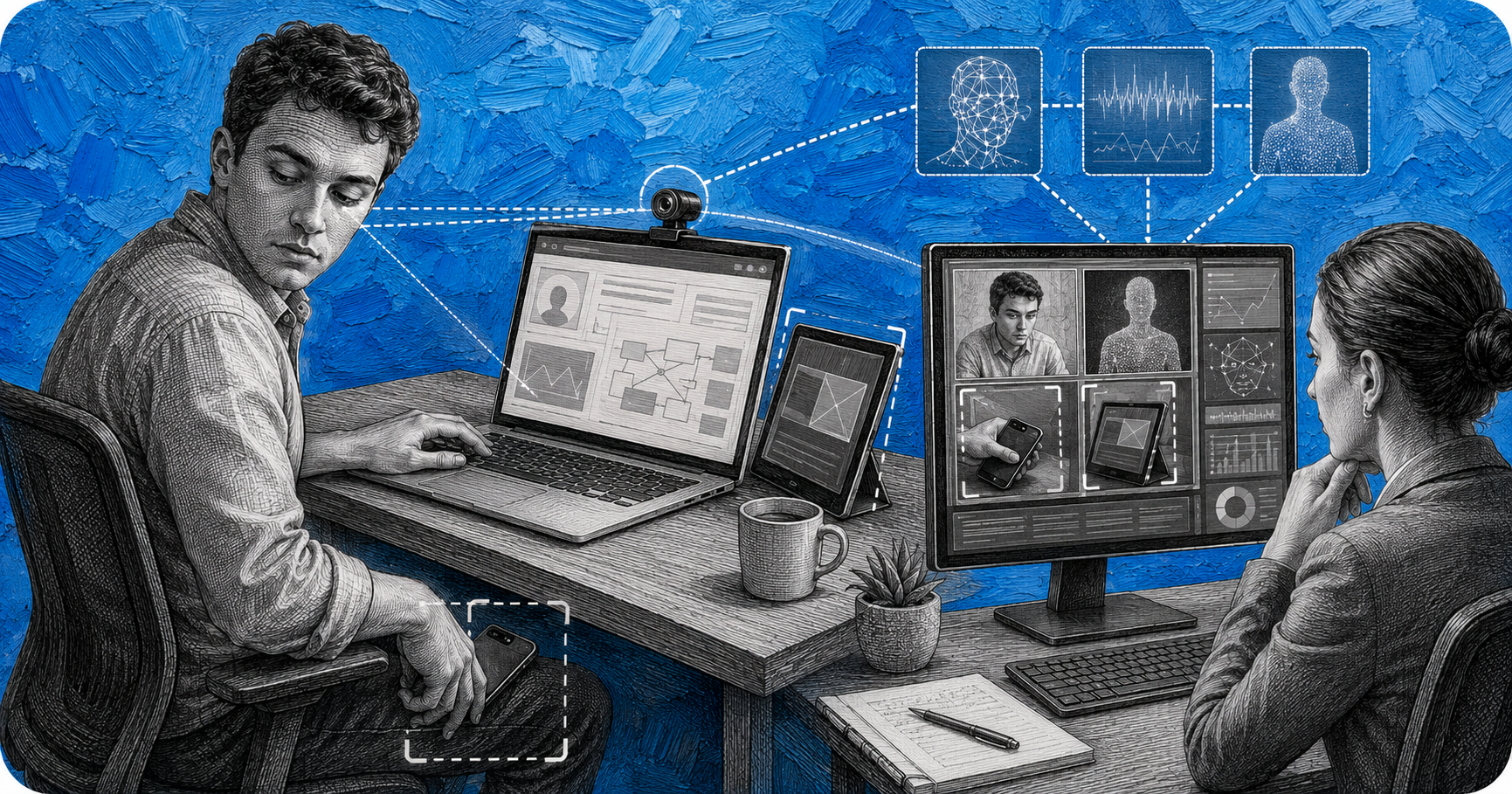
Second device cheating is when a candidate uses a phone, tablet, or second monitor outside the webcam’s view during a proctored online assessment to look up answers, message someone for help, or mirror their screen to a helper. It is one of the hardest forms of assessment fraud to stop with software alone, because the […]
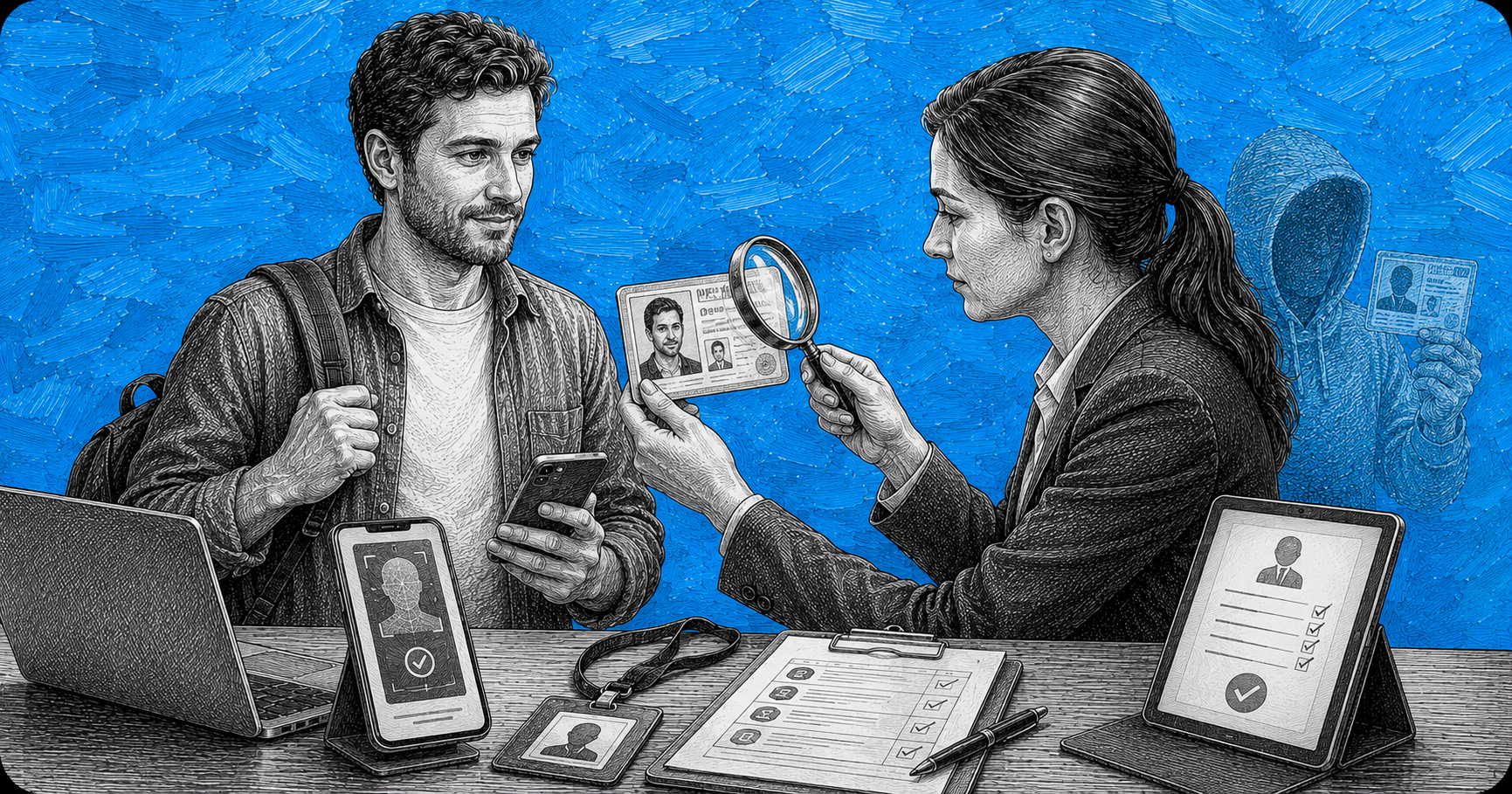
Contingent worker identity verification is the practice of confirming that a freelancer, contractor, or gig worker is who they claim to be before they are onboarded, not just screened on paper. Most companies apply this scrutiny to full time employees and skip or shortcut it for contingent talent, which is exactly the gap fraud actors […]

A structured interview scorecard is a standardized form that lists the specific competencies a role requires, gives every interviewer the same rating scale to judge candidate answers against, and forces a written justification for each score. It exists to replace gut feeling with evidence, so five interviewers evaluating the same candidate land on comparable, defensible […]