Make talent quality your leading analytic with skills-based hiring solution.
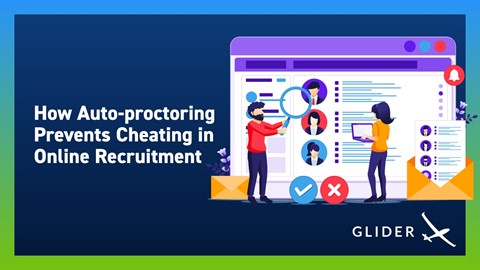
Online recruitment has gained tremendous importance since the onset of Covid pandemic. Doubtlessly, organizations have accelerated virtual hiring like never before. But, online recruitment has also raised concerns about candidate cheating and assessment fraud. Thanks to auto proctoring, many of these concerns can be prevented in online recruitment.
Proctoring is one of the age-old practices in the world. As per a forecast, the CAGR of global online remote proctoring is expected to reach 17.66% by 2027.
The dawn of online recruitment has provided a unique set of challenges to proctors. From cheating to impersonation, candidates are resorting to innumerable dishonest practices during assessment. Not everyone does cheat, but those who do, do it well!
To make matters worse, a majority of these acts go uncaught in online recruiting assessments. For example, between the end of 2020 to the first half of 2021, Glider Talent Intelligence tracked a 92 percent increase in fraudulent test tracking activities. Further, the AI-enabled proctoring features also reported that 23% of the candidates engaged in some assessment malpractice.
Technological advances have provided challenges and opportunities in online proctoring. At the forefront, the emergence of auto proctoring within the online recruitment and assessment processes has enhanced user experience for both recruiters and candidates. Additionally, as a part of defending assessment security, it has also extensively prevented cheating practices.
Many researchers and academicians have found a positive relationship between technology and behavior intention. Similarly, many companies are leveraging proctoring technology to secure top talent.
What is auto proctoring? It is AI-powered assessment technology that completely monitors candidates on a one-to-one and one-to-many basis, their multimedia and their environment during online assessments or examinations. The e-assessment method has gained tremendous acceptance in the recent times of global pandemic where everything was done on a remote and online platform.
Compared to online human proctoring, auto proctoring needs very less human intervention. The algorithms are designed to mimic the behavior of a human proctor in order to prevent the likelihood of cheating in assessments. A candidate can take up the assessment anywhere and anytime as long as there is a strong internet connection.
Auto proctoring includes components extracted from various domains like technology, AI, human behavior, NLP, and academics among others. According to a research paper on automated online exam proctoring, the basic components of auto proctoring system for detecting real-time cheating behavior are:
As a part of remote and online recruitment, auto proctoring in a 360-degree approach. Hence, it works in three types:
Video Proctoring: The candidate’s webcam will be used for real-time monitoring and recording the candidate’s identity, test environment, and other activities. Any potential cheating or fraud is detected, and auto-flagged.
Audio Proctoring: Through the microphone, the candidate’s audio feed is scanned, recorded, and monitored with keen attention to additional noise or voice occurring during the assessment. Any sound that doesn’t conform to test guidelines will be auto-flagged.
Image Proctoring: Live images of test candidate is captured at regular intervals. Then they are compared against the base image (taken before the assessment) to verify the genuineness. Any abnormality or other person intruding is auto flagged.
Online recruitment is not just limited to assessments and tests alone. It covers various forms like ATS, cold e-mails, profile data on professional social media like LinkedIn, job portal database, phone screen and video interviewing as well. Now as a promising job candidate, one must take care of the following in order to avoid violations by the auto-proctoring system:
Auto proctoring is redefining test integrity in online recruitment programs. A comparison between various proctoring platforms tells you how various parameters are considered to prevent cheating from beginning to end.
The artificial intelligence system works through:
Hardware: Webcam and wearcam, microphone capture everything that is happening on an active window screen. The inputs like candidate’s face, body movements, sound, proxy or any other suspicious presence are auto-flagged immediately.
Continuous Monitoring: It assesses the test taker’s surroundings, background, nearby gadgets, and presence of any other person. Frequent monitoring of such elements gives an estimation of candidate’s behavior and test integrity to the proctoring system.
Plagiarism Report: As a powerful anti-plagiarism tool, auto-proctoring verifies a candidate’s coding submissions against similar codes copied from internet or elsewhere. The comprehensive monitoring report provides details and copy-pasted snippets and submits the same for review.
Audit Trail: Auto-proctoring also records the physical, visual and acoustic environment of the candidate’s location. Through this, recruiters can analyze and review candidates’ skills, performance, and suspicious activities (if any).
Auto proctoring is one technology that organizations do not want to go away. The AI-based tool helps manage online recruitment with less human interference. Apart from reducing cost-per-hire, auto proctoring plays a key role in attracting quality talent and enhancing employer brand value too. It is certainly the best tag for “Do More With Less.”

Second device cheating is when a candidate uses a phone, tablet, or second monitor outside the webcam’s view during a proctored online assessment to look up answers, message someone for help, or mirror their screen to a helper. It is one of the hardest forms of assessment fraud to stop with software alone, because the […]

Contingent worker identity verification is the practice of confirming that a freelancer, contractor, or gig worker is who they claim to be before they are onboarded, not just screened on paper. Most companies apply this scrutiny to full time employees and skip or shortcut it for contingent talent, which is exactly the gap fraud actors […]

A structured interview scorecard is a standardized form that lists the specific competencies a role requires, gives every interviewer the same rating scale to judge candidate answers against, and forces a written justification for each score. It exists to replace gut feeling with evidence, so five interviewers evaluating the same candidate land on comparable, defensible […]