
Make talent quality your leading analytic with skills-based hiring solution.
Recruitment fraud is any act of deception carried out during the hiring process, and it cuts two ways. Job seekers are targeted by fake recruiters running scams under a real company’s name, and employers are targeted by fraudulent job seekers, impersonators, and sometimes their own staff who exploit weak points in the hiring pipeline. Most “recruitment fraud” alert pages online address the first problem, warning candidates about fake job offers. This page addresses the second: what recruitment fraud looks like from the employer’s side, why it is accelerating, and what talent acquisition teams can do to keep fraudulent candidates out of their pipeline before they become expensive, risky hires.
For HR and talent acquisition leaders, recruitment fraud is no longer a rare edge case. Remote hiring, AI generated resumes, and deepfake video tools have made it far easier for someone to look qualified on paper and on screen without actually being the person, or having the skills, they claim. Protecting the pipeline now requires the same rigor companies apply to financial fraud or cybersecurity.
Recruitment fraud, in the employer facing sense, is any deliberate misrepresentation by a candidate, a third party, or an internal actor that is intended to secure a job offer, a placement, or a payment through deception. It can happen at any stage: application, screening, interview, background check, or onboarding.
Broadly, employer facing recruitment fraud takes two shapes:
Both erode the same thing: confidence that the person your company is evaluating, interviewing, and eventually paying is who and what they claim to be.
Fabricated work history, inflated titles, invented employers, and AI generated cover letters are now common enough that many recruiters assume some degree of embellishment on every resume. The harder problem is fully fictitious candidates built from stolen or synthetic identities, sometimes applying to dozens of remote roles at once. For a deeper look at how to catch these, see this guide on fake candidate profiles and how to spot them.
One of the fastest growing forms of recruitment fraud is proxy hiring: a skilled stand in takes the coding test, technical interview, or even the live video interview on behalf of the actual applicant, who then shows up for the job. This is especially common in remote technical roles where there is no in person moment to catch the swap.
Fake degrees, forged certifications, and misrepresented licenses let unqualified candidates pass initial screening. Without verification against issuing institutions or a skills based assessment, a polished resume and a confident interview can be enough to get through.
Recruitment fraud is not always external. A hiring manager, recruiter, or interviewer can coach a favored candidate on interview answers, leak assessment content, or push a hire through despite red flags, in exchange for a kickback or personal relationship. This category is harder to detect because it hides inside processes that otherwise look normal.
Referral bonus programs create an incentive to game the system: employees referring fake candidates, non existent hires, or people who never intend to actually work the role, purely to collect the payout. In staffing and contingent workforce contexts, this can extend to entirely fabricated placements.
Three trends are converging to make this problem worse. Remote and hybrid hiring removed the in person checkpoints that used to make impersonation and proxy interviewing difficult, a shift covered in more depth in this breakdown of remote hiring fraud risks and prevention. Generative AI now produces convincing fake resumes, cover letters, and even real time deepfake video and voice, lowering the skill and effort required to impersonate someone. And high volume, high velocity hiring in tech and contact center roles gives fraud rings a large attack surface with fast turnaround and light manual review.
Recruitment fraud is not a compliance footnote; it has a direct financial and operational cost.
Protecting the pipeline requires layering verification into the process rather than relying on interviewer instinct alone. Practical steps include:
For a broader step by step framework, see this hiring fraud prevention guide.
Glider AI, Findem’s hiring integrity platform, is built specifically to close the gaps that recruitment fraud exploits. The platform combines AI powered skills assessments that measure real competence instead of resume claims, video interviewing that captures how a candidate actually communicates and performs live, and remote proctoring that flags identity mismatches, unauthorized assistance, and suspicious behavior during any online test or interview. Learn more about how proctored assessments work in this overview of remote proctoring for online assessments.
Together, these capabilities give talent acquisition teams identity and skill verification at the exact moments recruitment fraud tends to occur: the assessment and the interview. Instead of trusting a resume or a single video call, hiring teams get evidence that the candidate they evaluated is the candidate who shows up on day one, with the skills the role actually requires.
Recruitment fraud is any deliberate deception carried out during the hiring process to gain a job, a placement, or a payment. It includes fake recruiters targeting job seekers, as well as fraudulent candidates, proxy test takers, and internal collusion that target employers directly.
Look for mismatches between a candidate’s resume claims and their live performance in a skills assessment or interview, inconsistent answers across interview rounds, unverifiable employment history, and unusual behavior on video such as reading from a script or audio delay. Combining structured skills assessments with proctoring makes these gaps far easier to catch than interviewer judgment alone.
Common examples include fake or exaggerated candidate profiles, proxy interviewing or proxy test taking, forged degrees and certifications, collusion between a candidate and an internal recruiter or hiring manager, and referral fraud involving fabricated or non existent hires.
Companies should verify candidate identity at multiple points in the process, replace resume based screening with skills based assessments, add proctoring to remote interviews and tests, independently verify credentials and employment history, and periodically audit referral and interview processes for collusion risk.
Yes, many forms of recruitment fraud, including identity theft, forged credentials, and fee based hiring scams, can constitute criminal fraud or identity theft under applicable law. Even when a specific act falls short of a criminal charge, it still breaches employment contracts and company policy and can be grounds for immediate termination.
Recruitment fraud specifically refers to deception during the sourcing, screening, and hiring stages, before someone is actually employed. Employment fraud is a broader term that can also include fraud committed after hiring, such as timesheet fraud or misuse of company resources; this employment fraud guide covers that fuller picture.
Yes. AI powered skills assessments, video interview analysis, and remote proctoring can flag inconsistencies, identity mismatches, and suspicious behavior far faster and more consistently than manual review, especially at the volume most high growth companies hire at today.

Global hiring fraud hotspots are the countries and regions where documented candidate fraud and identity verification risk run highest, based on named industry indices rather than assumption. In 2026, that data points consistently in one direction: fraud vulnerability is concentrated in markets with weaker centralized identity infrastructure and fast growing digital hiring volume, led by […]
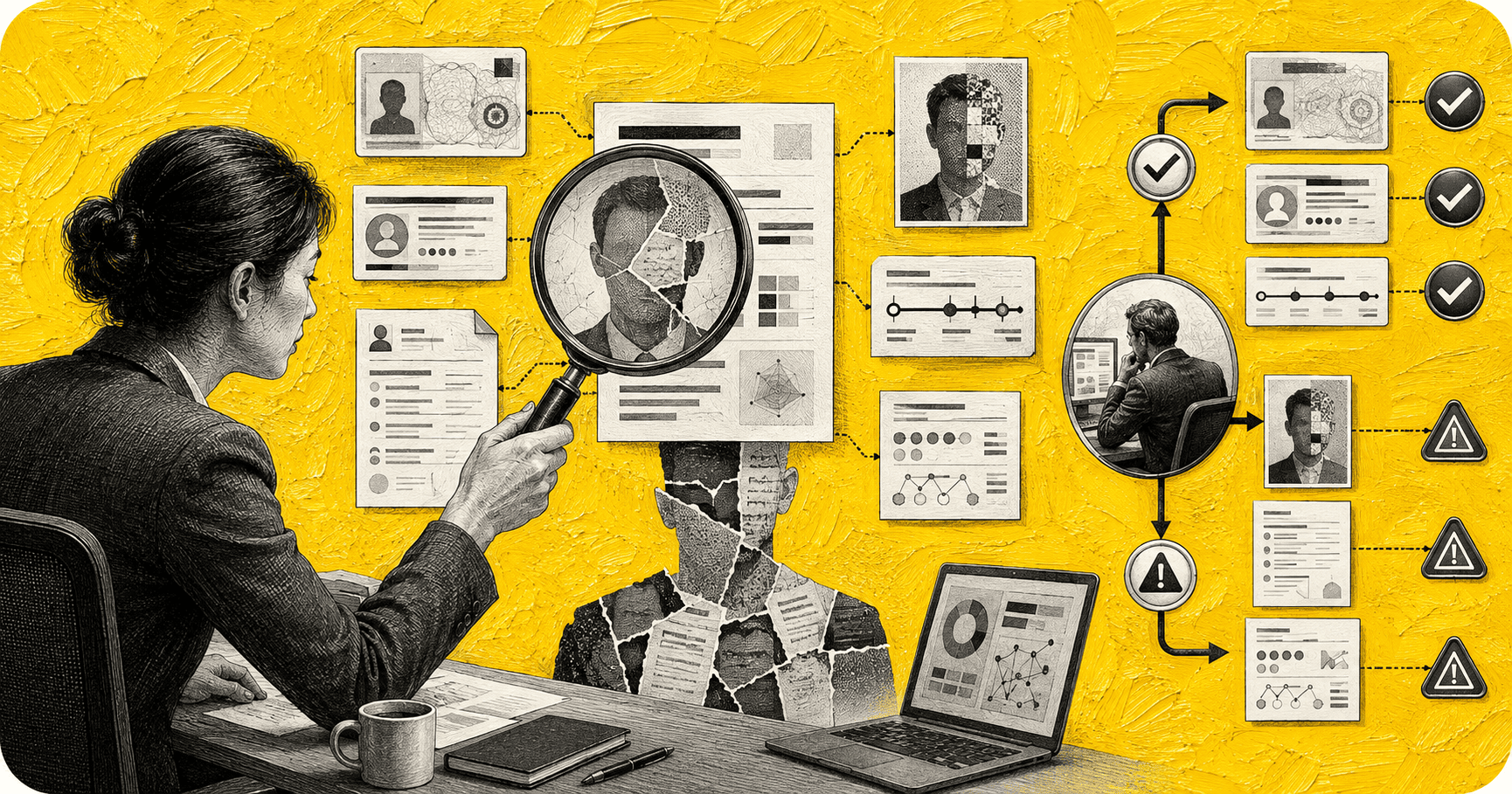
A synthetic candidate is a job applicant who does not exist as a single real person at all. The persona is assembled, usually by combining stolen or purchased personally identifiable information (PII) with an AI generated resume, an AI generated or composite photo, and an invented work history, into a package that looks, on paper […]

Hiring overqualified candidates is not automatically a mistake, but it is a decision that carries real, well documented risk if the role and the offer are not restructured around it. Recent survey data shows most employers already do this regularly: 70 percent of hiring managers say they typically consider candidates who are overqualified for the […]