Make talent quality your leading analytic with skills-based hiring solution.
A recruiter screens a promising resume, runs a smooth video interview, and moves a candidate to offer, only to find out weeks later that the person who showed up on day one is not the person who interviewed. This is not a rare edge case anymore. Fake candidate profiles, built from stolen identities, AI written resumes, and coached or swapped interview performances, have become a routine part of high volume, remote first hiring. Talent acquisition teams that do not know what to look for are absorbing the cost in bad hires, security exposure, and wasted recruiter hours.
This guide breaks down what fake candidate profiles actually look like today, why they have become so common, the concrete red flags that give them away, and the verification workflow recruiting teams can put in place right now, along with how Glider AI’s assessment and identity verification platform is purpose built to catch them.
A fake candidate profile is any application, resume, or interview presence that misrepresents who the person actually is or what they can actually do. That covers a wide range of tactics: a real person using a fabricated resume to inflate their experience, someone applying under a stolen or borrowed identity, a candidate who has a more skilled person take their technical assessment or sit in on their interview, and increasingly, an entirely AI generated persona built to pass initial screening. The common thread is a gap between the identity or skill set presented during hiring and the identity or skill set that actually shows up to do the job.
Several trends have converged to make this problem worse in the last two years:
Recruiters rarely catch fraud from one obvious signal. It is usually a pattern of small inconsistencies. Use this checklist during screening and interviews.
On the resume and application – Job titles, dates, or employers that shift slightly between the resume, LinkedIn profile, and application form – Generic, overly polished language with no specific project names, metrics, or details that a real practitioner would naturally include – A profile photo that looks slightly off, overly stylized, or appears elsewhere online under a different name (a reverse image search takes seconds) – Contact information, time zone, or stated location that does not match the accent, background noise, or working hours seen later in interviews – A LinkedIn profile that is brand new, has very few connections, or has activity that started suspiciously close to the application date
During video interviews – Audio and lip movement that do not quite sync, or lighting and background that look artificially smoothed or inconsistent frame to frame – Long, unnatural pauses before answering simple questions, suggesting the candidate is reading a fed answer or waiting on someone off screen – Answers that are impressively detailed on rehearsed topics but fall apart the moment a follow up question goes slightly off script – Reluctance to turn on video, share a screen, or move the camera when asked – A visible mismatch between the person on the interview and the person shown in earlier ID or profile photos
During skills assessments – Assessment results that are far stronger than the depth of experience described in the resume or interview – Typing patterns, problem solving pace, or communication style during a live coding or writing test that feel noticeably different from how the candidate communicated in earlier conversations – Requests to complete assessments outside of a proctored environment, on unusual schedules, or with the camera off
Manual vigilance helps, but it does not scale across thousands of applicants a month, which is exactly where Glider AI’s platform is built to help. Glider AI combines AI powered skills assessments, video interviewing, remote proctoring, and identity verification into one workflow, so the person who applies, the person who gets assessed, and the person who shows up for the job are demonstrably the same individual.
Glider AI’s remote proctoring and monitoring flags suspicious behavior during live assessments in real time, including tab switching, unrecognized voices, and camera anomalies that can indicate a proxy test taker, closing one of the most common loopholes described above. Learn more about how this works in Glider AI’s guide to remote proctoring and online assessments. Identity verification checks tie assessment and interview results to a confirmed, government verified identity, addressing the stolen and fabricated identity problem directly rather than relying on a recruiter’s judgment call.
Because fake candidate profiles are one symptom of a much larger candidate fraud problem, teams that want a full program view, covering policy, workflow, and technology together, should also see Glider AI’s candidate fraud detection and prevention guide and its broader hiring fraud prevention guide. Teams hiring primarily distributed or offshore talent will also want the specific playbook in remote hiring fraud risks and prevention, since remote funnels carry the highest exposure to the tactics described above.
Fake candidate profiles are applications, resumes, or online professional presences that misrepresent a person’s real identity, experience, or skills. They range from exaggerated resumes and stock photo LinkedIn accounts to stolen identities and AI generated personas built specifically to pass hiring screens.
Look for inconsistencies across the resume, LinkedIn profile, and interview, such as shifting job dates, a generic or reused profile photo, unnatural pauses or audio and video mismatches on camera, and assessment results that do not match the depth of experience described elsewhere. No single sign is definitive, but two or more together are a strong warning sign.
Fully remote hiring removes the in person checkpoints, like meeting face to face or verifying a badge, that used to naturally catch identity mismatches. Combined with cheap AI resume writing tools and readily available deepfake software, remote funnels have become the easiest path for fraudulent candidates to reach an offer.
Yes. AI powered tools can flag behavioral anomalies during live video interviews, detect voice or face inconsistencies, monitor for proxy test taking during assessments, and cross reference identity documents against liveness checks, catching patterns a human reviewer would likely miss.
Proxy interviewing is when a more qualified person interviews or completes a technical assessment on behalf of the actual applicant, who then shows up to do the job in their place. It is one of the fastest growing forms of candidate fraud in technical and skills based hiring.
Recruiters verify identity by requiring a government issued ID check paired with a liveness check before a live interview, keeping interviews and assessments on camera and recorded, and confirming that the same verified identity is used consistently across every stage of the hiring process.
In most jurisdictions, knowingly using a stolen or fabricated identity to obtain employment can constitute identity theft or fraud, carrying both civil and criminal liability for the applicant, separate from any internal hiring policy violation.
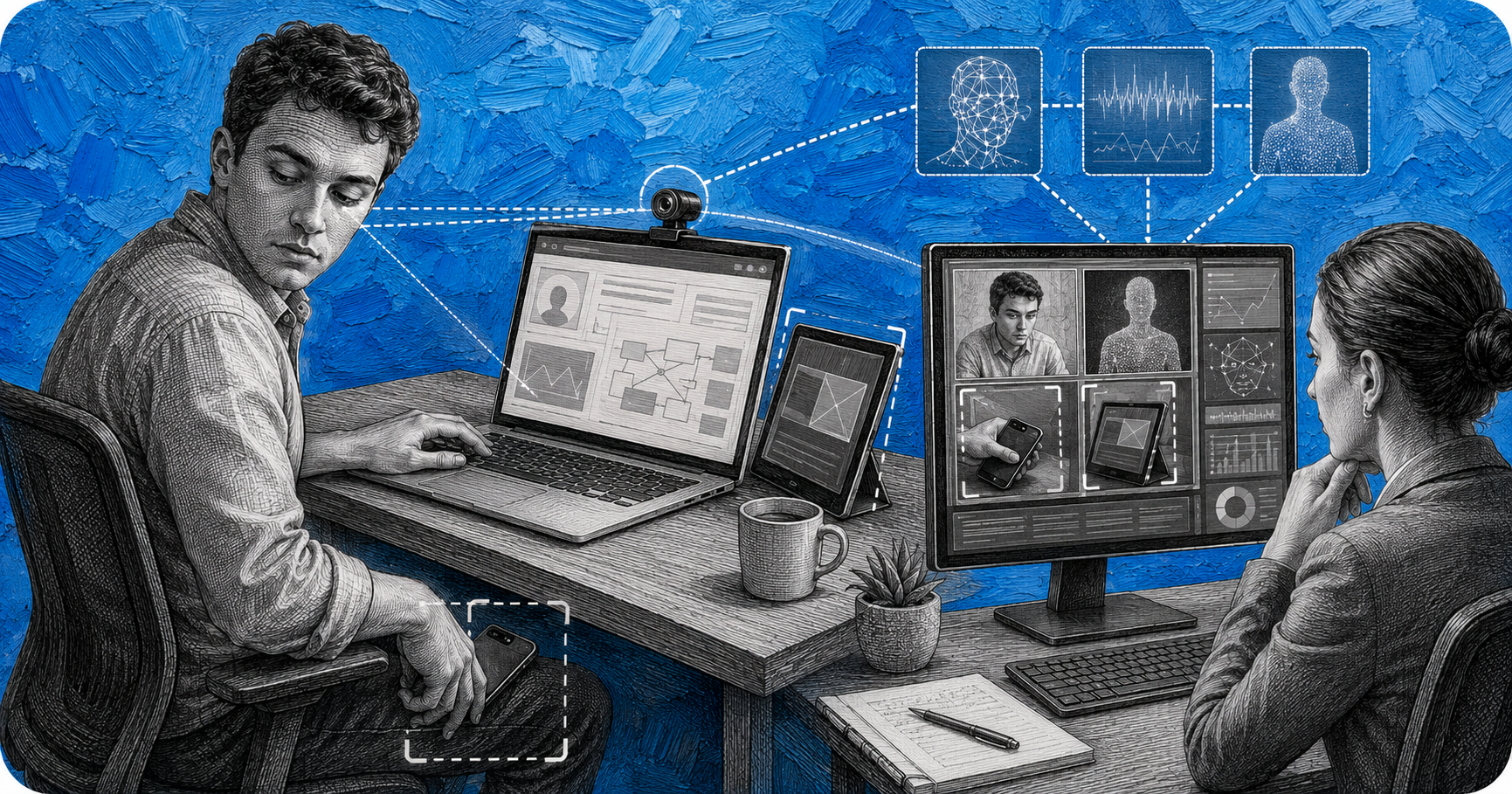
Second device cheating is when a candidate uses a phone, tablet, or second monitor outside the webcam’s view during a proctored online assessment to look up answers, message someone for help, or mirror their screen to a helper. It is one of the hardest forms of assessment fraud to stop with software alone, because the […]
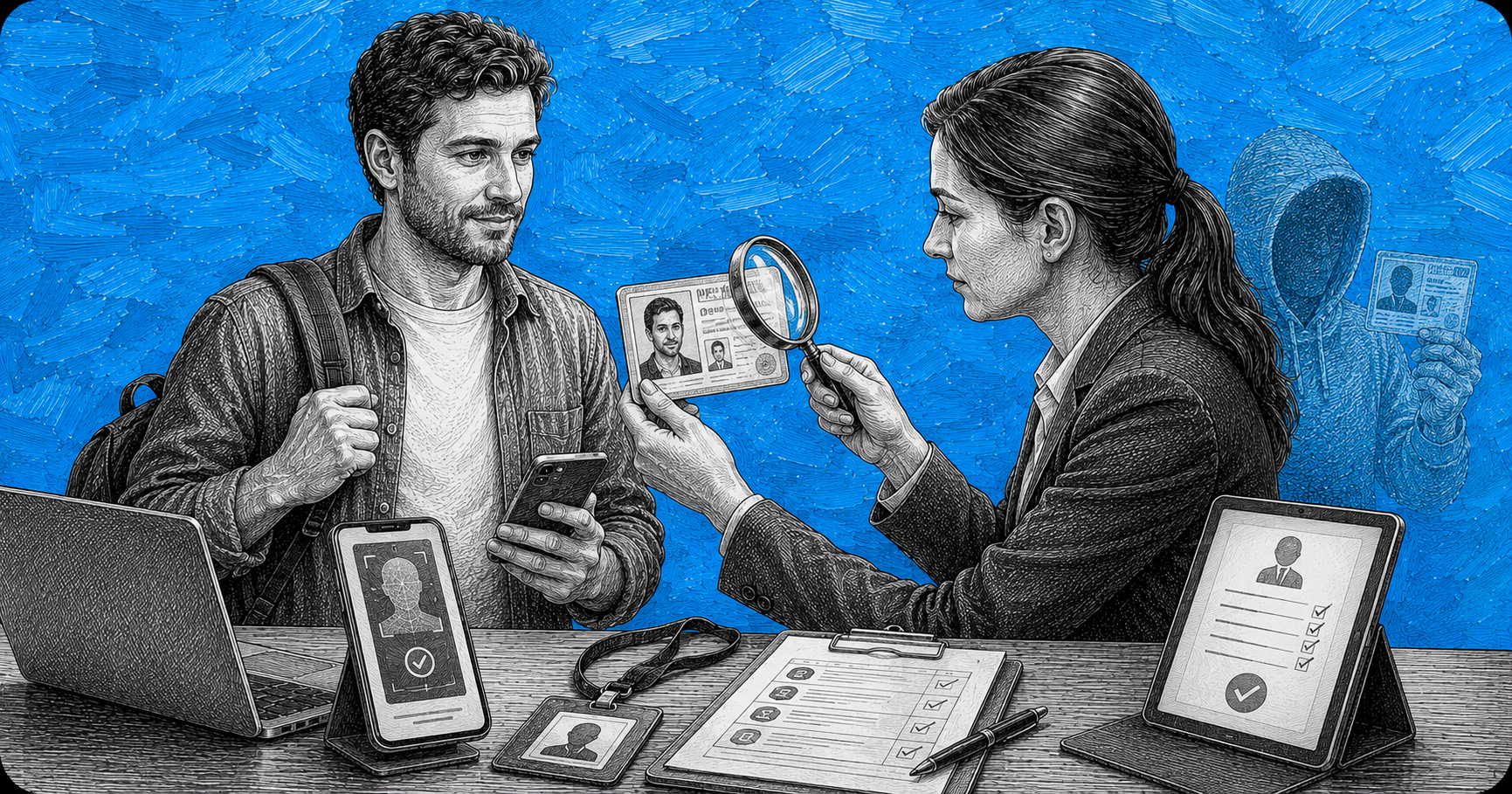
Contingent worker identity verification is the practice of confirming that a freelancer, contractor, or gig worker is who they claim to be before they are onboarded, not just screened on paper. Most companies apply this scrutiny to full time employees and skip or shortcut it for contingent talent, which is exactly the gap fraud actors […]

A structured interview scorecard is a standardized form that lists the specific competencies a role requires, gives every interviewer the same rating scale to judge candidate answers against, and forces a written justification for each score. It exists to replace gut feeling with evidence, so five interviewers evaluating the same candidate land on comparable, defensible […]