
Make talent quality your leading analytic with skills-based hiring solution.
Employment fraud happens whenever someone deliberately deceives an employer, or is deceived by one, somewhere in the hiring or employment relationship. In the HR and talent acquisition context, that usually means a candidate misrepresenting their identity, credentials, work history, or skills to get a job they would not otherwise qualify for. This is a different problem from unemployment insurance fraud, which involves someone falsely claiming government unemployment benefits, and different again from generic workplace theft. This guide focuses specifically on employment fraud during hiring and employment verification, the risks it creates for employers, and the practical framework HR and talent acquisition teams can use to catch it before it becomes a costly hire.
The stakes are higher than many HR leaders assume. A fraudulent hire is not just an embarrassing mistake, it is a compliance, safety, and financial exposure. Studies on resume screening consistently find that a meaningful share of applications contain embellished dates, inflated titles, or outright fabricated credentials, and the rise of remote hiring and generative AI tools has made those misrepresentations easier to produce and harder to catch with a manual review alone. Understanding the main categories of employment fraud is the first step toward building a screening process that actually catches it.
This is the most common form of employment fraud: candidates who fabricate degrees, certifications, licenses, or job titles, or who quietly extend employment dates to hide a gap or a short, unflattering stint at a previous employer. Credential fraud is especially dangerous in regulated fields such as healthcare, finance, and engineering, where a fabricated license is not just a hiring mistake but a regulatory violation that can expose the employer to fines and liability if the fraud surfaces after the person is already doing the job.
Identity fraud occurs when the person who shows up for interviews, assessments, or even the job itself is not who they claim to be. This includes candidates using someone else’s identity or credentials entirely, and increasingly, “interview for hire” schemes where one person interviews on video while a different, less qualified person actually performs the job once hired. Remote and distributed hiring has made this category grow quickly, since employers have fewer in person cues to catch a mismatch. Our remote hiring fraud risks and prevention guide covers this specific risk in more depth.
Reference fraud covers fabricated references, friends or associates posing as former managers, and candidates who list a real company but a contact who never actually supervised them. Because most reference checks rely on a phone number or email the candidate provides, this is one of the easiest categories of employment fraud to fake and one of the hardest for a generalist recruiter to catch without a structured, independent verification step.
Related but distinct from resume fraud, this category covers candidates who misstate their actual employment history: inflating tenure, fabricating a job that never existed, or misrepresenting the scope of a role (claiming to have led a team of twelve when they were an individual contributor, for example). Because many employers rely on self reported work history with only light verification, this type of employment fraud often goes undetected until performance issues surface months into the job.
Background check fraud involves candidates who alter, forge, or omit information specifically to pass a screening step, such as submitting doctored transcripts, using a different legal name or date of birth to hide a prior record, or coaching a third party to answer verification calls on their behalf. This category carries direct legal exposure: employers have a legal duty in many jurisdictions to exercise reasonable care in hiring, and a negligent hiring claim becomes much harder to defend if a background check was circumvented through fraud that a more rigorous process would have caught.
The newest and fastest growing category. Generative AI tools now make it possible to produce polished fake reference letters, fabricated diplomas and certificates that look convincingly real, and AI generated cover letters and resumes tailored to defeat keyword screening. More alarmingly, deepfake video and voice tools are now being used in live video interviews, letting one person’s face and voice stand in for another candidate in real time. Fake or AI generated candidate profiles built entirely from synthetic or stolen information are also showing up at higher volumes in high volume, remote first hiring funnels, making manual resume screening alone an increasingly unreliable line of defense.
Every category above carries a version of the same downstream risk. A fraudulent hire can mean a person performing safety sensitive or client facing work without the qualifications they claimed, direct financial loss from a bad hire’s ramp time and eventual termination, regulatory exposure in licensed professions, and negligent hiring liability if an employer is later shown to have skipped reasonable verification steps. There is also a quieter cost: every fraudulent hire that slips through erodes trust in the hiring process itself, and forces recruiting and hiring managers to second guess otherwise strong candidates, slowing down the pipeline for everyone.
Treat this framework as a starting point rather than a finish line; a more detailed, tactical breakdown of these steps lives in our hiring fraud prevention guide, and if a fraud incident has already happened during recruiting rather than after hire, our recruitment fraud guide covers pipeline specific defenses in more detail.
Manual screening alone cannot reliably catch modern employment fraud, especially at volume or across a distributed, remote workforce. Glider AI’s platform is built to close that gap at the points in the hiring process where fraud is most likely to occur:
Together, these capabilities turn employment fraud prevention from a manual, judgment based process into a consistent, documented, and largely automated part of the hiring workflow.
Employment fraud is any deliberate deception during hiring or employment, most commonly a candidate misrepresenting their identity, credentials, work history, or skills to secure a job. It is distinct from unemployment insurance fraud, which involves falsely claiming government benefits.
The most common types are resume and credential fraud, identity fraud, reference fraud, employment verification or work history fraud, background check fraud, and, increasingly, AI enabled fraud such as deepfake interviews and fabricated documents.
Resume fraud is widespread enough that most experienced recruiters and background screening providers report catching embellished dates, inflated titles, or fabricated credentials on a regular basis, and the volume has increased as generative AI tools make convincing fabrications easier to produce.
HR teams can detect employment fraud by verifying identity early, confirming credentials directly with issuing institutions, running independent reference checks, and replacing self reported experience claims with live, proctored skills assessments that are far harder to fake than a resume.
Lying on a resume is not automatically a crime in most cases, but it can become civil fraud if it causes measurable harm, and fabricating specific items such as a professional license or academic degree can carry separate legal consequences depending on jurisdiction and industry.
Employment fraud involves deception between a candidate or employee and an employer during hiring or work, while unemployment fraud specifically involves someone falsely claiming government unemployment insurance benefits; the two are unrelated despite the similar terminology.
Generative AI tools now allow fraudulent candidates to produce convincing fake diplomas and reference letters, resumes tailored to beat keyword screening, and even deepfake audio or video used to impersonate someone else during a live interview, all of which are harder to catch through manual review alone.
HR should document the discovered misrepresentation, involve legal and compliance teams to determine next steps under company policy and applicable law, and review how the fraud passed through screening so the verification process can be strengthened going forward.

Global hiring fraud hotspots are the countries and regions where documented candidate fraud and identity verification risk run highest, based on named industry indices rather than assumption. In 2026, that data points consistently in one direction: fraud vulnerability is concentrated in markets with weaker centralized identity infrastructure and fast growing digital hiring volume, led by […]
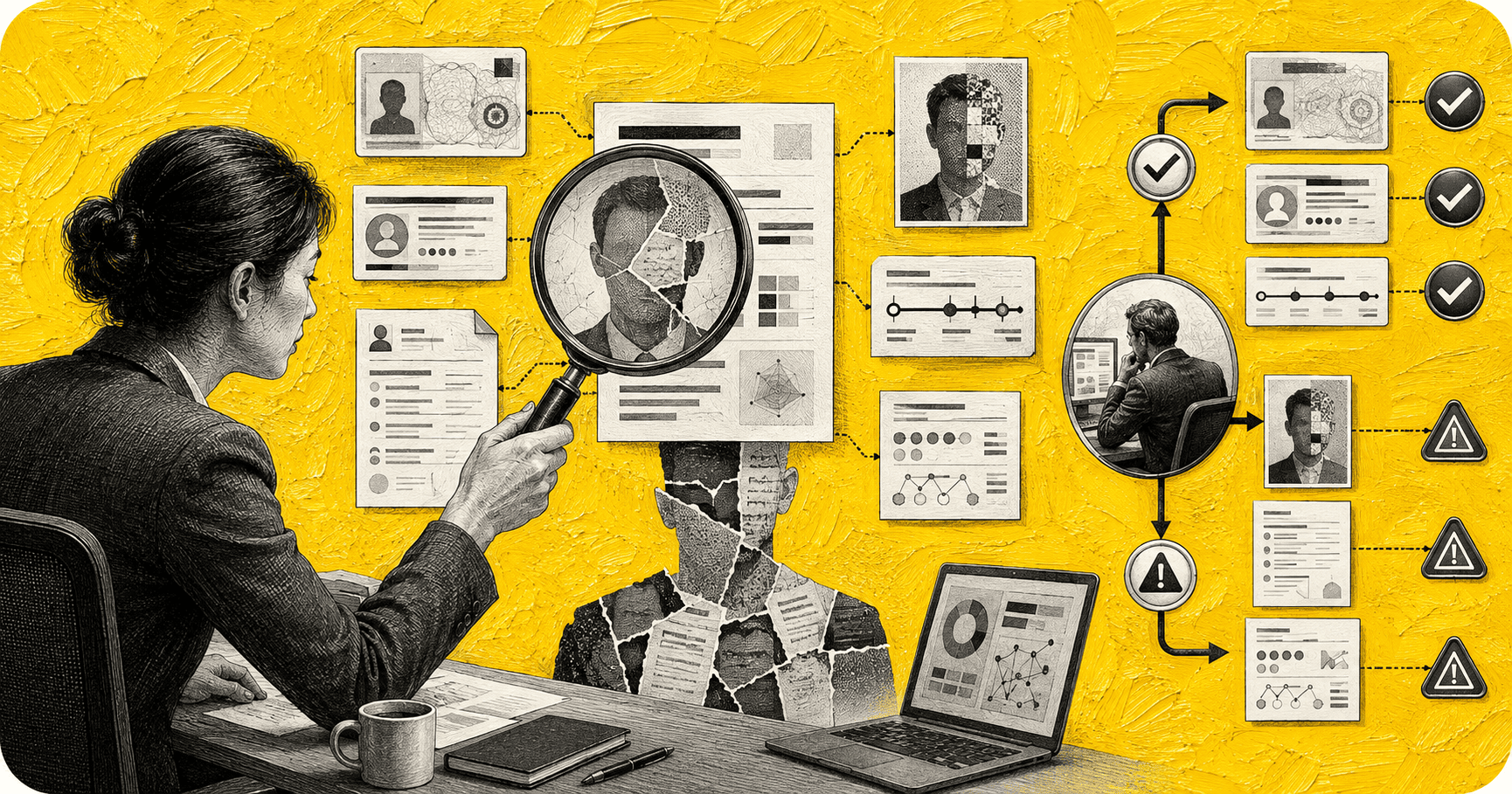
A synthetic candidate is a job applicant who does not exist as a single real person at all. The persona is assembled, usually by combining stolen or purchased personally identifiable information (PII) with an AI generated resume, an AI generated or composite photo, and an invented work history, into a package that looks, on paper […]

Hiring overqualified candidates is not automatically a mistake, but it is a decision that carries real, well documented risk if the role and the offer are not restructured around it. Recent survey data shows most employers already do this regularly: 70 percent of hiring managers say they typically consider candidates who are overqualified for the […]