Make talent quality your leading analytic with skills-based hiring solution.
Fraud in hiring doesn’t fade because you catch it. It fades when you make it pointless.
Across millions of Glider AI validated technical assessments conducted over multiple years, one pattern stands out:
And it matters now.
Investigations by The Wall Street Journal and Bloomberg recently exposed how remote workers using stolen identities embedded themselves inside U.S. companies, sometimes funneling millions of dollars abroad.
Remote hiring built on signals is structurally vulnerable. Resumes can be written by anyone. Profiles can be manufactured. Assessments can be outsourced. Interviews can be staged. Signals scale. Manipulation scales with them.
Proof changes the math.
The data reveals three distinct stages.
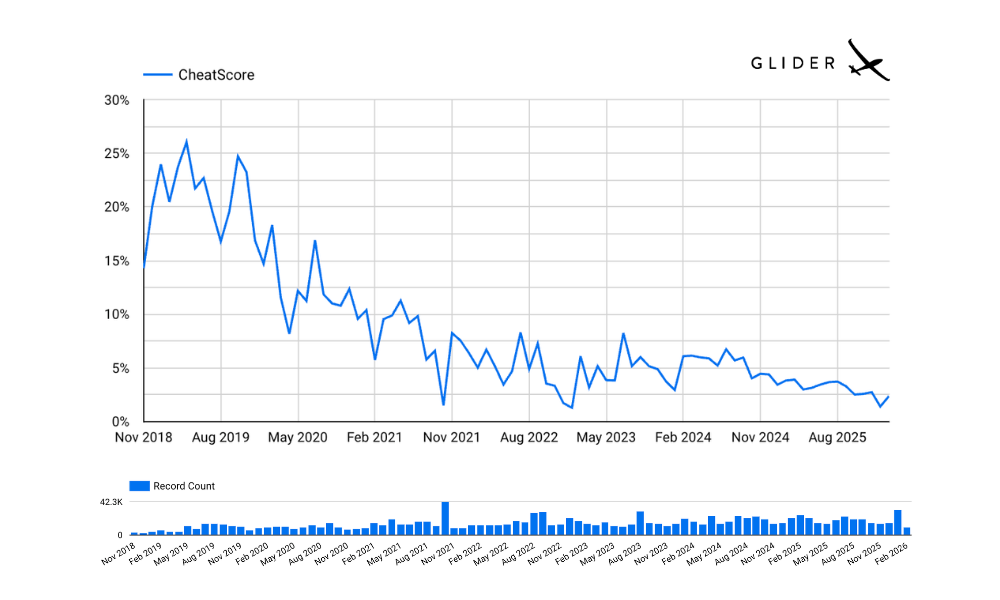
Phase 1: Signal Dominance: In environments driven by resumes and unverified remote testing, fraud indicators approached 20–25%. Where manipulation works, it spreads.
Phase 2: Validation Introduced: Add structured skill validation and identity controls, and fraud doesn’t vanish. It fluctuates. Bad actors test the boundaries. Variance across hiring organizations becomes visible.
Phase 3: Proof Normalized: Over time, fraud stabilizes in the low single digits, typically 2–4%. Volume increases. Fraud does not.
That’s the collapse. Not detection. Deterrence. Once gaming the system stops paying off, the system stops getting gamed.
Fraud doesn’t spread uniformly across the hiring ecosystem. And by hiring ecosystem, we mean the full architecture of how talent enters an organization:
To better understand the pattern, we analyzed the top 100 enterprise hiring organizations by assessment volume. A clear trend emerged.
The highest-volume organizations largely clustered in the low single digits, typically between 1-4% fraud indicators. But variance widened quickly outside that band.
Governance did.
Enterprise hiring organizations operating within structured validation environments stabilized fraud rates over time. Those with weaker identity controls or inconsistent oversight exhibited materially higher exposure.
Even among large, enterprise-scale hiring organizations–whether internal enterprise teams or external staffing partners, risk varied significantly.
Fraud clusters where validation is weakest. This isn’t a candidate integrity problem.
It’s an architecture problem. And architecture determines risk exposure.
Here’s what makes this counterintuitive. Assessment volume increased over time. Fraud decreased.
In most enterprise systems: cybersecurity, financial fraud, compliance–scale multiplies vulnerability. In proof-based hiring systems, scale compounds deterrence.
When validation becomes standard practice, manipulation becomes inefficient. Enterprise hiring organizations adapt. Repeat offenders disappear. Behavioral norms shift.
Fraud collapses because the incentives collapse. That’s structural suppression.
Remote hiring now intersects with:
A fraudulent hire isn’t just a poor recruiting outcome. It’s a potential insider risk event. As remote work expands and AI lowers the barrier to impersonation, signal-based systems grow more fragile. Proof-based systems grow more resilient. That’s the curve.
When hiring relies on signals, fraud rises. When hiring requires proof, fraud declines, and stays down.
If fraud follows a curve, system design determines where you sit on it.
The question isn’t whether fraud exists. It’s whether your hiring architecture suppresses it, or quietly rewards it.
The year Skills based hiring became non-negotiable If 2025 proved anything, it is that the old way of hiring does not survive economic pressure. Budgets stayed tight. Headcount stayed constrained. Every hire had to justify itself quickly. At the same time, AI adoption accelerated faster than trust, governance, or data quality could keep up. For […]
[Cupertino, California] — November 6, 2025 — Glider AI, the Skills Validation Platform™, and Findem, the only talent-acquisition and management solution powered by 3D data, today announced a strategic partnership to elevate accuracy and trust in hiring. By combining Findem’s expert-labeled data with Glider AI’s real-world skills validation, enterprises now have a new foundation for […]
Artificial Intelligence is now woven into nearly every talent operation, from sourcing to interviewing. According to SHRM, about 70% of HR and TA teams using AI report challenges with data privacy, trust or oversight. (SHRM) At the same time: What’s the pattern? Speed and scale matter, but not at the cost of accuracy, fairness, or […]