Make talent quality your leading analytic with skills-based hiring solution.
Behavioral Assessment Tests for Better Hiring Decisions
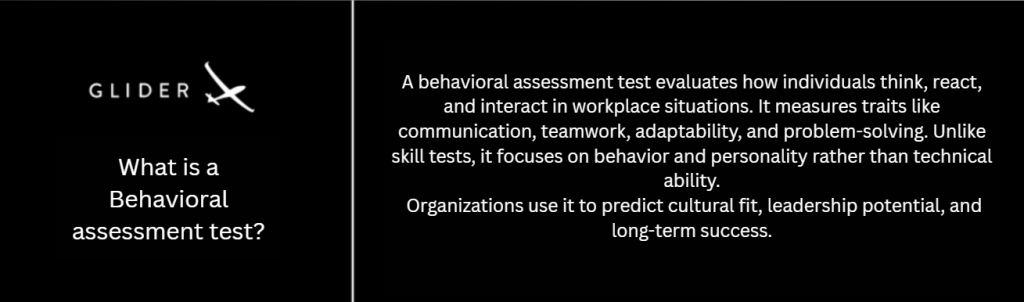
A behavioral assessment test gives you the clarity to choose candidates who will thrive, not just survive. Hiring the right candidate is about more than technical skills. A behavioral assessment test helps you understand how candidates think, react, and adapt in real work situations. By uncovering personality traits and soft skills, you can predict success on the job more accurately and build stronger, more collaborative teams.
Go deeper than what a resume can tell you.
Resumes and interviews rarely tell the complete story. Many candidates appear impressive on paper but may not align with the team’s culture or the demands of the role. A behavioral assessment test provides objective insight into qualities like problem-solving, communication, and resilience under pressure. This gives hiring managers confidence that their decisions are grounded in real behaviors instead of surface-level impressions.
For example, a candidate may have strong technical credentials but struggle with adaptability or teamwork. Without a behavioral test, these traits often go unnoticed until after the hire, leading to frustration and turnover. Using a behavioral assessment test early in the process reduces these risks and ensures new hires are ready to add value from day one.
Hire with insight, build stronger teams, and retain talent longer.
Organizations that include behavioral assessment tests in their hiring process see measurable results, including lower turnover and stronger collaboration across teams. These tests uncover aspects of a candidate’s personality that traditional interviews miss, helping recruiters make more thoughtful and fair decisions.
Key benefits include:
A well-designed behavioral test also improves the candidate experience. When assessments are simple and transparent, applicants feel the process is fair, which helps keep top talent engaged throughout the hiring journey.
With 4 core features, Glider helps you measure what really matters.
| Features | Description |
| Scenario-based evaluations | Candidates respond to realistic work situations |
| Competency measurement | Assess adaptability, leadership, and decision-making |
| Standardized scoring | Consistent benchmarks to reduce bias |
| Candidate-friendly design | Simple, intuitive interface for stress-free assessments |
Hiring the right people is not only about hard skills. A behavioral assessment test gives you a clear view of how candidates think, act, and adapt. By adding behavioral tests to your hiring process, you reduce guesswork, improve cultural fit, and make confident choices. Over time, this leads to stronger teams, higher retention, and better business outcomes.
Behavioral tests reveal potential, fit, and growth beyond resumes.
Hiring the right people is not just about hard skills. A behavioral assessment test reveals how candidates think, act, and respond to challenges. Adding behavioral tests to your process improves cultural fit, reduces uncertainty, and leads to more confident hiring decisions. Over time, this translates into stronger teams, higher retention, and better outcomes for the business.
Behavioral assessments also support employee development. By identifying strengths and areas for improvement, organizations can guide career growth and provide better coaching. This means the value of behavioral testing goes beyond hiring and extends into long-term workforce management.
It is an evaluation that measures a candidate’s personality traits, behaviors, and soft skills relevant to workplace success.
They help predict job performance, cultural fit, and long-term potential beyond what resumes or interviews reveal.
Yes. They use standardized scoring to provide objective results and reduce personal bias.
They are most useful before final interviews, to shortlist candidates who match both skills and behavior needs.

Take home assignment outsourcing happens when a candidate has someone else, a freelancer, a friend, or a paid ghost writing service, complete their take home coding, design, or writing test for them. Because the assignment is done alone, on the candidate’s own schedule, and away from any interviewer or proctor, nothing about the format itself […]

Leaked interview questions are exact, or nearly exact, copies of a company’s real assessment or interview questions that have been collected, compiled, and shared, often for a price, so that later candidates can memorize the answer before they ever see the question live. This is a test bank leak: a candidate is not solving a […]

You posted one backend role and got 900 applicants. Some can code. Some can explain their code. A few used a proxy test taker last time they applied somewhere. The tool you choose for the first screen decides which of those people reach your hiring managers, so picking it is worth more than an afternoon […]