Make talent quality your leading analytic with skills-based hiring solution.
For recruiters worried about what AI means for their jobs, Hank Levine does not offer false reassurance.
Hank is the founder of Be Additive Corporation, a global recruiting firm operating across 30 countries, with legal entities in India and the Philippines and an in-house software arm building AI-driven hiring products. Before Be Additive, he ran a large RPO with nearly 1,000 recruiters worldwide. He has seen recruiting through multiple cycles and he believes the next two years will be especially difficult.
On The Talented Podcast, Hank laid out a clear argument. AI will not eliminate recruiting overnight. But it will reduce the number of recruiters needed, long before it creates new roles to replace them.
Much of recruiting, Hank argues, has always been task-heavy. Scheduling interviews. Screening basic qualifications. Parsing resumes. Coordinating logistics. These are not high-judgment activities, and AI is already better at them.
“AI does not replace jobs. It replaces tasks. And tasks are, and jobs are a combination of tasks. A lot of recruiting tasks can be done much more efficiently. You don’t really need very advanced skills to do them, and they can be done well by AI.”
Over the next year or two, those tasks will be handled almost entirely by software. The consequence is not abstract.
“So the number of recruiters that we need is probably going to decrease.”
This aligns with broader industry signals. Gartner has projected that automation will continue to absorb large portions of administrative HR work as AI systems mature, particularly in high-volume recruiting environments.
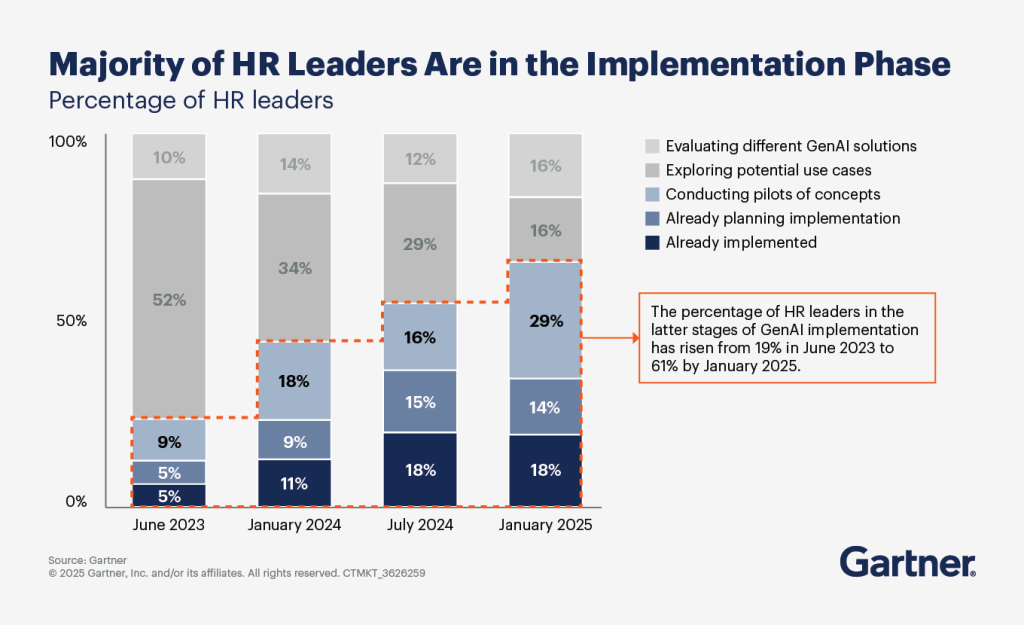
The uncomfortable implication is that efficiency gains arrive faster than new opportunities. That gap is where pain shows up.
Hank is explicit about where AI sits in its adoption curve.
“When new technologies are introduced, usually the first version of them is focused on efficiency, cost cutting and I think that’s largely what we’re seeing in AI now.”
This pattern is not unique to HR. Deloitte’s research on enterprise AI adoption shows that early deployments overwhelmingly target productivity gains rather than new business models.
Only later, once AI systems are embedded across workflows, does innovation accelerate.
“Once AI gets embedded all over the place, it will make it enormously easier to innovate and develop companies. AI will morph over from being an efficiency tool to an innovation tool.”
The problem is timing. Recruiters are facing the efficiency phase now. The innovation phase comes later.
Hank draws a sharp line between junior and senior roles.
For entry-level jobs, AI-driven marketplaces and agents will dominate. There is little reason to involve humans in screening basic requirements.
“You don’t need a recruiter to ask somebody, ‘Can you lift 60 pounds?’ AI can do that faster.”
At senior levels, the equation changes. Technical depth, motivation, judgment, and cultural alignment still require human evaluation.
“When you get into very senior roles, you can use technology a lot to do preliminary screens, but they need to talk to a person. And you need to talk to a person who is an expert.”
This mirrors what hiring platforms are already seeing. High-volume automation scales easily. High-stakes hiring does not.
AI’s critics often focus on bias. Hank sees a different, more immediate threat.
“I often times hear people’s concern in recruiting with AI having bias, and whenever I hear that, I say bias compared to what? Compared to a hiring manager?”
Human bias, he argues, is pervasive and poorly controlled. AI bias, while real, is at least measurable and improvable.
The bigger danger is fraud at scale. AI enables candidates to apply everywhere, instantly. It also enables bad actors to disguise intent, credentials, or identity.
“We’re going to see the first round of interviewing be agent versus agent. The company is going to have an agent. The candidate is going to have an agent. And if the agents like each other, they’ll arrange for the humans to talk.”
That future demands human oversight at critical decision points, not blind automation.
Hank’s advice to recruiters is blunt.
“If you don’t have AI as a skill, you’re just going to become a dinosaur.”
Learning tools is only part of the answer. The deeper shift is identity. Recruiters cannot define themselves by sourcing or screening anymore.
“Most recruiters, if you’re a good recruiter, you should be an expert in your industry. Meet people in the industry. Network with them. Understand their problems.”
This echoes a broader shift in white-collar work. As generative AI absorbs entry-level tasks, value moves toward judgment, context, and trust skills that compound with experience rather than automation.
Hank’s most important insight is not that recruiting will disappear. It’s that the transition will be uneven and uncomfortable.
AI will reduce recruiter headcount before it creates new roles. It will automate faster than organizations can retrain. And it will reward those who move early, not those who wait for clarity.
“The worst thing companies can do is analysis paralysis. Just start. Jump in and start.”
For talent leaders, the mandate is clear. Use AI aggressively for scale and efficiency. But preserve human judgment where risk, trust, and complexity matter most. For recruiters, the message is harder but necessary. The future belongs to those who expand beyond tasks and become industry operators, not process managers.
Hank Levine laid out the challenge clearly. What comes next will depend on who listens.
Stay tuned for more conversations with leaders shaping how AI is actually being used inside hiring and HR beyond the hype.
Hank Levine (00:00)
I think recruiters have something to really be concerned about. So here’s what many people say about AI, and I think I’m in agreement with it. AI does not replace jobs. It replaced tasks. And tasks are, and jobs are a combination of tasks. And a lot of recruiting tasks can be done much more efficiently. You don’t really need very advanced skills to do them, and they can be done well by AI.
And over the next year or two, they’re gonna be done even better by AI. So the number of recruiters that we need is probably going to decrease. Now the thing with AI and any new technology, when new technologies are introduced, usually the first version of them is focused on efficiency, cost cutting. And I think that’s largely what we’re seeing in AI now.
But once you get these platforms in place and once AI gets embedded all over the place, it will make it enormously easier to innovate and develop companies. AI will morph over from being an efficiency tool to an innovation tool. And there will be new products, there will be new industries created around the HR space that recruiters will have very good skills to move into. But I think the next couple of years are going to be rough for recruiters.
Joseph Cole (01:53)
Hello, Hank. Thanks for joining us. Why don’t we start things off first by you sharing a little bit about yourself, giving an introduction where you work, what you do, maybe something that people wouldn’t be able to find about you on Google.
Hank Levine (02:04)
Very good. Well, thank you for having me on the Glider Show, Joseph. I’m Hank Levine. I am the founder of Beatative Corporation. Beatative is a recruiting company, but we have a bunch of different businesses. So we do have a conventional staffing firm. We also have a group that does large hiring projects. We provide employer record services, but there’s two things that really make us different.
⁓ One is that we have a software company, we also are building and recruiting software products. And two, we have legal entities set up in both India and the Philippines, so that really gives us a very global perspective. In fact, we’re working in about 30 countries right now.
Joseph Cole (02:50)
Wow. And what’s the recruiting technology that you’re developing or that you have?
Hank Levine (02:54)
So we are building a really cool product. As I’m sure you know, the recruiting space hasn’t been the best space to be in the last three years or so. We are somewhat in a three-year recession. But there is one area in recruiting that’s growing very rapidly, and that is anything that touches AI, particularly in senior AI positions that are very, very hard to fill.
And we have lots of clients in the US and in Europe who are both telling us what a hard time they are having filling positions like data scientists and ML engineers. It’s especially true for funded startups. I said these startups have a lot of money. They have VCs breathing down their necks saying, build, build. Let’s go faster, go faster. And then they can hire the key talent they need to bring into build AI products.
Not only that, the salaries these people are commanding are in another world. ⁓ So even if these startups are willing to pay that type of money, what they often find is still they can’t recruit these people because they want to go to OpenAI or Microsoft or Google. It’s more name recognition. They get even bigger salaries. They get options. So they’re having just a real hard time.
Joseph Cole (03:51)
Yeah.
Hank Levine (04:12)
hiring this senior AI talent. Meanwhile, we’re a global company and there is a lot of very good AI talent, senior AI talent in lower wage companies, particularly India, also Philippines, also in Latin America. And what we have discovered is we can, rather than having companies hire
the senior positions locally in the US or in Europe, they can hire them in lower wage companies. They can get them onboarded under long-term contracts and generally in two to three weeks. And the contractors love to work for an American or European country because it really builds your resume. It gives their profile a much more global look.
these contractors, you know, they love to work for American or European company. And for the American or European company, they get people, very good people on boarded two or three weeks at about a third the half the price they would pay locally. So.
Joseph Cole (05:15)
Very cool.
Hank Levine (05:16)
So that’s what we did. We had a few placements like that and we were talking to companies and we realized that this is something that we can productize because we have a software company, we have the offshore entities to bring the talent in. So it really is a very good fit for the specific capabilities we have as a company.
Joseph Cole (05:33)
Excellent. I guess product related. You’ve seen the landscape change and it’s changing even faster now with AI. So what inspired you to launch Be Additive and that AI talent marketplace concept?
Hank Levine (05:47)
Well, really what we wanted to do was the AI talent marketplace. And I had run a pretty large RPO before this. had about 950 recruiters. We had operations in India and Philippines. So I knew lots and lots of people who wanted to work with me, but my last company was not a software company. So the goal of the additive was to take all the knowledge we had in recruiting, bring in the very best people from my previous company.
We brought in some AI experts to build our product. And so now we’re building this marketplace, which is doing just what I’m saying, just what I was talking about. It’s really focused on helping funded AI startups bring in senior talent. They’re one side of the marketplace. And then the other side of the marketplace are many, many vetted candidates from India, Philippines, Latin America, and other countries.
Joseph Cole (06:39)
so AI is changing so much in recruiting and in HR. There’s concern that it’s gonna replace many of the roles, which it naturally is across.
whatever the function or discipline is, right? So what skills or advice would you give to an HR or a talent acquisition professional, know, concerned about AI taking away their job?
Yeah, it’s
Hank Levine (07:02)
Well, I think recruiters have something to really be concerned about. So here’s what many people say about AI, and I think I’m in agreement with it. AI does not replace jobs. It replaced tasks. And tasks are, and jobs are a combination of tasks. And a lot of recruiting tasks can be done much more efficiently. You don’t really need very advanced skills to do them, and they can be done well by AI.
And over the next year or two, they’re gonna be done even better by AI. So the number of recruiters that we need is probably going to decrease. Now the thing with AI and any new technology, when new technologies are introduced, usually the first version of them is focused on efficiency, cost cutting. And I think that’s largely what we’re seeing in AI now.
But once you get these platforms in place and once AI gets embedded all over the place, it will make it enormously easier to innovate and develop companies. AI will morph over from being an efficiency tool to an innovation tool. And there will be new products, there will be new industries created around the HR space that recruiters will have very good skills to move into. But I think the next couple of years are going to be rough for recruiters.
Joseph Cole (08:19)
interesting. agree with that. What do you think is the biggest opportunity for recruiters then, you know, if AI is uncovering new opportunities?
Hank Levine (08:29)
My advice to recruiters would be to dive in headfirst into AI and to learn all about it, try to use all the tools, encourage their companies to use all the tools because AI is a skill that if you don’t have it, you’re just gonna become a dinosaur. You’re gonna become a dinosaur quickly. So get in front of the curve, look for opportunities. And I think what…
I hear this question a lot from people graduating from college. And you see people who went to good schools with computer science degrees. If for the last three decades, if you did that, you had five or six job offers. Now you might not have any job offers. And they ask like, what should I do? And I give them two pieces of advice. First one is to understand that coding is
Joseph Cole (08:56)
Yeah.
Hank Levine (09:17)
A language, just like English, just like French, just like any other language. And that’s why Genitive AI is so good at reproducing coding, at least basic coding, because it’s just speaking A language. If you want to be more than a speaker of a language, learn other skills. So don’t just learn computer science, learn about an industry, take humanities. And then the second really important thing is
What AI is mostly replacing is entry level jobs. So talk to people who have senior jobs. That means you need to network. A lot of people in computer science don’t really know how to network. And I tell them, discuss this with your professors. They all have good networks. They all know senior people in industry and ask to the people in industry to have an informational discussion for 15 or 20 minutes and be prepared, know about their company, ask smart questions.
and they will help you. I think the same thing is true with recruiters. We’re no longer in a position where you can just do what you used to do in recruiting and not be concerned about getting replaced. You have to learn the AIA tools. You have to learn other skills. Most recruiters, if you’re a good recruiter, you should be an expert in your industry. So meet people in the industry. Tell them about your concerns. Network with them and you’ll get other opportunities.
Joseph Cole (10:37)
Yeah, what would you say is the new value prop then for tele and acquisition or recruiting professionals?
Hank Levine (10:43)
Well, we’ve already, you over the last couple of decades, we’ve just seen much shorter cycles of employment, right? you’re, whatever you’re, 30, 40 years ago, you could stay with a company for life. Virtually nobody graduating today is going to stay with a company for life. And recruiters aren’t going to stay with companies for life. And they need to look at their career more broadly than being a recruiter.
they should look at themselves as industry experts and talk to senior people in their industry and tell them about their career plans and their goals and try to always be helpful. That’s how you get people who wanna help you back. And if you do that, you’ll have a network that will protect you.
Joseph Cole (11:23)
Yeah. It’s, you know, that makes me think of one of my friends who’s an analyst in the space, Kyle Lagunas. came up with this idea probably two or three years ago about TA and HR almost being the talent engineers, right? Because it’s, know, if we’re going to be focused on recruiting like one of these tasks, like you mentioned, it’s going to be replaced, but it’s almost like this concept of, you you’ve got to understand all the different people dynamics.
There are so many different facets or lenses within managing people and recruiters and what they do. But it’s really like, how do you bring all of that together in one place? Because there’s also the legal part of it as the execution and implementation of it. So I like what you’re saying in terms of having different ⁓ aspects. ⁓
Hank Levine (12:06)
Yeah, you
need expertise that is a lot broader than knowing how to source candidates. When you know how to do a source candidates, you’re going to get replaced.
Joseph Cole (12:12)
Yeah
Exactly. Any role, know, regardless, you Now, the future of hiring. I’ve got a few questions here. The first is, how do you see AI driven talent marketplaces like yours changing the traditional staffing and recruiting model?
Hank Levine (12:18)
Great.
I think you’re going to see more and more of them, but I also think it’s going to be somewhat different depending on the level you’re at. So people are very used to transacting online and to a large extent, they might be even more comfortable doing that. I think for entry level positions, you are going to see recruiting go almost totally online into marketplaces because you don’t need a recruiter.
to ask somebody, can you lift 60 pounds? You just don’t. And AI can do that faster for a recruiter. They can schedule interviews at two in the morning if that’s when someone wants the interview. And so it’s just better. Now, when you get into very senior roles, I think you can use technology a lot to do preliminary screens to get smarter about a candidate. But they need to talk to a person.
And they, and you need to talk to a person who is an expert. So, you know, any recruiter who used to ask questions like how many years of experience do you have? That’s not even a question, right? I can get, that can get screened that you have to ask. You have to understand the industry. You have to understand the person’s career goals. You need to ask open ended questions. You need to listen. need to understand and be able to connect the dots and ask more open ended questions.
Joseph Cole (13:33)
Bye.
Hank Levine (13:47)
And really that’s what good recruiters have done forever. But when things were simpler and a lot of times you didn’t really need to do those skills. You could probably still survive just by making a lot of phone calls and asking questions like how many years of experience do you have? But not today’s market, not at all.
Joseph Cole (14:05)
So I’m curious, your AI driven talent marketplace, so how do they work? Can you kind of walk us through how it works versus the traditional models today?
Hank Levine (14:15)
Yeah. So we have AI tools that reach out to companies. have big networks. We get a conferences. And when someone is interested, we have them fill out a form. We don’t want to just start trying to match people. We always have an account manager talk to the person, understand their project, understand their company, understand their needs. And then we have a process.
where they can upload a company profile or upload a position description. We can parse it and get it in our database, and they can get registered in the database. On the candidate side, we also use AI tools to go out and reach a lot of candidates, do a preliminary vetting, but not a final vetting. So here’s where we use both technology and people.
Once we have a bunch of vetted candidates, once we have a bunch of job orders, we match the job orders to the vetted candidates, but we don’t just submit the candidates. We then have a real human being talk to them and make sure that it’s a real resume, they’re not fake, they really can do the things they say, and that they have the right motivations to be the right fit for the job.
⁓ For each position, we’ll try to two or three interviews, get interview slots in advance. You can line up all those things on the marketplace and we can fill jobs usually in two or three weeks. And these are jobs that if you were trying to fill them locally, it might take you months.
Joseph Cole (15:44)
Yeah. so I guess related to this, we have a question here about contingent and gig work growing. I’ve also seen it somewhat shrinking more recently. How do you see AI working within the global contingent workforce economy, if you can call it that?
Hank Levine (16:00)
Well, I think you’re going to see a lot of marketplaces, again, at lower entry level jobs. I think they’re going to be all done through voice AI and agents. And there might not, you know, there’ll be minimal human interaction. At more senior jobs, I think for at least for the next four or five years until AI gets even better. It’s largely, a large part of this is going to be hand holding by very professional.
and smart recruiters.
Joseph Cole (16:28)
Yeah, and you mentioned some of this as you’re explaining your marketplace, right? You have the human come in there and also validate maybe from secondary skill perspective, but also soft skills and just ensuring there’s the right fit or engagement that I think is also very human. So in terms of skill validation and quality hiring,
You’ve mentioned, I think in the public forum, ensuring the right candidate gets hired for the right role. So how does AI improve skills validation and reduce mismatches?
Hank Levine (17:02)
I think what AI can do is it can reach out to a whole lot of people very quickly. And it can do the initial screen of a candidate. So you can get much more volume, which you can put into various buckets. And you can do that much faster than a human could ever arrange all those conversations. But if you’re doing a very senior positions like we do in AI,
I don’t think that’s enough because there’s a lot of smart candidates who know how to fake AIs. And so you have to do a second round of vetting to make sure that it’s a real candidate that he or she has all the skills they say they have, that they’re the right cultural fit. From a business perspective, we can’t do that on day one with every candidate that we bring in through the initial AI vetting.
because there’s just too many people and it would take forever. But when we get a job and we match them before we submit that candidate to the client, we do do the human vetting.
Joseph Cole (18:03)
Yeah, know, and somewhat related, you you look on LinkedIn, you hear stories of it where, and in fact, some of our customers have shared previously when they posted jobs that get like maybe 200 responses or applications. Now when they post a job, like within minutes, they’re getting hundreds of applicants. And then, you know, within days,
Hank Levine (18:17)
Mm.
Right. Because
everyone’s using AI. So all the candidates are using AI and they’re sending their profile to a thousand companies and the companies don’t respond. So what’s going to happen in recruiting is the first round of interviewing is going to be agent versus agent. So the company is going to have an agent, the candidate is going to have an agent. And if the agents like each other, they’ll…
Joseph Cole (18:25)
Yeah.
Hank Levine (18:48)
arranged for the humans to talk. The kind of weird concept.
Joseph Cole (18:50)
Yeah, it is. But you know, it sounds like a reality. And in fact, I was reading an article about AI actually scheming. So, you know, it can change its responses, can evaluate people differently, if it feels like it’s going to get a better outcome based on whatever criteria that it’s using. So it’s just becoming a lot of, you know, very, very autonomous, you know, and dynamic and independent, really. So
Along those lines, then, you you’ve got all these candidates applying for jobs, you’ve got them, like you said, agent, you know, qualifying, know, whether it’s voice AI glider has a AI voice recruiter as well that can call and, know, basically validate. We see candidates actually receptive to that, right? As long as they get a fair chance, right? And they actually, you know, compared to the human process, they actually get to engage, right? They actually get to
provide more insight. Have you seen any deflection with this new world of like
Hank Levine (19:51)
I think voice AI is being very well received. And there’s a lot of very good products, at least a half dozen excellent voice AI products. People are getting used to it. Because the world experience is there’s so few jobs, if you send your resume out to 100 positions online, you’ll probably get no responses. And so if you can talk to…
Joseph Cole (19:55)
Yeah.
Hank Levine (20:17)
I think that what you need to do is you, anyone who speaks to an agent should at least get a response from the company telling them if they’re interested or not. And then if they’re interested, you talk to a human. Agents are great for screening a lot of people, people like them, they’re used to them. They can certainly do a first round of interviewing, oftentimes more effectively than people.
They can do it any time of day or night. And so it’s a very good first round tool.
Joseph Cole (20:48)
Yeah, I agree. So obviously there are different stages in the recruiting process or hiring process. And then, you’ve got the initial screening as you mentioned. So I guess at this point, like what is the balance between these AI enabled assessments versus human judgment?
Hank Levine (21:05)
Well, again, I think it’s very dependent on the rule. So if it’s an entry-level rule, you probably don’t need humans. And I’m not trying to be crass when I say that. But again, if there are recruiters in the past whose interview had been consist of, you lift 60 pounds? Can I arrange a background check? And you just don’t need a person to do that.
Joseph Cole (21:27)
Yeah.
Hank Levine (21:28)
But if you’re going to recruit a senior person in AI, if you’re to recruit a doctor, a nurse, really any business professional, I think these voice AI tools are great screening tools, but you should never use them to make a decision. And the other thing we’ve already mentioned is there are a lot of candidates who are getting smart at deceiving tools.
Joseph Cole (21:53)
Yeah.
Hank Levine (21:53)
And so, it reminds me, a long time ago, there was a magazine, Mad Magazine, where they had Spy vs. Spy, where he’s trying to fold the other side. So, it totally gets smarter on both sides. ⁓ But at least today, they’re not at a level where you don’t need human interaction.
Joseph Cole (22:04)
I remember the mad.
Yeah, that’s funny. You brought me back way back when, like the you’re talking about the mad magazines where you do that folding thing.
Hank Levine (22:21)
They’re the small data. ⁓
Joseph Cole (22:23)
Awesome. So obviously you’ve worked, you’ve got a very robust work history, rich work history. How have brands or customers that you’re working with using AI now? Are they similar to the ways that we discussed or are there different use cases or interesting examples that you can share?
Hank Levine (22:42)
I think most of the companies we are talking, there’s virtually no companies not doing something. You know, if you’re talking about recruiting industry, say most recruiting companies are using AI for client outreach. But again, you need to use it intelligently. It should be a combination of AI and people. Most are using it for sourcing. A lot are using voice AI for screening.
Joseph Cole (22:48)
Yeah.
Hank Levine (23:08)
for screening interviews. There are some end-to-end products. Glider is a good example. companies are doing that more and more. One of the things I find really interesting about all the AI technology and recruiting is there are so many companies building products. And these products are changing so fast. So we have an AI assessment, or not an AI, we have a tools assessment team that looks at
Joseph Cole (23:25)
Yeah.
Hank Levine (23:33)
any new technology we hear that’s good. And the thing that’s most remarkable about it to me is I oftentimes will hear something, so I’ll tell the team to look at it. And they’ll come back to me and they’ll say, well, it’s not really a very good product that’s missing these three things. they say what the three things are. But then I keep hearing about it. So four months ago, I say, can you look at it again? And they say, it’s really good now.
It’s like a new company. And so this stuff is moving so fast. And I think that’s one of the big challenges that recruiting companies and really all companies have. There’s so many startups, there’s so many new products. It’s a bit overwhelming. And sometimes they get analysis paralysis or just overwhelmed. There’s too many choices. My advice to companies is just start, jump in and just start.
Joseph Cole (24:16)
Yeah.
Hank Levine (24:24)
because you can, you’ll never make a perfect decision. Everything, as I said, is changing. So even if you made the perfect decision today, in three months, it won’t be the perfect decision anymore. But if you jump in and start using it, you will figure out where this stuff is going and what’s important, what’s hype, what matters, what doesn’t matter. If you just keep studying it, you won’t learn it.
Joseph Cole (24:45)
Yeah, and AI is obviously not this point ubiquitous, right? It’s everywhere and is so integrated into the recruiting and hiring process. There’s a lot of risk, right? And concerns that people have about AI. How do you see the labor laws adapting to this?
Hank Levine (25:03)
I would be pretty concerned about trying to create labor laws or other types of regulation around AI now for the reason I just said, it is changing so fast, no one knows where it’s going. And it moves way faster than regulators can regulate. So I think, know, in certain things, if you’re going to be a global company,
Joseph Cole (25:21)
Mm-hmm.
Hank Levine (25:27)
and you’re going to hire globally, certainly make sure that you employ someone through an employer of record who can make sure that you’re in compliance with all the countries and local laws and use your common sense. know, have a good lawyer, review your agreements. But I would be very hesitant to try to put very heavy regulation and AI. I’ll give you great example.
I oftentimes hear people’s concern in recruiting with AI having bias. And whenever I hear that, I say bias compared to what? Compared to a hiring manager? Hiring managers are some of the most biased people in the world. In every way you can be biased, human beings are biased. And AI tools are biased because human beings have been biased.
Joseph Cole (26:00)
Yeah.
Hank Levine (26:15)
But AI tools learn to get less bias. So I wouldn’t want to put laws around being biased on AI tools because it’ll just slow up innovation. It’s just too soon.
Joseph Cole (26:27)
Yeah.
Right. I agree with that, right? You know, I hear a lot of feedback and concern from people saying, you know, AI is biased and yeah, it is going to be biased based on the data that has been put there as you rightly put, right? With human creating the data. But I do think there is a level of fairness and, you know,
Hank Levine (26:46)
It’s
less bias than hiring managers today. right. So, you know, how many hiring managers don’t hire someone because they’re more attractive or they went to the same school they went to, or they’re from the same hometown, things that aren’t relevant to doing the job at all. you know, AI doesn’t make those mistakes. It has some other biases, but as I get pointed out, they’ll get fixed.
Joseph Cole (26:50)
Yeah, no, I agree.
Exactly.
Hank Levine (27:12)
Human beings aren’t gonna get fixed.
Joseph Cole (27:14)
Yeah. So are there any other risks that you see with AI and where it’s today and where it’s going? There are things that you mentioned, but there are things like candidate trust. What thoughts do you have there?
Hank Levine (27:29)
Mm-hmm.
Well, I think there’s enormous potential in AI. I also think there’s enormous risk. I’m just a 100 % techno-optimist by any means. do think there’s a… In other major technological innovations, there’s always been a lot of job destruction, but there’s always been a lot of new job creation. And that’s what we talked about earlier. Initially the job that the new…
Technology is mostly based on efficiency, cutting costs, and that usually means cutting people. But as you get a new foundation, like electricity, like the internet, all of a sudden that infrastructure allows all kinds of new jobs to thrive. AI certainly has that potential. If you look at something like software development, do something like
to build our AI talent marketplace. If you built that 15 years ago, you wouldn’t be able to because it’s full of AI. But besides that, to build that, you’d probably need a development team of 15 or 20 people. Now you can, with Vibe coding, you can develop products like that, a pretty complete version of it with two or three people. So it makes the cost of building products, it makes the cost of innovating much less expensive. Now the big concern I have is I have no…
doubt that AI is going to create a lot of innovation, but is that innovation going to be jobless innovation? Most of the innovations we’ve gone through from the past, like when we went from being an agricultural society to a manufacturing society, people move from doing agricultural jobs to doing manufacturing jobs. Then they moved into service jobs.
Joseph Cole (28:52)
Yeah.
Hank Levine (29:10)
But now we’re going after the white collar jobs that are in service with AI and what comes next? Where do they go? They, I think it’s likely, if I had a bet, something new will get invented and they’ll have a place for them to go, but maybe not. So there’s a lot of risk. There’s a lot of risk of bad actors getting hold of AI and doing terrible things. And so…
Joseph Cole (29:24)
Yeah.
Hank Levine (29:33)
You have to be very aware.
Joseph Cole (29:35)
Yeah. So one thing that’s not in the script here, but we’ve seen a lot of increase in candidate fraud. And, you know, where you have foreign actors actually, you know, from foreign governments, infiltrating hiring. Yeah. They’re, actually going there and then stealing IP and customer data. So it’s a huge enterprise risk. What does it, I mean, have you heard of any like crazy stories of,
Hank Levine (29:47)
I think North Koreans
Yeah.
Joseph Cole (30:01)
fraud through AI or nefarious AI tactics.
Hank Levine (30:06)
Well, yeah, I we have the very recent example of quite a few North Koreans being employed by U.S. companies. Ironically, from at least from what I’ve read, is it wasn’t so much to steal trade secrets. It was just to get paid a good income. And then the North Korean government took their income. But nonetheless, you could easily imagine they’re taking trade secrets. And so I do think we
Joseph Cole (30:24)
⁓ yeah.
Hank Levine (30:33)
I need to understand that there are a lot of bad actors out there. I don’t think you can regulate that away, but you need to have very smart people building AI tolls to fight the people using AI in a bad way. And I think you need people involved. If you had really, I don’t really know how these people got hired, but I think if you had very experienced recruiters interviewing them, you
probably could have stiffed it out. I will tell you that the people in Beatative, in my prior company, we hired over 4,000 people in India. So we saw every trick that you could ever try. And our recruiters are very alert to them. It doesn’t mean they’re perfect, but they get 95 % of them. And so I do think it’s important to have people in the…
Joseph Cole (31:11)
Yeah.
Hank Levine (31:26)
in the process flow just to look for things like fraud.
Joseph Cole (31:29)
Yeah. So, let’s talk about the future. know, 2030 is only five years away. It’s going to be four years away very soon. What excites you most about the next phase of AI in talent acquisition, talent management?
Hank Levine (31:39)
you
Well, I think that’s when you’re going to really see the rapid innovation phase of AI. OK, so today we are seeing a lot of innovation in AI, but we’re seeing more cost cutting. Then we’re seeing innovation. And once the foundation gets laid and people learn how to use all these tools and large language models, then you’re going to just see people creating. And you’re also going to see AI creating.
So AI is going to work with people to create. And I hope they do it in a way that creates a lot of jobs. I also hope they do it in a way that creates, you know, does not create a lot of income inequality. And income inequality is another big risk. It’s a big risk in terms of just in the US, but also it’s not good for the world if all the AI companies are in the US and China and the rest of the world’s not participating.
Joseph Cole (32:13)
Right.
Hank Levine (32:39)
And there’s global inequality among nations. That’s just, when there’s a lot of inequality, that doesn’t create stability between countries or people.
Joseph Cole (32:48)
Yeah. How do you create that stability? Cause I agree with you. mean, ⁓ there are big companies out there with founders of these companies, which are, you know, very, very outsized in terms of like, you what they get, you know, compared to their employees. you know, obviously income and equality, but like, what do you think needs to happen?
Hank Levine (33:07)
Well, it’s very hard. So this is where you need to watch. I think if we can come out with more open source models, that would be good. I think our government should encourage that. I wouldn’t tell them to regulate that. And a lot of it just requires a lot of education of the populace. And I don’t know that
Joseph Cole (33:09)
Yeah.
Hank Levine (33:33)
That’s not an easy thing to do, but.
If people see egregious acts of inequality that are destabilizing the country, they should speak up. They should speak up and try to stop it. That’s not a very good answer, all right? Because that’s kind of wishful.
Joseph Cole (33:42)
you
Yeah. No, I think
that’s very, you know, astute. I think like what you said is AI shouldn’t be a walled garden, right? Rather, it should be a means of democratizing skill in some ways, right? And the ability to get things done. So that is it is more equal. But I think right now there are lot of these walled gardens where
You know, everything’s flourishing, but you’ve got to pay a lot of money for it.
Hank Levine (34:16)
Yeah, I think that’ll, you know, think AI is going to become a lot more cost effective over time. You already see the large language models becoming much more efficient. You’re going to see chips becoming much more efficient. And, and just competition, I think is going to drive costs down. So I hope it’s done in a very open way where they can just bring on huge innovation and innovation that creates jobs.
Joseph Cole (34:23)
Yeah, well thank you Hank. Anything else that you want to share before we close this off?
Hank Levine (34:46)
Well, the last thing I’d like to share for the AI Talent Marketplace, we’ve done a soft launch of the product, but we’re going to do a more formal total launch probably in February. And we’re still looking to work with two or three hopefully funded startups who will work with us. They’ll get a lot of special treatments. We’ll fill out their positions for them. And if they’re interested in doing that, they can just reach out to us at
www.beadditivetech.com and we would love to talk to them.
Joseph Cole (35:19)
Excellent. Well, thank you, Hank.
Hank Levine (35:20)
All right, Joseph, thank you.
AI Has Changed Hiring Forever: HR Must Become a Security Function Hiring is undergoing a transformation that few HR teams are prepared for. What once felt like a talent challenge has rapidly evolved into a cybersecurity challenge unfolding inside the hiring process itself. That shift came into focus during a recent episode of The Talented […]
The Limits of AI in Hiring Why Human Judgment Still Matters Abhishek Nag is not a conventional HR leader. An engineer turned entrepreneur turned HR executive, he currently serves as Global Head of HR at Fornax, a multi-entity services organization with more than 40,000 employees across 16 countries. That cross-functional background gives him a systems-level […]
Keeping the Human in the Loop: How AI Is Rewriting HR, Recruiting, and the Role of Leadership Featuring Lionel Paul David, Global CHRO, WaterTech India As the Global Chief Human Resources Officer at WaterTech India, Lionel Paul David has spent the past two years driving transformation across HR, communications, and ESG for one of India’s […]