Make talent quality your leading analytic with skills-based hiring solution.
A bad estimate does not announce itself on the day it is submitted. It shows up months later as a lost margin, a change order fight, or a bid you won for the wrong reasons. That delay is what makes estimators hard to hire. Almost every candidate can describe a quantity takeoff in an interview. Far fewer can show you how they handle incomplete drawings, a missing subcontractor quote, or a project scope that keeps moving.
These estimator interview questions are built to surface that difference. They work for a general construction estimator, a cost estimator in manufacturing or engineering, and a design estimator who prices work before the drawings are finished.
The best estimator interview questions test three things: how the candidate builds an estimate (method), how they handle uncertainty (judgment), and how they explain numbers to people who do not like them (communication). Ask about real past projects, have them walk through a takeoff, and finish with a short practical exercise scored against a rubric.
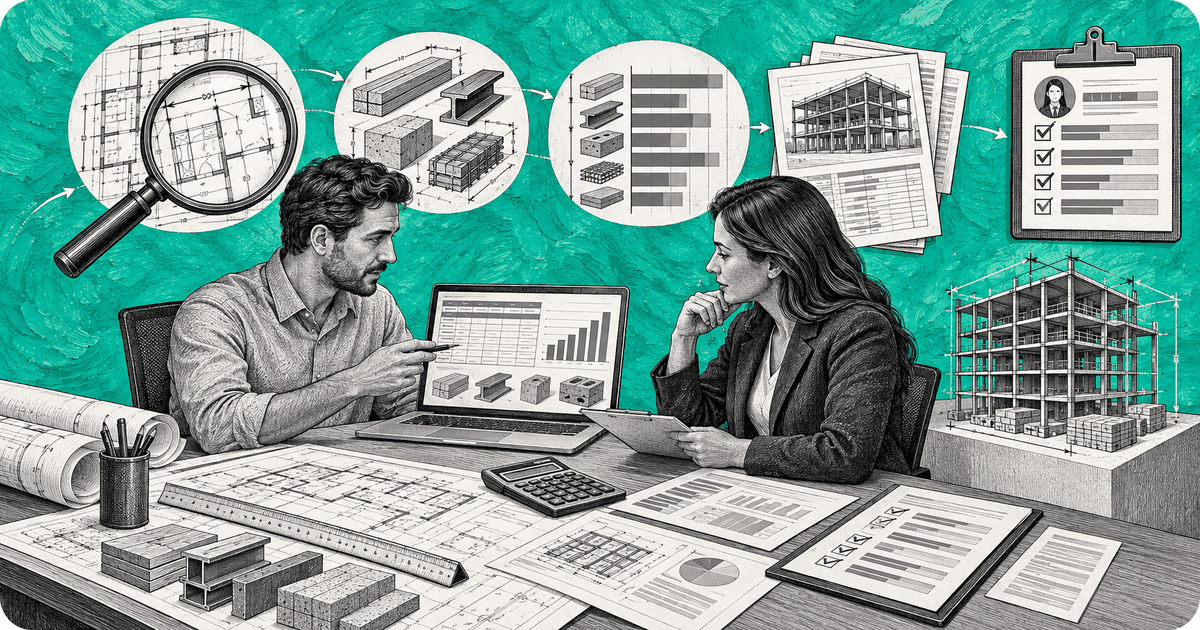
An estimator predicts the construction cost (or production cost) of a project before work begins. That means reading drawings and specifications, completing quantity takeoffs, pricing labor, material, and equipment, collecting and leveling subcontractor quotes, and adding contingency for risk. The estimate then feeds bids, budgets, and go or no go decisions.
The role changes with the stage of the project. A bid estimator works from complete documents and a hard deadline. A design estimator works earlier, during schematic design or design development, when the project scope is still being defined and the estimate shapes design choices rather than just pricing them. Your interview should reflect which version you are hiring for.
These questions confirm the candidate understands the job beyond software and spreadsheets.
What good answers sound like: a clear sequence (review documents, clarify scope, takeoff, pricing, quote leveling, review, submit), specific tools named in context, and an honest read on where errors creep in. Vague answers that skip scope review are a warning sign.
Use these to test depth of estimating experience, not just years in the role.
What good answers sound like: concrete project examples, a repeatable self check (a second takeoff method, unit cost comparisons against past jobs, peer review), and a habit of closing the loop with actual costs. Candidates who never compare estimates to final costs are guessing at their own accuracy.
A design estimator works with partial information and influences decisions that are still open. These questions test that judgment.
What good answers sound like: a strong design estimator talks in ranges, explains assumptions plainly, and treats the estimate as a decision tool. They should be comfortable saying “this number depends on three choices you have not made yet” and then show how each choice moves the cost.
These test how the candidate thinks under realistic pressure.
What good answers sound like: the candidate protects accuracy without freezing. Look for escalation when it is warranted, written clarifications, and a willingness to push back on pressure to shave numbers without a reason.
What good answers sound like: ownership of mistakes, specific fixes, and evidence that the candidate learns from variance rather than defending it.
Score each area from 1 to 5 and agree on the bar before the first interview. Consistent scoring is what turns a list of estimator interview questions into a fair comparison between candidates.
An interview shows how a candidate talks about estimating. An exercise shows how they actually do it:
The walkthrough matters as much as the number. A candidate who reaches a slightly different total but documents every assumption is usually a better hire than one who lands close to your answer and cannot explain how.
If you are screening many candidates, a structured online assessment can handle the first pass. Glider AI’s skill assessment software supports role based questions and hands on tasks, with configurable proctoring so you know the work is the candidate’s own. For the conversation stage, AI interview software runs structured interviews against a fixed rubric, so every candidate answers the same questions and is scored the same way.
Ask the candidate to walk through how they build an estimate, how they check their takeoff, how they handle a late or high subcontractor quote, and how they compare estimates to actual construction cost. Those four questions cover method, accuracy, judgment, and learning.
A design estimator prices a project during the design phases, before construction documents are complete. They work with partial drawings, document assumptions, and help owners and architects make design choices that fit the budget. The role is common in design build firms and preconstruction teams.
Use a short practical exercise: a small drawing set or scope description, a takeoff for a few items, a priced summary, and a written list of assumptions. Score it with the same rubric for every candidate, and ask them to explain their work afterward.
Many estimators hold a degree or certificate in construction management, engineering, or quantity surveying, but relevant estimating experience on similar project types matters more than the credential.
There is no fixed number. Look at the size and complexity of projects they have owned end to end, whether they have managed bids independently, and whether their past estimates held up against final costs.
Vague process descriptions, no habit of checking work, no comparison of estimates to actual costs, blaming others for estimate misses, and a willingness to cut numbers to win work without documenting why.
A construction estimator focuses on building projects and trades. A cost estimator is a broader title that also covers manufacturing, engineering, and product costs. The core skills overlap: reading specifications, defining project scope, pricing inputs, and managing risk.
Estimating mistakes cost the most when they are discovered late. The same is true of hiring mistakes. Pair these estimator interview questions with a consistent scorecard and a hands on exercise, and you will see how a candidate works before they price your next bid. To run that first screen at scale, explore Glider AI and its assessment and interview tools.
Related interview guides: underwriter interview questions, tax accountant interview questions, and benefits specialist interview questions.

A strong architect portfolio tells you what got built. It rarely tells you what the candidate personally decided, what they gave up when the budget moved, or how they handled a contractor who said the detail couldn’t be built. Those are the things that decide whether a hire works out, and they only come out […]

The best benefits specialist interview questions test four areas: compliance knowledge (COBRA, ERISA, ACA, HIPAA), program administration (open enrollment, vendors, HRIS), employee communication and judgment in sensitive situations. Ask for specific examples, then confirm the skills with a short job based skill test before the final round. A benefits specialist is the person employees call […]

Underwriters review applications, whether for insurance policies or loans, and decide how much risk a company should take on. Get a clear snapshot of how to screen the ideal candidate for your organization with this set of underwriter interview questions. The job of an underwriter is to review insurance or loan applications and carry out […]