
Make talent quality your leading analytic with skills-based hiring solution.
The HR Tech industry in 2025 witnessed explosive growth driven by AI integration and strategic consolidations, reshaping talent acquisition and workforce management for enterprise leaders. Major acquisitions by giants like Workday and SAP accelerated innovation in HCM and recruiting platforms.
In August 2025, the European Union’s AI Act began phased enforcement for high-risk AI systems, explicitly including AI used in recruitment, candidate screening, and employee assessment. For the first time, large employers operating in or hiring from the EU faced binding obligations around explainability, bias testing, human oversight, and audit trails for HR AI systems.
This was not a symbolic shift. It forced CHROs and CIOs to jointly inventory hiring and assessment tools, demand clearer model documentation from vendors, and slow or pause deployments that could not meet compliance thresholds. The impact was immediate: HR Tech conversations in 2025 moved decisively away from “what’s possible” to “what’s defensible, scalable, and governable.”
By 2025, AI in HR was no longer new. What changed was scrutiny. According to Gartner’s 2025 HR Technology Survey, over 60% of large enterprises reported using some form of AI in at least one HR workflow, but fewer than 30% described those systems as “fully governed and audited.”
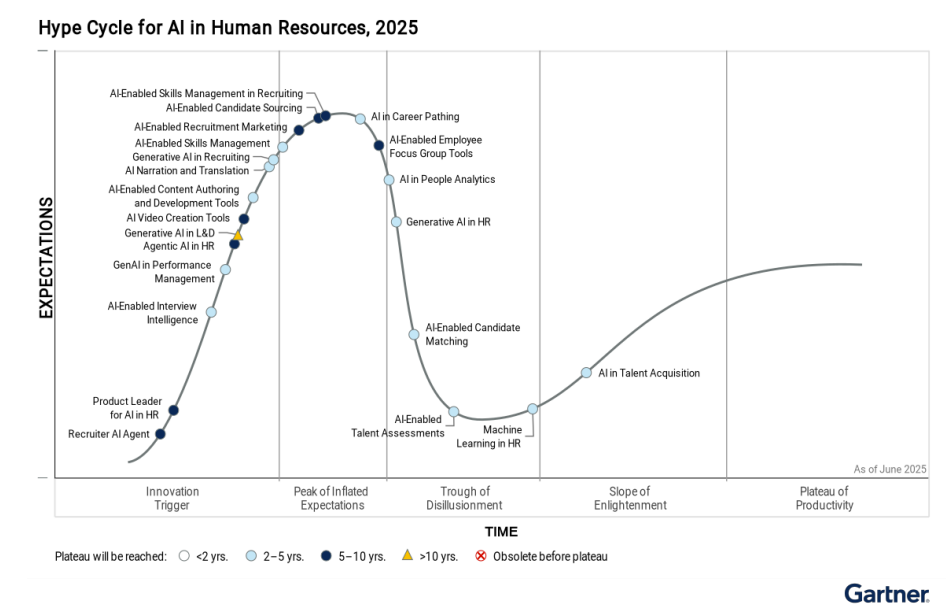
Several macro trends defined the year:
HR Tech in 2025 was defined less by innovation velocity and more by operational discipline.
Unlike the mega-mergers of earlier years, 2025 was characterized by targeted acquisitions, aimed at filling specific capability gaps rather than building end-to-end suites overnight.
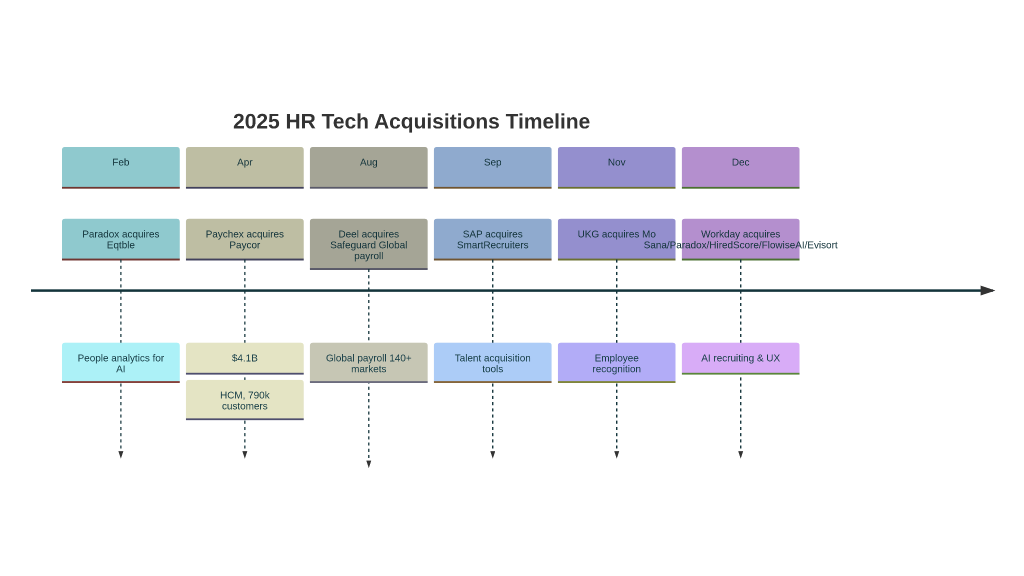
HR Tech saw unprecedented M&A activity, with over a dozen high-profile deals totaling billions, focusing on AI, payroll, and employee experience enhancements.
These HR Tech deals in 2025 showed three clear patterns:
Earnings calls from large HR software vendors throughout 2025 repeatedly emphasized “platform depth” and “customer consolidation” as drivers, signals that enterprise buyers were actively reducing vendor sprawl rather than expanding it.
A subset of HR technologies achieved scaled deployment in 2025:
What did not scale: fully automated hiring decisions, black-box assessment models, and AI tools that could not produce audit-ready explanations.
Several data points from 2025 help ground the narrative:
These metrics reinforced a central reality: technology alone did not solve structural talent challenges. Data from 2025 reveals HR Tech’s tangible ROI, guiding investment decisions for hiring and development teams.
| Category | Adoption Rate | Key Impact |
| AI-powered tools | 73% | 28% faster hiring |
| Automated screening | 75% | 43% time savings |
| Cloud-based HRMS | 61% | 31% cost reduction |
HR budgets reached 15.7% of total company spend, up from 12.3% in 2020, with 87% of organizations increasing tech investments. Time-to-hire dropped 14% to 36 days, while diverse leadership drove 21% higher profitability.
CHROs face hybrid work dominance, with 76% of employees preferring it and 61% of firms adopting permanent remote policies. AI adoption hit critical mass at 73%, enabling 32% better business outcomes for data-driven teams.
Events like HR Tech 2025 and HR Week highlighted 60+ new products in AI recruitment and analytics. Leaders should integrate skills-based hiring and employee experience platforms to combat 79% turnover risk from poor development.
The lessons of 2025 translate into practical implications:
Most importantly, CHROs in 2026 will be judged less on adoption speed and more on risk management, transparency, and measurable workforce outcomes.
The HR Tech story of 2025 was not about disruption. It was about maturity.
This was the year when regulation caught up, buyers became more selective, and AI shifted from promise to practice. Hiring and development teams learned, sometimes painfully, that scalable technology requires trust, governance, and strong data beneath it.
For enterprise HR leaders, 2025 reshaped how success is defined: not by how advanced the tools appear, but by how responsibly and effectively they operate inside complex organizations.

Pioneering Excellence in Staffing and Operations Professional Background Joy Pastor has been in the staffing industry since 2007, following a successful career with major technology companies such as Sun Microsystems, Network Appliance, and SAP. Her passion for technology, coupled with her background in operations, naturally led her to the staffing industry, where she excels at […]

Talent Acquisition has experienced a lot of challenges from longer and slower hiring cycles to not knowing the impact of AI-recruiting, in turn causing a lot of uncertainty for TA, HR, and staffing firms. In this webinar, Joseph Cole, VP of Marketing and Research, interviews Ali Ghiassi, leader of TA and People Experience at Fortrea. Ali […]

As the US population ages, burgeoning demand for healthcare talent continues to put pressure on hospital groups looking to hire skilled talent. The U.S. Bureau of Labor Statistics has also predicted a 13% growth in employment from 2021-2031, much faster than the average for other occupations. Coupled with Gen Z looking for employment in other […]