Make talent quality your leading analytic with skills-based hiring solution.
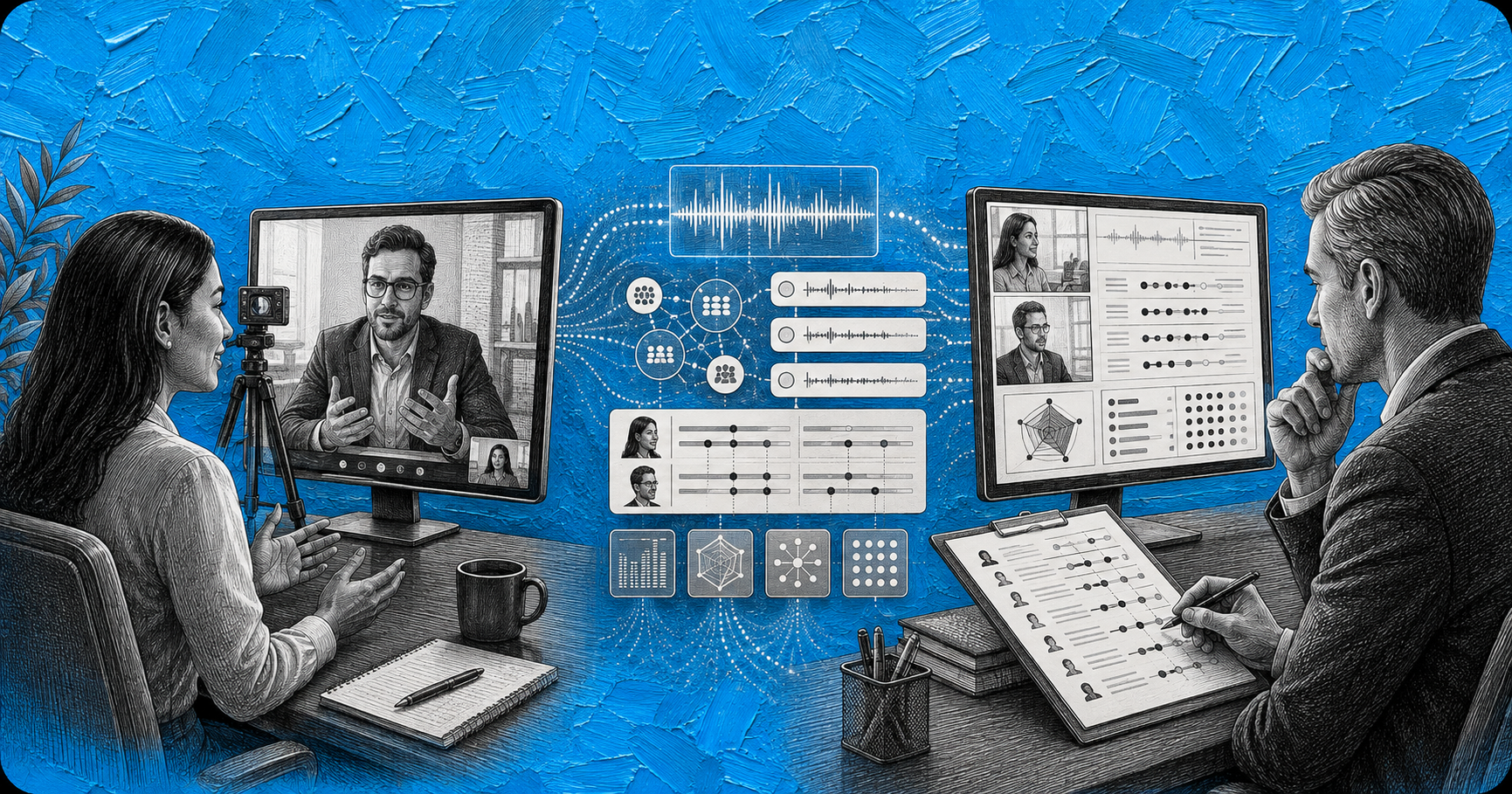
AI interview intelligence is software that records, transcribes, and analyzes interviews that a human recruiter or hiring manager is actually conducting, turning the conversation into structured data such as talk time ratios, sentiment trends, and competency or keyword tags. It does not run the interview itself. It sits behind the human led conversation and gives hiring teams a consistent, searchable record of how that conversation actually went, so a structured hiring decision can be checked against evidence rather than a single interviewer’s memory.
That distinction matters more than it sounds. Search results for “interview intelligence” in 2026 are crowded with tools that blend two very different jobs: AI that conducts the interview (voice agents, chat based screens, guided video assistants) and AI that analyzes an interview a person is running. Gartner’s dedicated “AI Enabled Interview Intelligence” reviews market now tracks vendors across both camps, and buyer guides from Metaview, SocialTalent, Phenom, and HireVue often cover them side by side without drawing a clean line. This post draws that line. It is about the second category only: conversation analytics layered onto human led interviews.
AI interview intelligence analyzes a conversation a human is running. AI led interviewing, by contrast, has an AI agent asking the questions and steering the exchange, as with voice screening agents or AI guided interviews that provide real time prompts to keep a structured conversation on track. Both categories aim at the same outcome, more consistent hiring decisions, but they intervene at different points.
Glider AI’s own AI voice interviews product sits in the AI led category: an AI agent runs a first round phone screen. Interview intelligence, the subject of this post, is the layer that would instead sit behind a human recruiter’s live call, panel interview, or video conversation, scoring how that human led exchange actually unfolded. A team can use both. They solve different problems.
Most platforms in this space, including BrightHire, Metaview, Phenom Interview Intelligence, HireVue’s Interview Insights, and SocialTalent’s Cara, build their analysis around a similar core set of signals pulled from a recorded and transcribed conversation.
A structured hiring decision is only as defensible as the evidence behind it. A scorecard tells you what an interviewer concluded. Interview intelligence tells you what actually happened in the room, which is the piece that turns a disputed hiring decision, an internal calibration disagreement, or an external compliance inquiry into something a team can actually resolve with a transcript and a timestamp instead of two conflicting memories.
This is also where interview intelligence and a genuinely structured process reinforce each other rather than compete. A skills assessment already gives a team an objective, job related competency framework before the interview happens. Interview intelligence checks whether the actual conversation stayed inside that framework, and whether the resulting scorecard reflects what was said rather than what an interviewer remembers saying. Neither one replaces the other. Together they close the loop between designing a fair process and proving it was actually followed.
For teams running interview software across video, panel, and live coding formats at volume, that loop matters even more, because the number of conversations a hiring team can personally spot check drops fast once volume climbs past a handful of roles.
The most immediately useful application for a lot of TA teams is not the historical record, it is the coaching layer. Platforms like Phenom Interview Intelligence surface personalized reminders before an interview, flagging a specific interviewer’s known patterns, such as a tendency to talk too much early or to skip the closing questions when running short on time, and then flag coachable moments inside the actual recording afterward, the exact minute where a bias risk or a process gap showed up.
That turns interview training from an annual workshop into an ongoing feedback loop tied to real conversations. A hiring manager who consistently runs a 70/30 talk ratio in their own favor, or who never actually asks the behavioral questions on the agreed script, becomes visible in the data rather than invisible until a bad hire surfaces months later.
Metaview’s 2026 evaluation guidance recommends skipping vendor claims entirely and running a direct bake off: take five completed interviews, run every candidate tool against the identical set, and compare outputs against the actual recordings. A few dimensions are worth scoring specifically.
AI interview intelligence is software that records, transcribes, and analyzes interviews conducted by a human recruiter or hiring manager, converting the conversation into structured signals like talk time ratios, sentiment trends, and competency tags that support more consistent hiring decisions.
No. Interview intelligence analyzes a conversation a human is running. A separate category, AI led interviewing, has an AI agent asking the questions itself, as with voice screening agents or AI guided interviews. The two are often marketed together but solve different problems.
Talk time ratio is the share of an interview’s total speaking time that belongs to the interviewer versus the candidate. A heavily skewed ratio toward the interviewer is one of the most common and most fixable structured interviewing failures, since it usually means the interviewer talked over the portion of the call meant to surface the candidate’s own evidence.
It can surface patterns that correlate with bias risk, such as an interviewer who consistently skips certain question categories for certain candidates, or whose ratings run high or low regardless of answer quality, and several vendors report meaningful reductions in assessment bias once those patterns become visible and get coached. It flags patterns for a human reviewer to investigate; it does not make the bias determination on its own.
In most jurisdictions, yes, with consent, and most platforms build consent into the scheduling flow by default. Requirements vary by state and country on notice and storage, so confirm your rollout against local recording and biometric data laws before turning it on, particularly if any candidate facing video or audio review is involved.
No. A scorecard defines what a structured interview is supposed to measure and records the interviewer’s conclusion. Interview intelligence checks whether the actual conversation matched that plan and whether the scorecard reflects what was really said. They are complementary layers of the same structured process, not substitutes for each other.
Reputable platforms disclose recording and AI analysis to candidates at scheduling and require consent before the call, consistent with how most jurisdictions treat interview recording generally. Teams evaluating a platform should confirm exactly what candidates are told and when, since disclosure practices vary by vendor.
Structured hiring only works if the structure actually gets followed, call after call, interviewer after interviewer. AI interview intelligence is the layer that checks that assumption instead of assuming it, giving hiring managers and TA leaders a shared, evidence based record of what happened in the room, and giving interviewers specific, data backed coaching instead of a once a year training deck. Paired with a real competency framework and consistent interview software underneath it, that record is what turns “we run structured interviews” from a policy statement into something a team can actually prove.

AI hiring accessibility means making sure automated interviews, video assessments, and proctoring tools do not create barriers for candidates with visual, hearing, speech, motor, or neurodivergent disabilities, and that reasonable accommodations, like extended time, alternative formats, and human review, are built into the process rather than bolted on afterward. Getting this right is not just […]

AI resume fraud is the practice of candidates using generative AI tools like ChatGPT to invent, inflate, or heavily embellish work experience, job titles, projects, and skills on a resume, specifically to slip past applicant tracking system keyword filters and impress a human reviewer. It is a resume and application stage problem, distinct from a […]
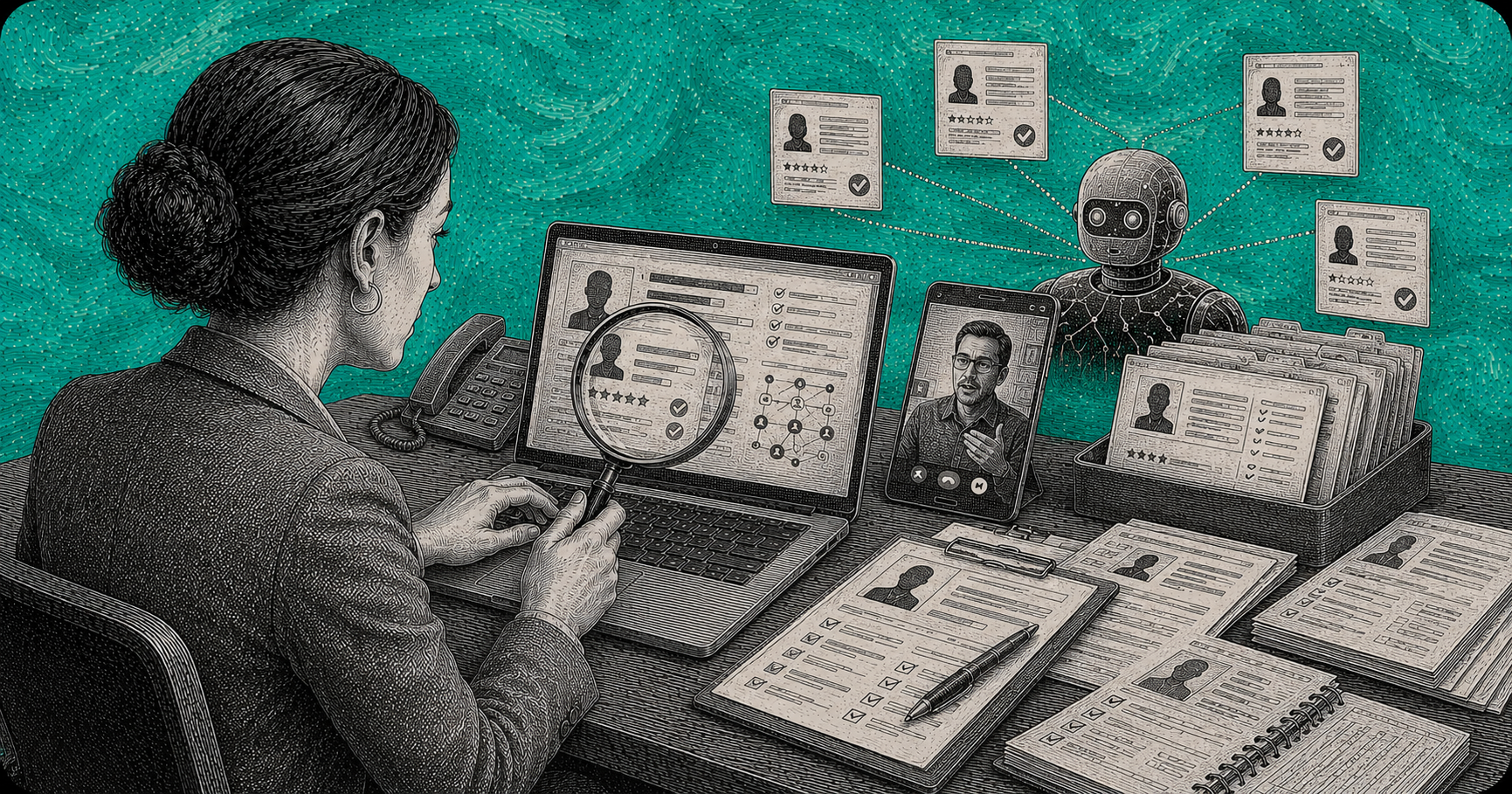
AI reference checking uses software, not a recruiter’s personal phone calls, to reach a candidate’s former managers or colleagues, collect their feedback through a structured digital survey or a conversational voice or chat interface, and analyze the responses for consistency and red flags. Done well, it does not just digitize the old “would rehire, yes […]