Make talent quality your leading analytic with skills-based hiring solution.
AI proctoring does not have to feel invasive to candidates. The friction candidates report almost never comes from the security measure itself, it comes from monitoring that is unexplained, disproportionate to the role, or reviewed without a human in the loop. Done well, AI proctoring protects assessment integrity while candidates barely notice it, because they understood what was being watched and why before they ever clicked start.
That balance, real security without a surveillance feeling, is the actual challenge for talent acquisition teams in 2026. Remote hiring is not going away, assessment and interview fraud is not going away, and neither is candidate scrutiny of how companies use AI on them. This post lays out where AI proctoring candidate experience problems actually come from, what a fair review process looks like, and how to implement proctoring in a way candidates trust rather than resent.
Candidates get uneasy about AI proctoring when they do not know what is being recorded, how long it is kept, or who reviews it. It is rarely the camera itself; it is the ambiguity around it.
Think about the experience from the candidate’s side. They are already nervous about the assessment or interview itself. If a proctoring tool activates their webcam, tracks eye movement, or locks their browser without a clear explanation beforehand, that ambiguity reads as suspicion rather than security. Candidates start wondering if a glance at their notes, a dog barking in the next room, or a slow internet connection is quietly counting against them.
This is compounded when candidates compare notes. Reddit threads, Glassdoor reviews, and campus recruiting groups regularly discuss which companies use invasive sounding monitoring, and a bad AI proctoring experience travels fast, especially among early career and campus candidates who are applying to a dozen companies at once and will simply avoid the ones that felt like an interrogation.
AI proctoring protects candidate experience for the vast majority of honest candidates because it protects the fairness of the process they are competing in. The risk to candidate experience comes from poor implementation, not from the presence of proctoring itself.
Here is the tension recruiting teams miss: skipping proctoring does not remove candidate anxiety, it just shifts who bears the cost. Glider’s own research into how candidates cheat in hiring assessments shows a real and growing set of tactics, from tab switching and screen sharing to a second person feeding answers off camera. Every one of those tactics, left unchecked, disadvantages the honest candidate who is doing the work themselves in real time. A proctoring layer that catches that behavior is protecting the applicant pool’s fairness, not undermining it.
The benefits of remote proctoring in the modern interview process extend past fraud prevention too. Proctored assessments let companies offer flexible, remote, any time testing windows instead of forcing candidates into a supervised test center or a rigid live time slot, which is itself a candidate experience win, especially for candidates juggling a current job, caregiving, or a different time zone than the hiring company.
A false flag typically comes from an AI proctoring system misreading normal human behavior, poor lighting, an unstable network connection, or an accessibility need as suspicious activity, rather than from actual dishonest behavior.
Common triggers include a candidate looking away from the screen to think, which some gaze tracking models can misread as consulting outside material; a second face briefly passing in the background, common in shared households; a screen resolution or multi monitor setup that trips a browser lockdown rule; or a connectivity drop that looks identical to an attempted screen recording. Accessibility needs matter here too. A candidate using a screen reader, a sign language interpreter, or an assistive device can trigger flags in a system that was not designed with those use cases in mind, which turns a security feature into a discrimination risk if it is not handled carefully.
The mechanics behind how auto proctoring prevents cheating in online recruitment matter here because the same signals, tab switching, multiple faces, audio anomalies, unusual gaze patterns, can indicate either fraud or an entirely innocent explanation. The tool’s job is to flag the pattern; a human’s job is to decide what it means.
The single biggest lever for candidate trust is disclosure before the assessment starts, not after. Tell candidates in plain language what is being monitored, why, how long the recording is kept, and who reviews it.
A short, specific disclosure screen before the assessment begins does more for candidate trust than almost any other change a team can make. Effective disclosure covers four things: what signals are monitored (camera, screen activity, audio), why (protecting the fairness of every candidate’s result), retention (how long footage is stored and who can access it), and recourse (what happens if something gets flagged, and how the candidate can respond). Companies that skip this step and let candidates discover the monitoring mid assessment consistently see more complaints and lower completion rates, even when the underlying technology is identical to a company that disclosed clearly upfront.
Proportionality matters just as much as disclosure. Not every role or every stage needs the same level of scrutiny. A senior engineering take home exercise with real production access risk warrants a different level of proctoring than an entry level customer support screening quiz. Matching the intensity of monitoring to the actual risk of the role, rather than applying maximum proctoring everywhere by default, keeps candidates from feeling like they are being treated as suspects before they have done anything.
The same transparency principle applies to the one way video interview stage, which is often a candidate’s very first live interaction with a company’s hiring technology. Explaining upfront that a one way interview may include integrity checks, and framing it as protecting every candidate’s shot at a fair evaluation, sets the tone for every proctored touchpoint that follows.
A fair AI proctoring process never lets an algorithm make the final adverse decision on its own. Every flag should route to a trained human reviewer, and the candidate should have a real chance to explain before any action is taken.
In practice, that means three things. First, the AI system’s job stops at flagging a pattern for review, not rejecting a candidate outright; the recommendation engine surfaces the case, a person closes it. Second, reviewers need context, not just a clip: what triggered the flag, what the baseline behavior looked like earlier in the session, and whether the same pattern shows up across other candidates taking the same assessment (a shared network issue affecting many candidates points to infrastructure, not fraud). Third, candidates who are flagged deserve a documented path to respond, whether that is a quick clarifying question from a recruiter or a retake opportunity, before a flag becomes a rejection.
This is also where AI proctoring connects to the wider identity and fraud prevention picture rather than standing alone. Proctoring answers “is this person behaving honestly during the assessment,” while a tool like ID Verify answers a related but separate question, “is this the same person who applied.” Keeping those layers distinct, and being transparent with candidates about which one triggered a review, avoids the confusion and anxiety that comes from a single unexplained black box decision.
Poorly explained AI proctoring measurably increases assessment abandonment, particularly among candidates who are already anxious about the process, including many strong candidates who simply decline to be watched by an unexplained system.
Recruiting teams that track funnel metrics closely tend to see a small but real drop in completion rate the moment proctoring is introduced without adequate framing, typically concentrated in the first ten to fifteen seconds after the monitoring notice appears. That drop shrinks substantially, in many teams’ internal data, once the disclosure language is rewritten to explain the “why” rather than just the “what.” Candidates who understand that proctoring exists to protect the integrity of everyone’s result, including their own, are far more likely to proceed than candidates who are simply told they are being recorded.
AI proctoring can feel invasive when it is undisclosed, disproportionate to the role, or reviewed without a human, but when candidates are told upfront what is monitored and why, most report it as a minor, expected part of a fair assessment rather than an invasion of privacy.
Well implemented AI proctoring has a neutral to positive effect on candidate experience because it protects the fairness of the result every candidate is competing for; poorly implemented proctoring, with no disclosure or no human review, is what actually damages candidate experience.
Common false flag triggers include poor lighting, unstable internet connections, a second person briefly entering the frame, multi monitor setups, and accessibility devices such as screen readers, none of which indicate actual dishonest behavior.
Yes, if a system is not configured with accessibility and diverse home environments in mind, candidates using assistive technology or testing from a shared living space can be flagged more often than others, which is why human review before any adverse action is essential.
Yes, disclosing what is monitored, why, how long footage is kept, and who reviews it before the assessment begins is the single most effective step for maintaining candidate trust and reducing abandonment.
In a well designed process, a flag routes to a trained human reviewer who checks the context of the session, and the candidate is given a documented chance to respond or clarify before any decision affecting their candidacy is made.
No, AI proctoring monitors behavior during an assessment or interview to protect its integrity, while identity verification tools like ID Verify confirm the person taking the assessment is who they claim to be; the two are complementary layers, not substitutes for each other.
Yes, proctoring measurably reduces common cheating tactics such as tab switching, screen sharing, and unauthorized second party assistance, all of which are documented in Glider’s research on how candidates cheat in hiring assessments, which is exactly the fairness problem proctoring exists to solve.
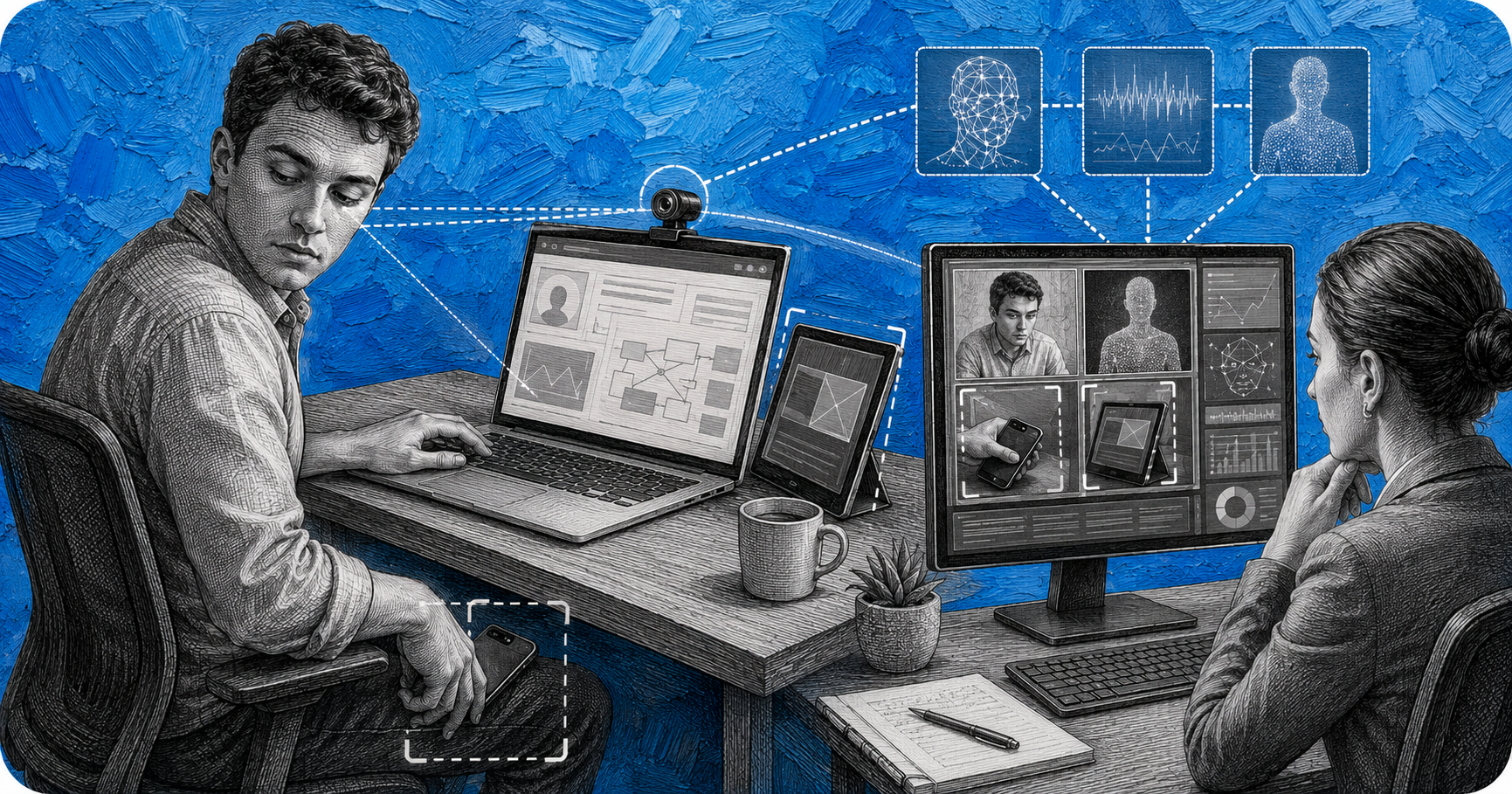
Second device cheating is when a candidate uses a phone, tablet, or second monitor outside the webcam’s view during a proctored online assessment to look up answers, message someone for help, or mirror their screen to a helper. It is one of the hardest forms of assessment fraud to stop with software alone, because the […]

Contingent worker identity verification is the practice of confirming that a freelancer, contractor, or gig worker is who they claim to be before they are onboarded, not just screened on paper. Most companies apply this scrutiny to full time employees and skip or shortcut it for contingent talent, which is exactly the gap fraud actors […]

A structured interview scorecard is a standardized form that lists the specific competencies a role requires, gives every interviewer the same rating scale to judge candidate answers against, and forces a written justification for each score. It exists to replace gut feeling with evidence, so five interviewers evaluating the same candidate land on comparable, defensible […]