

Make talent quality your leading analytic with skills-based hiring solution.
A recruiter at a staffing firm opens a new req at 9 a.m. By noon there are 400 applicants, a client asking for three submittals by end of day, and no reliable way to tell which résumés belong to people who can actually do the work. That gap between applicant volume and real signal is where the future of the staffing industry is being decided.
The future of the staffing industry belongs to firms that can prove a candidate is real, qualified, and interested before the client ever sees a profile. Seven changes are driving that shift:
Each section below explains what is changing, why it matters for a staffing firm, and what to do about it. A readiness checklist and FAQ follow at the end.
Any honest look at the future of the staffing industry starts with what the last few years changed. The original version of this article focused on the pandemic: moving recruiting online, running video interviews, and rethinking culture fit for remote teams. Those shifts happened. Remote sourcing and virtual interviews are now the default, not the exception.
The problem is what came with them. Remote hiring made it easier for anyone to apply anywhere, which multiplied applicant volume. It also made it easier for candidates to misrepresent who they are. The firms that adopted video tools in 2020 solved the access problem. The next set of problems is about trust and throughput.
The first wave of recruiting automation handled single tasks: parsing résumés, sending templated emails, booking calendar slots. The current wave is AI agents that handle a whole sequence on their own. An AI recruiter can call a candidate minutes after they apply, confirm interest, availability, pay expectations, and willingness to relocate, then pass a structured summary to the human recruiter.
For a staffing firm, this changes what a recruiter’s day looks like. Less time goes to phone tag and first touch screening. More time goes to client relationships, offer negotiation, and judgment calls on borderline candidates. Glider’s AI Recruiter handles this outreach over voice, SMS, WhatsApp, email, or web chat.
Résumés describe what a person says they did. Clients increasingly want to know what a person can do. Skills based hiring evaluates candidates on job relevant tasks: writing working code, handling a simulated customer call, building a query against a real dataset.
This matters most in the roles staffing firms fill at volume, such as tech, sales, and customer support positions with one to twelve years of experience. A validated skills result travels with the candidate submittal and gives the client something concrete to act on. Glider’s assessment library covers 250+ technologies and 200+ non technical roles, with 35+ interactive question types and 100+ hands on simulations.
Remote hiring opened the door to proxy test takers, impersonation during interviews, and the candidate who clears every round then sends someone else to start the job. For a staffing firm, one bad placement like that can damage a client relationship that took years to build.
Identity verification is becoming a standard step in the screening workflow, not an afterthought at onboarding. Glider’s ID Verify matches four identity signals (photo ID, live selfie, location, and audio biometric) across every stage, from assessment through interviews to onboarding. A mismatch raises a flag before the offer, and every check is logged for audit. For a deeper look at detection, see the proxy interview fraud detection guide.
Scheduling first round interviews is one of the biggest drags on time to submit. AI interviews remove that bottleneck. Candidates can complete a one way video interview on their own time, or sit an autonomous AI interview that asks follow up questions, assigns coding tasks, and scores responses against a defined rubric.
The rubric is the part that makes this defensible. Questions are set in advance, and candidates are evaluated on what they do, not only on what they say. At Infosys, Glider ran more than 30,000 AI interviews, and the AI outcome matched the hiring manager decision 80 percent of the time. Learn more about AI interview software.
Managed service providers and enterprise clients track supplier quality closely: interview to offer ratios, fall offs, early attrition. A staffing firm that submits a candidate with a verified identity, a scored skills assessment, and an interview recording is giving the client proof. A firm that submits a résumé and a recruiter note is asking the client to take its word for it.
In the future of the staffing industry, this pushes suppliers toward fewer, better submittals. Firms that can attach evidence to each candidate earn more interview slots and a stronger position in vendor rankings.
Contract, project based, and fractional engagements continue to grow as companies try to match headcount to demand more precisely. Workers also expect more control over when and where they work. Glider has written about why the extended workforce is central to the future of work.
For staffing firms, this means more reqs, shorter engagements, and faster redeployment. Screening has to be quick enough to keep up with that pace without lowering the bar on quality.
Growth in the staffing market has slowed, and clients are pushing harder on rates. When margins tighten, the cost of a recruiter spending hours on candidates who never should have reached a phone screen becomes visible. Automation at the top of the funnel, combined with verified skills and identity, lowers the cost of each qualified submittal. That is why cost per submittal sits at the center of the future of the staffing industry. The firms that hold margin will be the ones that spend recruiter time only on candidates worth that time.
Use this list to see where your firm stands today. Every “no” is a place where the next round of hiring and staffing changes is likely to cost you placements.
If you answered “no” to three or more, start with the step closest to your biggest client complaint. For most firms that is either submittal quality or speed.
Technology will not replace the relationship between a staffing firm and its clients. Clients still want a partner who understands their teams, their hiring managers, and the roles that are hard to fill. The firms that do well will use AI to clear the repetitive work so recruiters can spend more time on the conversations only a person can have. For a broader view of where AI fits, read about the role of AI in staffing and contingent hiring and the hiring trends employers are preparing for in 2026.
The future of the staffing industry centers on speed and proof. Firms will use AI agents to handle outreach and first round screening, validate skills through real tasks, and verify candidate identity before submitting. Recruiters will spend more time on client relationships and complex placements.
AI is taking over transactional work such as first contact, availability checks, scheduling, and early screening interviews. This lets agencies screen far more applicants per req without adding headcount, and it gives recruiters structured data on every candidate instead of raw résumés.
No. AI handles volume and repetitive steps, but recruiters still own client relationships, judgment on close calls, offer negotiation, and candidate care. The role shifts toward higher value work rather than disappearing.
The biggest disruptions are AI agents in recruiting workflows, the move to skills based hiring, rising candidate identity fraud in remote hiring, client demand for evidence backed submittals, and margin pressure from slower market growth.
Verify identity at several points in the process, not only at onboarding. Match photo ID, live selfie, location, and voice across the assessment, interviews, and onboarding, and use proctoring during skills tests. Keep an audit trail so flags can be reviewed by a recruiter rather than acted on automatically.
Recruiters will need strong client consulting skills, comfort reading assessment and interview data, and the judgment to act on flags and scores. Knowing how to configure and supervise AI screening tools will matter as much as sourcing skill.
If your firm is facing more applicants than it can screen and more pressure to prove quality on every submittal, see how Glider AI brings engagement, identity verification, skills assessment, and AI interviews into one screening workflow.

Global hiring fraud hotspots are the countries and regions where documented candidate fraud and identity verification risk run highest, based on named industry indices rather than assumption. In 2026, that data points consistently in one direction: fraud vulnerability is concentrated in markets with weaker centralized identity infrastructure and fast growing digital hiring volume, led by […]
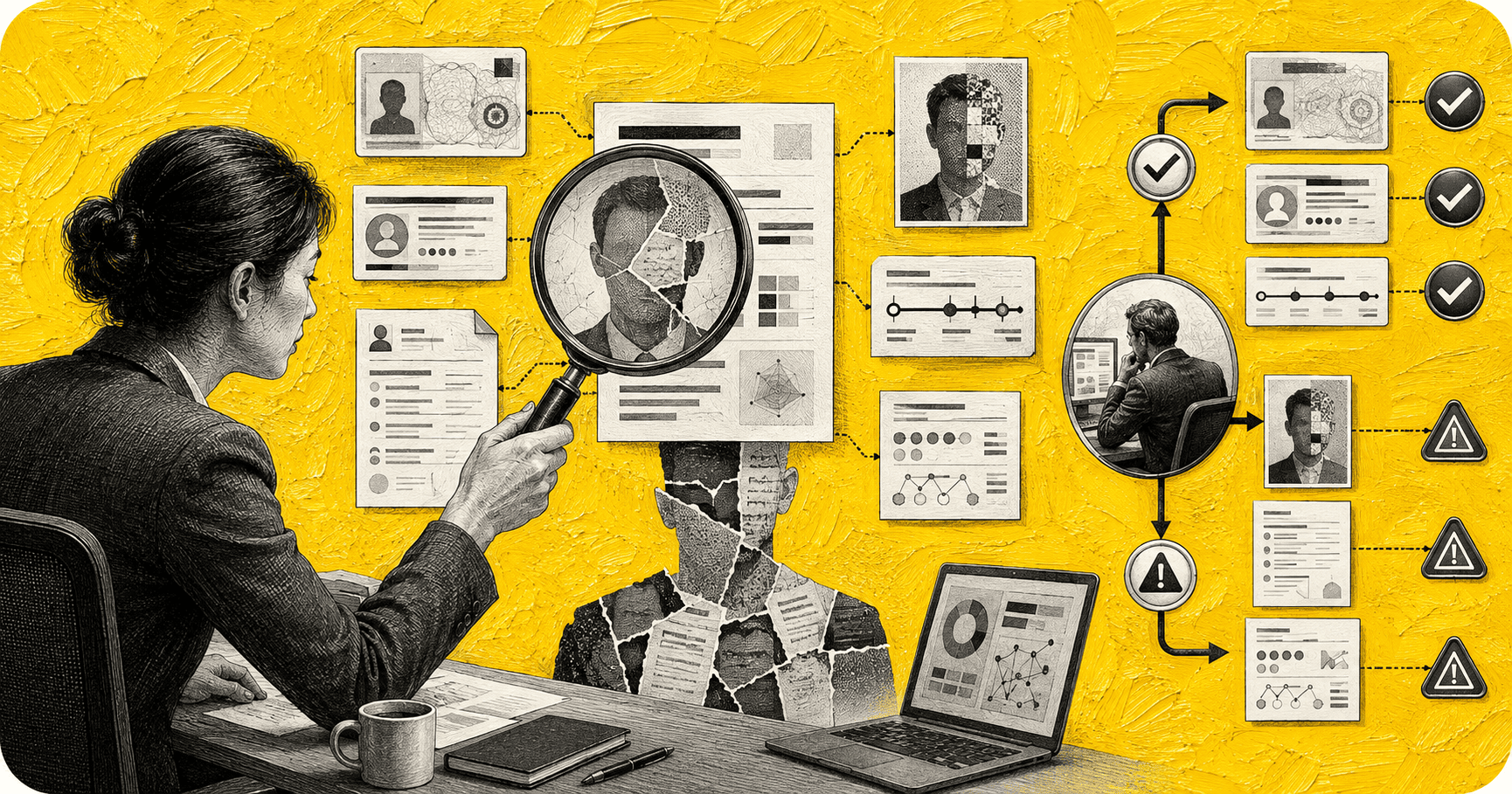
A synthetic candidate is a job applicant who does not exist as a single real person at all. The persona is assembled, usually by combining stolen or purchased personally identifiable information (PII) with an AI generated resume, an AI generated or composite photo, and an invented work history, into a package that looks, on paper […]

Hiring overqualified candidates is not automatically a mistake, but it is a decision that carries real, well documented risk if the role and the offer are not restructured around it. Recent survey data shows most employers already do this regularly: 70 percent of hiring managers say they typically consider candidates who are overqualified for the […]
