A resume that lists "Core Java, Spring, JDBC" tells you which tools a candidate has been near. It doesn't tell you whether they know which collection to reach for, how Java handles an anonymous inner class, or what happens when an exception goes unchecked. Glider AI's Java skill test answers those questions before an interview is booked. It's a proctored, multiple choice assessment that checks core Java knowledge in about 10 minutes, so hiring managers spend interview time on candidates who have already shown the fundamentals.
Multiple choice
About 10 minutes
English
Easy
The test focuses on the core Java knowledge every Java role depends on, whatever framework the team uses on top: object oriented programming (classes, objects, inheritance, encapsulation and inner classes), the collections framework, multithreading, exception handling, and Java language basics such as data types, literals and declarations.
It also touches the knowledge around core Java that shows up in daily work: relational databases such as MySQL and Oracle, Java frameworks and web development.
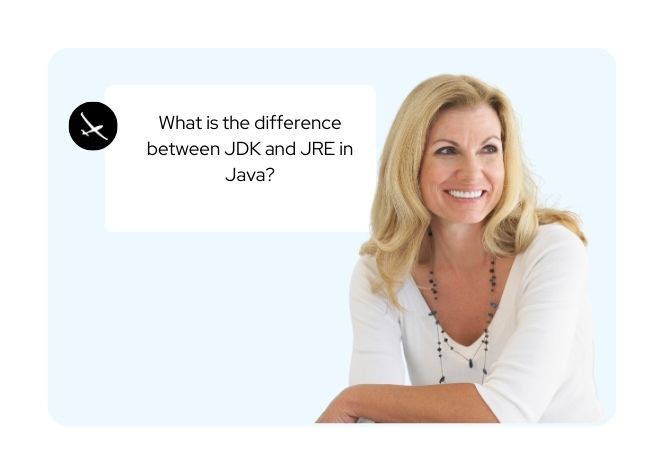
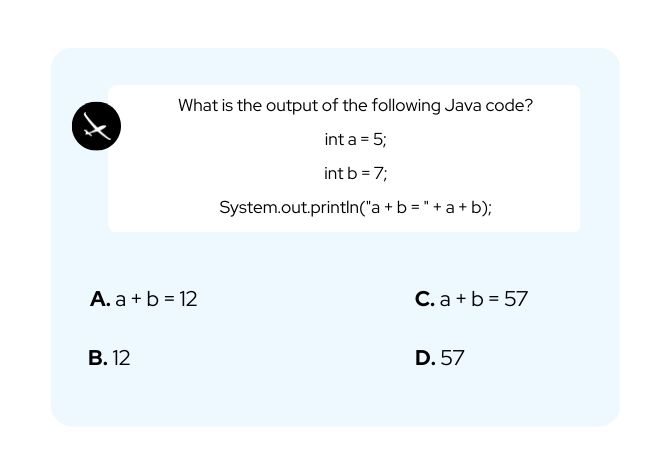
These five questions come from the test format. Each one checks a specific piece of Java knowledge.
What it checks: whether the candidate knows how Java's design differs from C and C++, especially around memory access.
What it checks: attention to syntax and an understanding of the char type and Unicode escapes.
What it checks: literal rules and number formats, the kind of detail that causes compile errors in real code.
What it checks: object oriented design knowledge and how Java implements inner classes.
What it checks: how the candidate thinks about object creation, references and memory.
A Java skill test like this one checks knowledge: does the candidate understand the language, its object model and its core libraries? It's fast and gives every candidate the same questions under the same conditions.
A Java coding test asks the candidate to write working code. That shows how they structure a solution, debug and handle edge cases, and it takes longer. Glider supports this through coding simulations that run in a browser based IDE with full project environments, and through technical skill tests that combine question types. Candidates can be allowed to use an AI coding assistant during coding tasks, and Glider records which prompts they used, so you see how they worked, not just the final answer.
For most Java hiring, the sequence that wastes the least interview time is:
A Java proficiency test is only useful if the person taking it is the person you're hiring and the answers are their own. The Java skill test runs with AI proctoring, and every control is configurable by your team.
Candidates consent at each step to camera, microphone and screen sharing. During the test, Glider tracks tab switching, copy and paste and other browser activity, and can record webcam and screen. Each session's questions carry a unique watermark tied to the candidate, which helps trace leaked questions. After the test, recruiters get a monitoring report with a cheating probability score and a timeline of flagged events.
Flags are data, not automatic rejections. A recruiter reviews the recording and timeline and makes the call, and the system logs who cleared each flag, which gives you an audit trail if a decision is questioned later.
The test takes about 10 minutes, uses multiple choice questions in English, and covers core Java topics: object oriented programming, collections, multithreading and exception handling. You'll be asked to allow camera, microphone and screen sharing before you start.
The Java skill test sits in Glider's skill test library alongside tests for other technologies and roles, and runs on the same skill assessment platform as Glider's coding simulations and AI interviews. Teams hiring at scale, from enterprise hiring groups to staffing firms, use it to send interviewers a shorter list of candidates who have already cleared the fundamentals.
Schedule a demo to see the Java skill test and the reports your team would get.
A Java skill test is a pre employment assessment that checks a candidate's knowledge of the Java language before an interview. Glider AI's Java skill test is a proctored, multiple choice test covering object oriented programming, collections, multithreading and exception handling.
About 10 minutes. It's built as a fast first screen, so it can go to every qualified applicant without slowing the process down.
Core Java fundamentals, object oriented programming, the collections framework, multithreading, exception handling, data structures and algorithms, plus related knowledge of relational databases, Java frameworks and web development.
No. The Java skill test checks knowledge through multiple choice questions. A Java coding test asks candidates to write and run code. Glider offers both: pair the skill test with coding simulations when the role needs proof of hands on coding.
The test is rated easy. It confirms the fundamentals a Java developer at any level should have, which makes it a good filter early in the funnel. Use coding simulations or a structured interview to assess senior level depth.
Yes. The test uses AI proctoring with candidate consent, browser activity tracking, optional webcam and screen recording, watermarked questions and a post test monitoring report. Recruiters review flags before making a decision.
Move to a structured technical interview. The Java developer interview questions guide has questions with scoring guidance.
Make talent quality your leading analytic with skills-based hiring solution.