
Make talent quality your leading analytic with skills-based hiring solution.
Talent acquisition is a broad term that covers a lot of ground, and a lot of metrics need to be tracked to get consistent results from your recruiting drives. Before getting into the metrics themselves, it helps to look at what talent acquisition actually involves and why it matters.
Talent acquisition means attracting, hiring and ultimately retaining the best talent for the needs of the business. There are many ways to define it, but at its core it is simply the process of acquiring the workforce a company needs to succeed.
As Bill Gates put it:
“The key for us, number one, has always been hiring very smart people.”
Most companies have a dedicated talent acquisition team made up of HR professionals, recruiters, sourcers and hiring managers, usually organized under the broader HR function.
Talent acquisition is a long process, and it often takes months before the right candidate is found. Broadly, it breaks down into six steps.
Talent acquisition is the process of identifying and hiring the employees who drive a company’s productivity and growth. Without strong talent, a company cannot thrive, since it is ultimately people who build and improve the business.
Talent acquisition is not just about filling open positions. It is a strategic process aimed at hiring people who fit the company culture and can keep delivering value over the long term, which is why it is best thought of as a long term investment rather than a one time transaction. Done well, it improves quality of hire and reduces the risk of a bad fit.
Talent acquisition metrics are the measurements used to evaluate how well the talent acquisition process is working, helping recruiters refine their approach and target the right candidates more consistently.
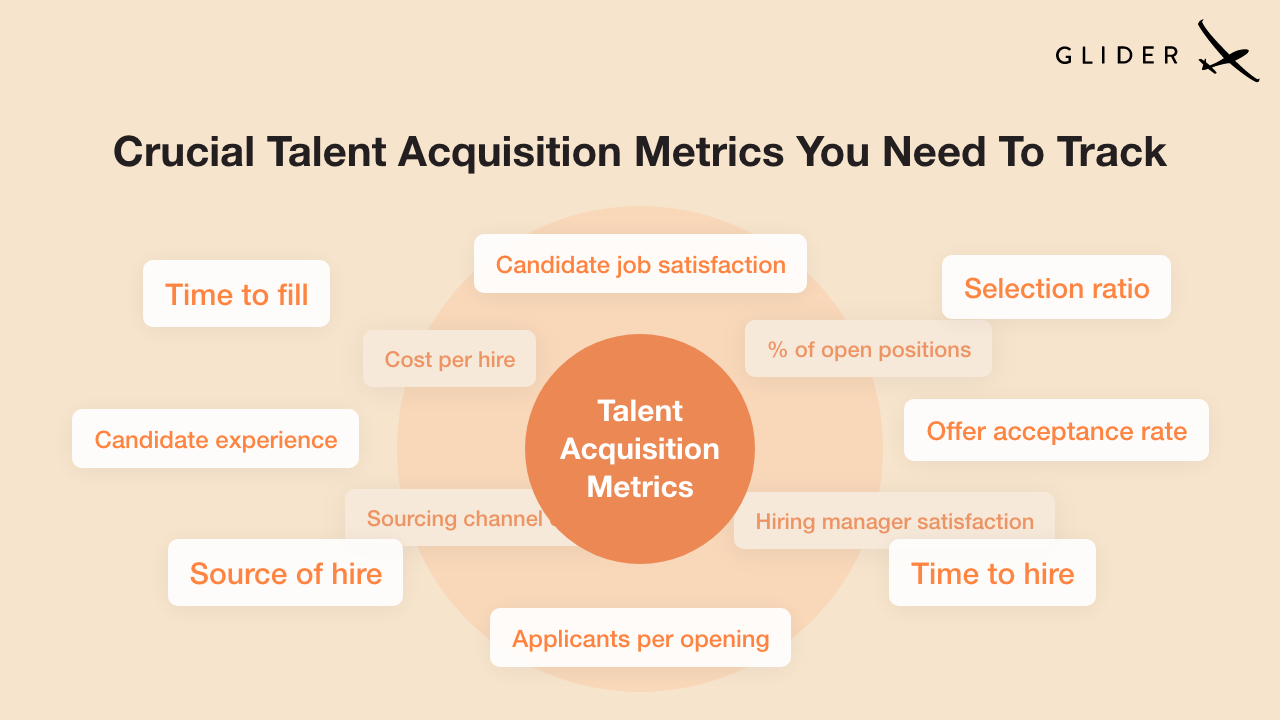
The right benchmark for each metric varies by company and role, but these are the metrics most teams find useful for measuring talent acquisition performance.
Tracking these metrics consistently gives a talent acquisition team a clear, evidence based view of what’s working and what needs to change.
Which talent acquisition metric should a new recruiting team track first?
Time to fill and cost per hire are usually the easiest to start with, since the data is already available in most applicant tracking systems, and they give an immediate baseline for the rest of the process.
How often should talent acquisition metrics be reviewed?
Most teams review core metrics like time to fill and offer acceptance rate monthly, while quality of hire and short term attrition are better reviewed quarterly since they need more time to produce a meaningful signal.
Can a company have a fast time to fill and still have a hiring problem?
Yes. A fast time to fill paired with a high short term attrition rate or low quality of hire usually means speed is coming at the expense of fit, which is why these metrics need to be read together rather than in isolation.
Glider’s recruitment platform is built on the principle of competency over credentials, helping talent acquisition teams evaluate candidates through a structured, data driven process rather than resume claims alone. With a large library of pre built skill assessments and real world simulations, you can improve quality of hire and reduce time to fill by identifying the right candidates earlier in the process. Learn more about our skill assessment platform.

Global hiring fraud hotspots are the countries and regions where documented candidate fraud and identity verification risk run highest, based on named industry indices rather than assumption. In 2026, that data points consistently in one direction: fraud vulnerability is concentrated in markets with weaker centralized identity infrastructure and fast growing digital hiring volume, led by […]

A synthetic candidate is a job applicant who does not exist as a single real person at all. The persona is assembled, usually by combining stolen or purchased personally identifiable information (PII) with an AI generated resume, an AI generated or composite photo, and an invented work history, into a package that looks, on paper […]

Hiring overqualified candidates is not automatically a mistake, but it is a decision that carries real, well documented risk if the role and the offer are not restructured around it. Recent survey data shows most employers already do this regularly: 70 percent of hiring managers say they typically consider candidates who are overqualified for the […]