
Make talent quality your leading analytic with skills-based hiring solution.
Quick answer: clinical nurse duties center on direct patient care. A clinical nurse assesses patients, carries out care plans, gives medications and treatments, watches for changes in condition, documents everything in the health record, and teaches patients and families how to manage care after they leave. Most roles require a registered nurse license, a degree in nursing, and current BLS certification.
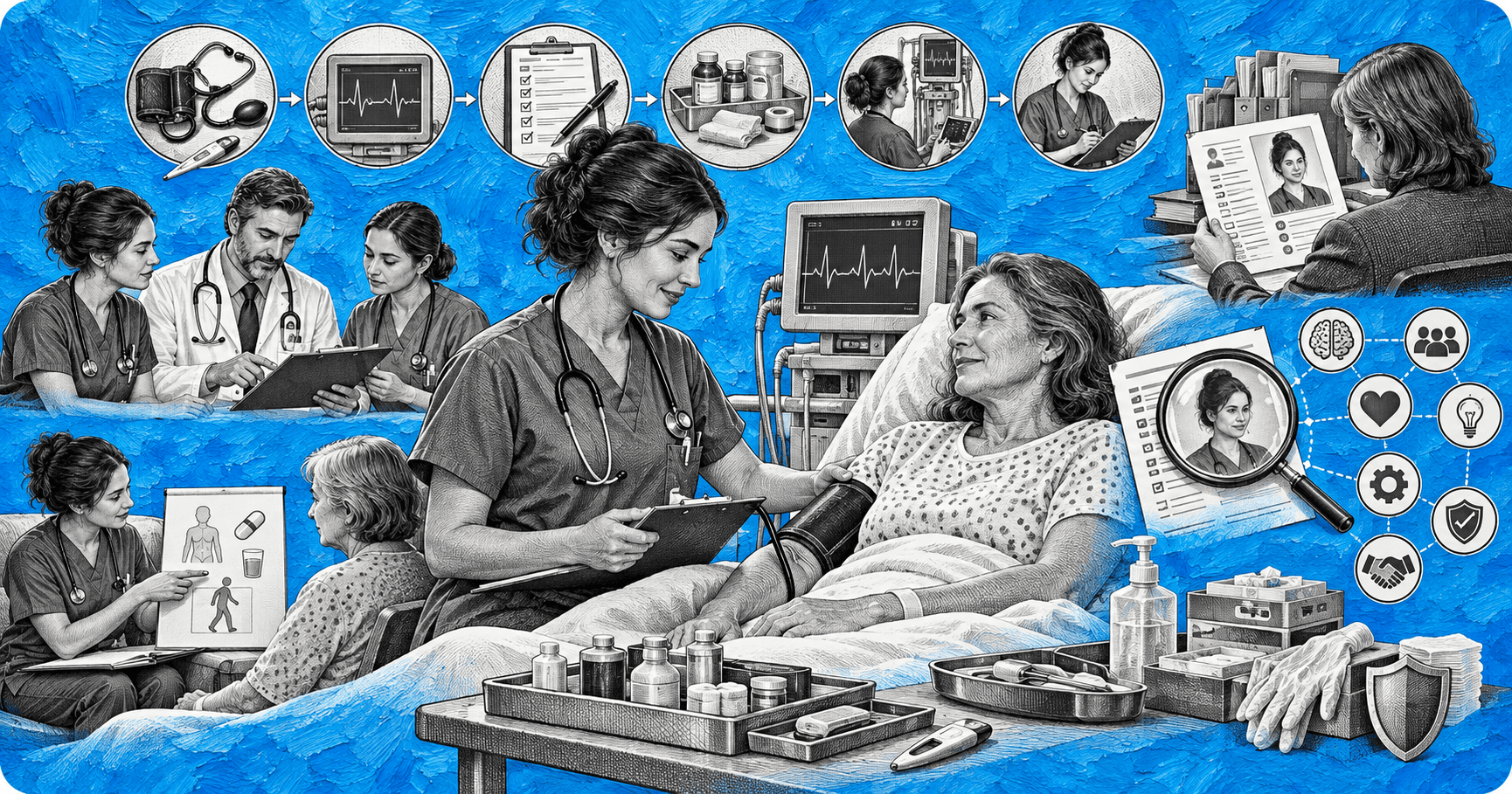
A clinical nurse is a registered nurse who works at the bedside or in a clinic, caring for patients directly rather than managing a department. You will find clinical nurses in hospital units, outpatient clinics, surgical centers, and long term care settings.
The role sits in the middle of the care team. Clinical nurses take direction from physicians and nurse managers, coordinate with pharmacists and therapists, and often guide licensed practical nurses and nursing assistants on the same shift. When a patient’s condition shifts at 3 a.m., the clinical nurse is usually the first person to notice.
If you are hiring for a broader RN opening, our registered nurse job description covers the general role. For high acuity settings, see the emergency room nurse job description.
Clinical nurse duties vary by unit, but the core work is consistent across hospitals and clinics.
Many clinical nurse duties are invisible on a resume. A candidate can list “medication administration” without showing how they catch a dosing error. That gap matters when you screen, which we cover below.
Most employers set the same baseline for a clinical nurse:
Nurse education does not stop at licensure. Most states require continuing education hours to renew a license, and clinical nurses often add specialty certifications in areas such as medical surgical nursing, critical care, or oncology. When you write the job description, separate required credentials from preferred ones. A long list of “nice to have” certifications narrows your pipeline without improving quality.
Licensed practical nurses (LPNs, called licensed vocational nurses in some states) complete a shorter program and work under the supervision of registered nurses. Practical nurses handle routine care such as vital signs and basic treatments. Clinical nurses carry a broader scope: full patient assessment, care planning, more complex medication administration, and responsibility for the overall care plan.
Credentials get a candidate through the door. These skills decide how they perform on a busy unit.
Copy this template and adjust the details for your facility.
Job title: Clinical Nurse (Registered Nurse)
About the role: We are hiring a clinical nurse to provide direct, high quality patient care on our [unit name] team. You will assess patients, carry out care plans, and work closely with physicians, practical nurses, and support staff to keep patients safe and informed.
Clinical nurse duties:
Requirements:
Preferred:
Schedule: [full time / part time], [shift pattern], [weekend and holiday rotation]
Healthcare hiring teams face a familiar problem. A posted nursing role pulls in a stack of applications, every resume lists the same duties, and nurse managers have little time to interview. Screening on credentials alone tells you who is licensed. It does not tell you who will catch a medication error on a twelve hour shift.
A better approach tests the work itself before the interview:
Glider supports each of these steps. Its skill assessment software includes question content for more than 200 non technical and functional roles, with open ended responses scored against a purpose built rubric and a human override available. One way video interviews let candidates record answers to scenario questions on their own schedule, which suits nurses working rotating shifts. AI proctoring and ID verification match photo ID, a live selfie, location, and an audio sample across stages, so a mismatch is flagged before the offer. Flags are recorded as facts for a recruiter to review, not automatic rejections.
For a wider view of hiring in the sector, see how Glider approaches healthcare recruiting, or browse more roles in the job description library.
The main clinical nurse duties are patient assessment, carrying out care plans, giving medications and treatments, monitoring for changes, documenting care, and educating patients and families. Clinical nurses also coordinate with physicians and guide practical nurses and nursing assistants.
You need either an associate degree in nursing or a Bachelor of Science in Nursing, then a passing NCLEX RN score and a state registered nurse license. Many hospitals prefer the BSN for clinical nurse roles.
A clinical nurse is a registered nurse whose job focuses on direct patient care in a clinical setting. Every clinical nurse is an RN, but not every RN works in a clinical role; some work in management, research, or nurse education.
Licensed practical nurses complete a shorter program and work under RN supervision on routine care. Clinical nurses hold an RN license and handle full assessments, care planning, and complex medication administration.
Clinical judgment, medication safety, clear communication, patient teaching, accurate documentation, prioritization, and teamwork. Clinical judgment matters most, because it drives every decision at the bedside.
Verify licensure and certifications, then use scenario based questions scored against a rubric. Recorded video answers let nurse managers review responses on their own time and compare candidates fairly.
Your nurse managers should spend interview time on candidates who have already shown clinical judgment, not on sorting resumes. See how Glider works for skill assessments and structured interviews that fit healthcare hiring.

Candidate trust in job postings has eroded to the point where treating a listing as a good faith, straightforward offer is now the exception rather than the default assumption. This is not one problem, it is several separate failures that have compounded on top of each other over a short period. Only 8 percent of […]

Skillfishing describes candidates, and sometimes existing employees, who overstate their capabilities, presenting a version of themselves on paper that looks strong but does not hold up once the actual work begins. The term is new, but the underlying research behind it is not a fringe finding. A full 91 percent of HR professionals now believe […]

This Communications Assistant job description template can be posted to online job boards and career pages to attract suitable candidates. The Communications Assistant job description, responsibilities, and requirements provided here can be customized based on your company’s needs. Key Responsibilities Job Statement We are looking for a Communications Assistant to support our communication efforts across […]
