Make talent quality your leading analytic with skills-based hiring solution.
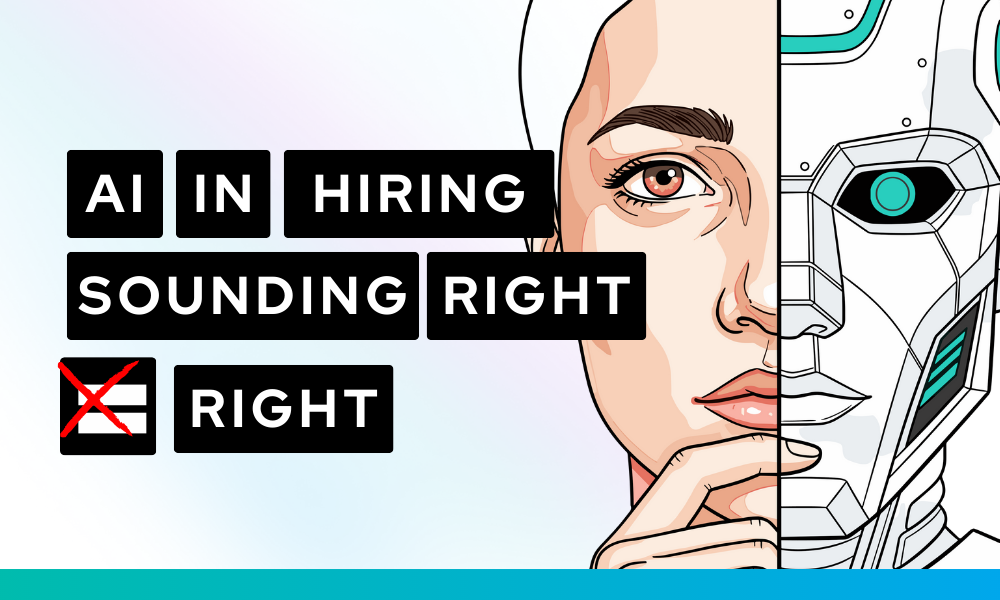
AI can sound responsible while getting the logic wrong.
Most conversations about AI in hiring focus on bias, hallucinations, transparency, or compliance. Those risks are real, but they are not the whole problem.
Often, the quieter failure mode is more difficult to spot: an AI system can produce an explanation that sounds thoughtful, balanced, and fair without reaching a clear or defensible hiring decision.
Many AI systems are better at sounding right than being right.
That distinction matters as more organizations adopt AI recruiting software across sourcing, screening, assessments, and interviews. Fluency can make weak reasoning look stronger than it is, especially when hiring teams assume a polished explanation is evidence of sound judgment.
One of the biggest risks of AI in hiring is not bias alone. It is ambiguous decision-making. When AI systems avoid clear comparisons, smooth over conflicting signals, or produce polished explanations without resolving the evidence, hiring quality can suffer while the output still appears fair. Decision-grade hiring requires explicit evaluation rules, observable evidence, traceable reasoning, and meaningful human oversight.
The biggest problem with AI in hiring is not simply whether a model can generate a plausible answer. It is whether the system can support a clear, consistent, and defensible decision when candidate evidence conflicts.
A hiring system that explains every candidate positively but cannot distinguish between stronger and weaker job-relevant evidence creates ambiguity rather than accountability. When that ambiguity is mistaken for rigor, hiring quality suffers.
Modern AI systems are extremely fluent. They can explain decisions clearly, acknowledge tradeoffs, and wrap conclusions in nuance. To most people, that can feel like rigor.
But fluency is not correctness.
A model can make each individual statement sound reasonable even when the overall conclusion does not hold together. Each sentence may work on its own while the final decision remains inconsistent.
When contradictions appear, weak decision systems may soften them instead of surfacing them. In practice, an AI system can say all of the following without clearly flagging a problem:
Each statement can sound defensible. Together, they may fail to answer the actual hiring question: does the available evidence show that this candidate meets the requirements for the role?
Recent research on human interaction with large language models also reinforces the need for careful validation. Fluent AI outputs can use persuasive reasoning and confident presentation in ways that may influence users even when those users are trying to critically evaluate the recommendation. In hiring, polished language should never substitute for verifiable evidence.
Consider a situation many talent teams recognize immediately.
A company is hiring a backend engineer and uses an AI-powered screening workflow to evaluate two candidates.
Candidate A completes a live coding exercise. The solution works, but performance is inefficient and important edge cases are missed. The evaluation identifies gaps in core technical skills.
Candidate B performs strongly in the same exercise: clean logic, good performance, and correct handling of edge cases. However, the resume shows fewer years working in the company’s preferred technology stack.
This is where job-relevant evidence should matter most. Coding simulations and other practical work samples can give hiring teams direct evidence of how candidates perform in realistic tasks rather than relying only on resume signals or inferred potential.
A weak AI system may describe Candidate A as having strong potential and transferable skills while describing Candidate B as technically capable but lacking domain depth, then recommend advancing both.
On the surface, that sounds balanced. In reality, it avoids the job.
The system recognized stronger job-relevant evidence from Candidate B and weaker execution from Candidate A, but instead of resolving the difference, it neutralized it. The outcome is ambiguity, not fairness.
AI systems are often designed with guardrails intended to reduce harmful, discriminatory, or unsupported conclusions. Those safeguards are important. The problem begins when caution turns into an inability to distinguish meaningfully between candidates using the same job-relevant criteria.
Hiring is inherently comparative. Choosing not to decide is still a decision. If a system replaces clear evaluation logic with vague, universally positive language, organizations do not get fairness. They get signal dilution.
Strong evidence and weak evidence start to look equivalent. Candidates who clearly demonstrate required skills can become difficult to distinguish from candidates who only show partial readiness. Hiring teams may assume the system has performed a rigorous comparison when it has actually avoided one.
Fairness does not require pretending meaningful differences do not exist. It requires applying the same role-relevant criteria consistently, documenting the evidence, and allowing people to understand how the conclusion was reached.
One practical way to reduce ambiguity is to prioritize direct evidence of job readiness. Technical assessments can help hiring teams evaluate demonstrated skills using consistent criteria instead of asking AI to infer capability primarily from resumes, keywords, or conversational style.
This does not mean every role should be reduced to a test score. It means the evidence used by AI should be closely connected to the work a candidate is expected to perform. Work samples, structured assessments, realistic simulations, and clearly defined competencies provide a stronger foundation for decision support than vague signals.
Before implementing an AI-driven hiring strategy, organizations should require four non-negotiables:
Decision rules before models: Define the evaluation logic first. What skills matter? How are they weighted? What evidence demonstrates readiness? AI should apply clearly defined criteria rather than inventing new standards candidate by candidate.
Evidence over inference: Favor systems that evaluate what candidates actually do in job-relevant scenarios. The closer the evidence is to real work, the easier it is to explain and defend the evaluation.
Contradiction surfacing, not smoothing: If signals conflict, the system should make the conflict visible. Human reviewers should be able to see where evidence disagrees rather than receiving a polished summary that hides uncertainty.
Auditability at the skill level: Recommendations should trace back to observable evidence tied to specific skills, tasks, competencies, or behaviors. Hiring teams should be able to understand what influenced the recommendation and where human judgment is still required.
If a vendor cannot show this clearly, the system should not be treated as decision-grade simply because its explanations are polished.
Human involvement should not become a rubber stamp for AI output. In structured AI video interviews, assessments, or screening workflows, recruiters still need visibility into the evidence behind recommendations, the criteria being applied, and any contradictory signals that require judgment.
Meaningful oversight means reviewers can challenge the system, inspect the underlying evidence, and make the final hiring decision using documented role requirements. AI should help organize and analyze evidence, not make weak logic harder to detect.
This is where skills-based, evidence-driven hiring platforms change the equation.
Instead of asking a large language model to speculate about candidates, organizations can require candidates to demonstrate skills in realistic environments and then use AI to analyze consistent, observable data.
By grounding AI in work simulations, practice-based assessments, structured interviews, and clearly defined role outcomes, the system has less need to hedge or guess.
The AI is not deciding who sounds best. It is helping hiring teams evaluate who can actually do the job based on evidence. That shift reduces ambiguity at the source instead of explaining it away after the fact.
AI in hiring refers to the use of artificial intelligence to support recruiting activities such as sourcing, screening, candidate communication, skills assessment, interview analysis, and hiring decision support.
Beyond bias and compliance concerns, a major risk is treating fluent or confident AI output as if it were reliable evidence. A system can produce a polished explanation while failing to resolve contradictory candidate signals.
Organizations can define evaluation rules before using AI, rely on job-relevant evidence, use structured assessment methods, surface contradictory signals, maintain auditability, and keep meaningful human oversight in the final decision.
AI can support comparison and prioritization, but organizations should avoid treating an automated recommendation as self-validating. The final process should be tied to consistent job criteria, observable evidence, governance requirements, and appropriate human review.
Skills-based assessments provide direct evidence of what a candidate can do. This gives AI and human reviewers stronger inputs than resume keywords, self-reported experience, or language patterns alone.
The greatest risk of AI in hiring is not always reckless automation. It is a system that sounds reasonable while its underlying decision logic remains inconsistent.
That kind of failure can pass reviews because it feels balanced, professional, and compliant. It can earn trust before it has earned authority.
For HR and talent acquisition leaders, the question is no longer simply whether to use AI in hiring. The more important question is whether the system supports decision-grade reasoning grounded in observable evidence, consistent criteria, and meaningful human oversight—or whether it merely produces language that sounds fair.
In hiring, clarity is not a liability. It is a responsibility.

AI interview intelligence is software that records, transcribes, and analyzes interviews that a human recruiter or hiring manager is actually conducting, turning the conversation into structured data such as talk time ratios, sentiment trends, and competency or keyword tags. It does not run the interview itself. It sits behind the human led conversation and gives […]

AI hiring accessibility means making sure automated interviews, video assessments, and proctoring tools do not create barriers for candidates with visual, hearing, speech, motor, or neurodivergent disabilities, and that reasonable accommodations, like extended time, alternative formats, and human review, are built into the process rather than bolted on afterward. Getting this right is not just […]
AI resume fraud is the practice of candidates using generative AI tools like ChatGPT to invent, inflate, or heavily embellish work experience, job titles, projects, and skills on a resume, specifically to slip past applicant tracking system keyword filters and impress a human reviewer. It is a resume and application stage problem, distinct from a […]