Make talent quality your leading analytic with skills-based hiring solution.
A recruiter screens a strong candidate on video, a hiring manager runs a solid technical round, and an offer goes out. On day one, the person who logs in is not the person who interviewed. Nobody on the team did anything careless. The process simply never confirmed who the candidate was.
That gap is why identity checks have moved from a nice extra to a basic requirement. This guide explains what changed, where candidate identity verification belongs in recruiting, and how to run it without slowing down the candidates you actually want to hire.
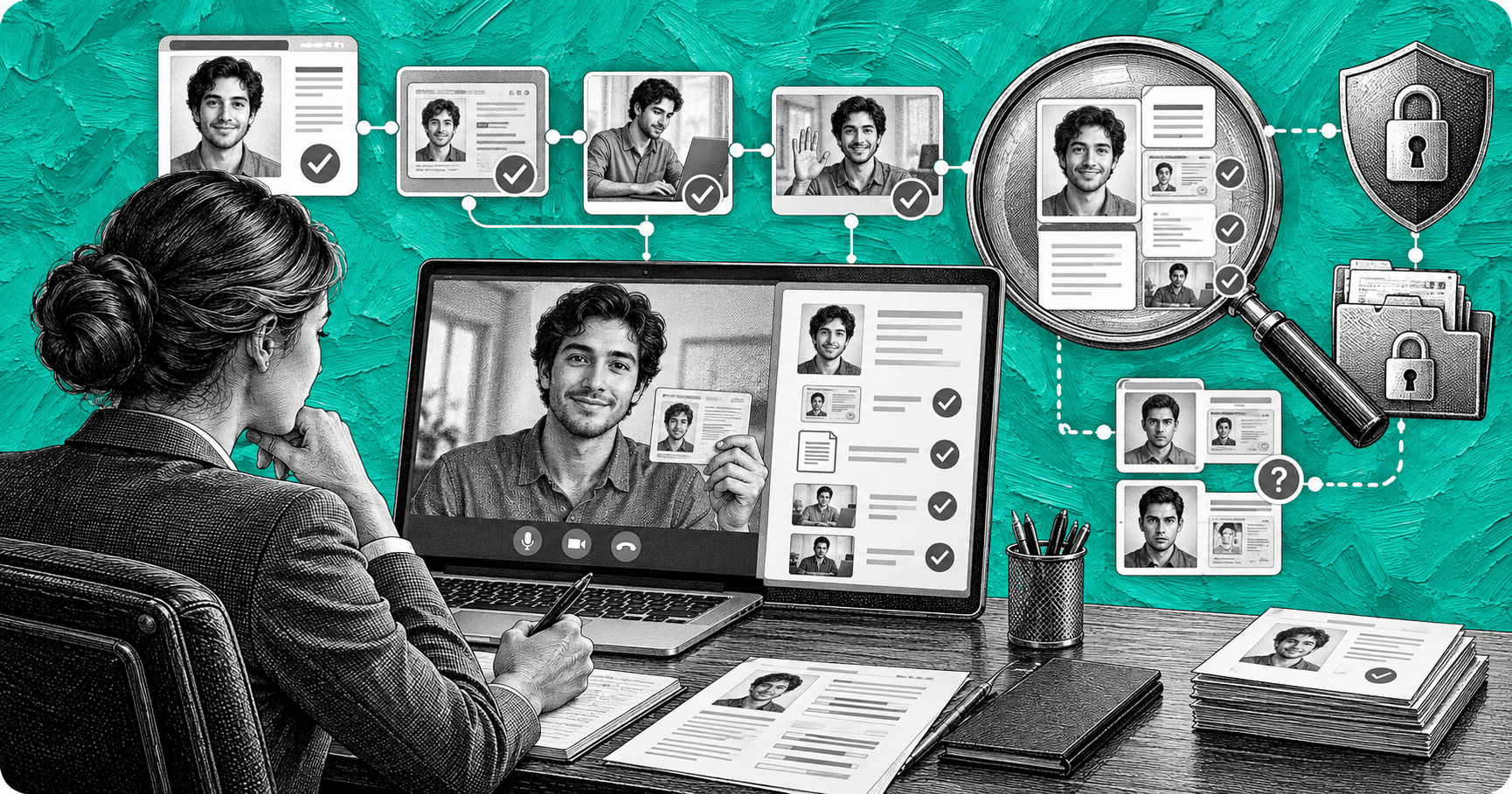
Quick answer: candidate identity verification recruiting teams use today confirms that the person applying, testing, interviewing, and starting the job is the same real person. It typically combines a government ID check, a live selfie with liveness detection, and matching at each later stage. It has become required because remote hiring removed in person checks, candidate fraud has grown more organized, and clients and regulators increasingly expect proof that identity was confirmed before an offer.
Candidate identity verification is the process of confirming that an applicant is a real person and is who they claim to be, then confirming it is still the same person at every later step. It is different from a background check. A background check looks at someone’s history. Identity verification answers a more basic question first: is this the right person at all?
In practice, a solid check usually covers:
Three pressures arrived at roughly the same time.
When interviews happened in an office, someone at reception saw the candidate, and a manager met them face to face. That informal check caught a lot of mismatches. Video interviews and online assessments removed it, and most hiring processes never replaced it with anything deliberate.
Identity fraud in hiring is no longer limited to a padded resume. Hiring teams now see proxy interviews, where a stand in takes the interview for the applicant; live coaching through hidden earpieces or second screens; AI generated resumes attached to synthetic identities; and candidates who pass every round and then send someone else to do the job. Remote technical roles are a frequent target. Gartner has predicted that by 2028, one in four candidate profiles worldwide will be fake.
Some of these bad actors want a paycheck. Others want access to systems and data, which is why the FBI has warned employers about North Korean IT workers using stolen or fabricated identities to get hired at U.S. companies. Glider covers that case in more detail in candidate fraud from North Korea.
Employment eligibility checks have existed for years, but the expectation now goes further. Enterprise clients, and federal contracts in particular, increasingly ask staffing vendors and suppliers to show that identity was confirmed for the people they place. For staffing firms and organizations that hire through several agencies, that means identity verification has to work consistently across the whole labor supply chain, not only inside one recruiting team. A documented, logged check is far easier to defend in an audit than a recruiter’s memory of a video call.
The most common mistake is checking once, too late. A single verification at onboarding catches fraud after the team has already spent interview hours and made an offer. A single check at application can be passed by the real person, who then hands the assessment or interview to someone else.
Identity verification works best as a thread through the hiring funnel:
Checking early also protects hiring manager time. If identity is confirmed before a candidate reaches a hiring manager’s calendar, nobody spends an hour interviewing someone who should never have been in the pipeline.
Use this as a working template for your own process.
Application and screening
Assessments
Interviews
Offer and onboarding
A flag is a piece of evidence, not a verdict. Lighting, an expired ID, a weak connection, or a name change after marriage can all trigger a mismatch for an honest candidate.
A fair review usually looks like this:
This keeps humans in charge of the outcome. The checks surface what happened, and the recruiter decides what it means.
Candidates who are who they say they are should barely notice the process. A few practices help:
Handled this way, verification also protects honest applicants. They are no longer competing against impostors and proxy test takers for the same role.
Glider ID Verify captures and matches four identity signals: photo ID, live selfie, location, and audio biometric. Matching runs across every hiring stage, from assessment through first and second round interviews to onboarding, so a mismatch raises a flag before the offer instead of after the new hire starts. Government IDs from more than 150 countries are supported, and every check is logged to give compliance teams a defensible audit trail.
Because ID Verify sits in the same platform as Glider skills assessments, interviews, and AI proctoring, recruiters see verified identity and validated skills together instead of stitching results from separate tools. For specific questions about setup and data handling, see the ID Verify FAQs, and for interview stage warning signs, read the proxy interview fraud detection guide.
It is the process of confirming that a job applicant is a real person who matches their stated identity, usually through a government ID check, a live selfie, and liveness detection, then confirming the same person appears at each later hiring stage.
No. A background check reviews a person’s history, such as employment or criminal records. Identity verification confirms you have the right person in the first place. Most teams need both, and identity should come first.
Before the first assessment or screening interview, then again at each interview round, before the offer, and on day one. One check at a single point leaves gaps that bad actors can use.
Liveness detection confirms that a live human is in front of the camera during a selfie or video check. It helps stop attempts that use a printed photo, a replayed recording, or a deepfake.
A well designed check takes a few minutes on a phone or laptop. It usually saves time overall, because hiring managers stop spending interviews on candidates who were never legitimate.
Yes, when it is done with clear notice, explicit consent, secure data handling, and respect for privacy laws such as GDPR and CCPA. Confirm the requirements for your locations with your legal team.
Increasingly, yes. Clients and contracts often expect staffing vendors to show that identity was confirmed for the people they place, so verification needs to be consistent across every agency and channel.
Identity verification works best as infrastructure, set up before the first interview and checked again at every stage, not as a response after an incident. If your hiring funnel still relies on recognizing faces over video, start by mapping where identity is confirmed today and where it is assumed.
To see how verified identity and validated skills work together, explore Glider AI or request a look at ID Verify.
Introduction Technical roles are some of the hardest to fill. The process is a landmine of recruitment challenges. HR teams often find themselves under-resourced and struggling to find suitable talent, while engineers waste too much time interviewing candidates who don’t meet the necessary qualifications. Meanwhile, high-quality candidates get frustrated by slow and inefficient hiring processes and […]

What is QA and Testing? Quality Assurance (QA) and testing are integral processes in software development aimed at ensuring the reliability, functionality, and usability of applications. QA involves establishing standards and procedures to monitor and improve the software development lifecycle, focusing on preventing defects and identifying areas for optimization. It encompasses various activities such as […]

Whether hiring for an entry-level web developer position or a web architect, asking the right JavaScript coding questions lets you assess the candidate’s depth of knowledge in core JavaScript concepts, problem-solving skills, and understanding of modern JavaScript practices. More than identifying which people in your pool of applicants can answer technical questions, these JavaScript interview questions also reveal who […]