Make talent quality your leading analytic with skills-based hiring solution.
Remote hiring has transformed recruitment by making it easier to evaluate candidates from anywhere. However, it has also increased the risk of impersonation, unauthorized assistance, and assessment fraud. To maintain hiring integrity, organizations need solutions that can verify candidate identity and detect suspicious behavior throughout the assessment process.
Auto proctoring combines AI proctoring, identity verification, fraud detection, and online proctoring technologies to help recruiters conduct secure online assessments without relying on continuous human supervision. This guide explains how auto proctoring works, why it matters, and how it supports fair and secure hiring.
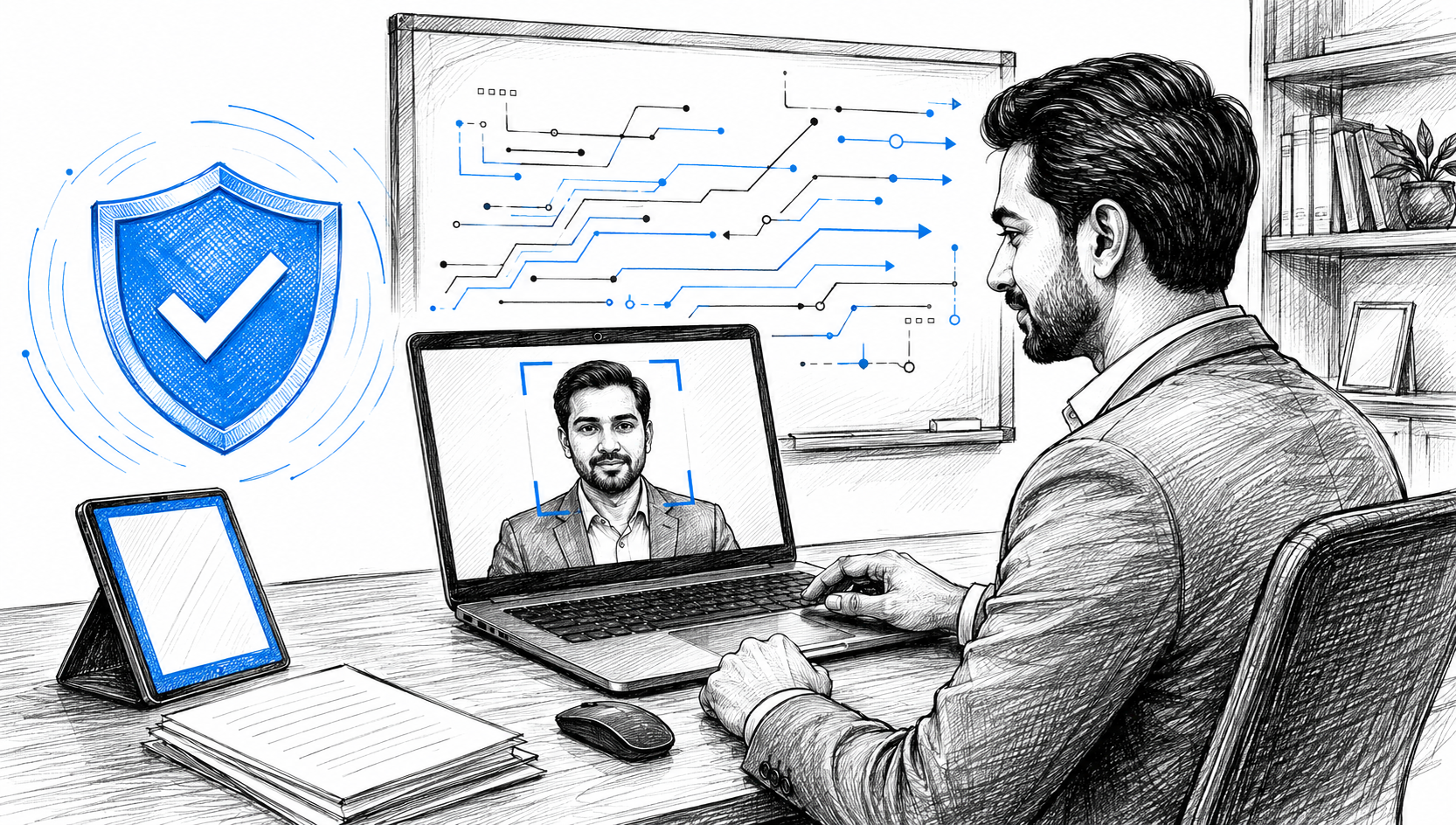
Auto proctoring is an AI-powered monitoring system that supervises candidates during online assessments. Unlike traditional live proctoring, it automatically verifies candidate identity, monitors assessment activity, and flags suspicious behavior for recruiter review.
Modern online proctoring platforms use artificial intelligence, computer vision, and behavioral analysis to improve assessment security while delivering a consistent experience for every candidate.
Common capabilities include:
These features help organizations reduce manual effort while protecting the integrity of hiring assessments.
A secure assessment begins with candidate verification. Before an assessment starts, candidates verify their identity using ID validation and facial recognition. This ensures the registered applicant is the individual completing the assessment.
During the assessment, AI proctoring continuously monitors candidate behavior. The system tracks browser activity, eye movement, screen switching, background noise, and multiple faces appearing on camera. If suspicious activity is detected, the platform records the event instead of immediately disqualifying the candidate.
After the assessment, recruiters receive a report containing risk scores, recorded incidents, screenshots, and activity logs. These insights help hiring teams make informed decisions while reducing manual review time.
Strong identity verification is essential for secure remote hiring. Without reliable verification, organizations risk evaluating the wrong individual, leading to poor hiring decisions and increased recruitment costs.
Modern verification methods include:
Together, these technologies strengthen online assessment security, reduce impersonation, and ensure assessment results accurately reflect each candidate’s skills.Organizations can also follow the NIST Digital Identity Guidelines to implement trusted digital identity verification practices and improve assessment security.
Organizations adopting automated proctoring gain several advantages throughout the hiring process.
Advanced fraud detection identifies suspicious behavior such as browser switching, screen sharing, unauthorized applications, and multiple people appearing during an assessment.
By combining candidate verification with AI monitoring, recruiters can make decisions based on genuine candidate performance rather than potentially compromised assessments.
Unlike live monitoring, online proctoring allows organizations to assess hundreds or thousands of candidates simultaneously while maintaining consistent security standards.
Candidates can complete assessments from any location while AI quietly monitors the session in the background, creating a fair and consistent assessment experience.
Organizations can strengthen assessment security by combining technology with structured hiring practices.
Following these practices helps organizations improve hiring quality while maintaining fairness throughout the recruitment process.
Glider AI AI recruitment software combines AI proctoring, identity verification, fraud detection, and skills assessments within a single hiring platform.
Recruiters can:
By integrating these capabilities into one platform, Glider AI helps organizations build a secure, scalable, and efficient hiring process.
As remote hiring continues to grow, organizations must protect the integrity of their hiring process. Auto proctoring enables recruiters to combine identity verification, AI proctoring, fraud detection, and online proctoring to create secure assessment environments.
With the right technology and hiring practices, organizations can reduce assessment fraud, identify genuine talent, and make more confident hiring decisions.
Auto proctoring is an AI-powered system that monitors candidates during online assessments. It uses technologies such as facial recognition, browser monitoring, and behavioral analysis to maintain assessment integrity without requiring a live proctor.
Auto proctoring verifies candidate identity, monitors assessment activity in real time, detects suspicious behavior, and generates reports for recruiters to review after the assessment.
Auto proctoring relies on artificial intelligence to monitor assessments automatically, while live proctoring requires a human supervisor. AI-powered monitoring is generally more scalable and cost-effective for high-volume hiring.
AI proctoring analyzes webcam feeds, browser activity, eye movements, background noise, and behavioral patterns to identify suspicious activities that may indicate cheating.
Identity verification confirms that the person taking the assessment is the registered candidate. This helps prevent impersonation and ensures fair hiring decisions.
Yes. Modern online proctoring platforms combine encrypted sessions, identity verification, browser monitoring, and fraud detection to create secure assessment environments.
Yes. AI proctoring helps recruiters identify genuine candidates, reduce assessment fraud, and improve confidence in hiring decisions while minimizing manual review.
Organizations can improve security by using AI proctoring, verifying candidate identity, enabling browser monitoring, conducting skills-based assessments, and reviewing AI-generated assessment reports.

Second device cheating is when a candidate uses a phone, tablet, or second monitor outside the webcam’s view during a proctored online assessment to look up answers, message someone for help, or mirror their screen to a helper. It is one of the hardest forms of assessment fraud to stop with software alone, because the […]

Contingent worker identity verification is the practice of confirming that a freelancer, contractor, or gig worker is who they claim to be before they are onboarded, not just screened on paper. Most companies apply this scrutiny to full time employees and skip or shortcut it for contingent talent, which is exactly the gap fraud actors […]

A structured interview scorecard is a standardized form that lists the specific competencies a role requires, gives every interviewer the same rating scale to judge candidate answers against, and forces a written justification for each score. It exists to replace gut feeling with evidence, so five interviewers evaluating the same candidate land on comparable, defensible […]