Make talent quality your leading analytic with skills-based hiring solution.
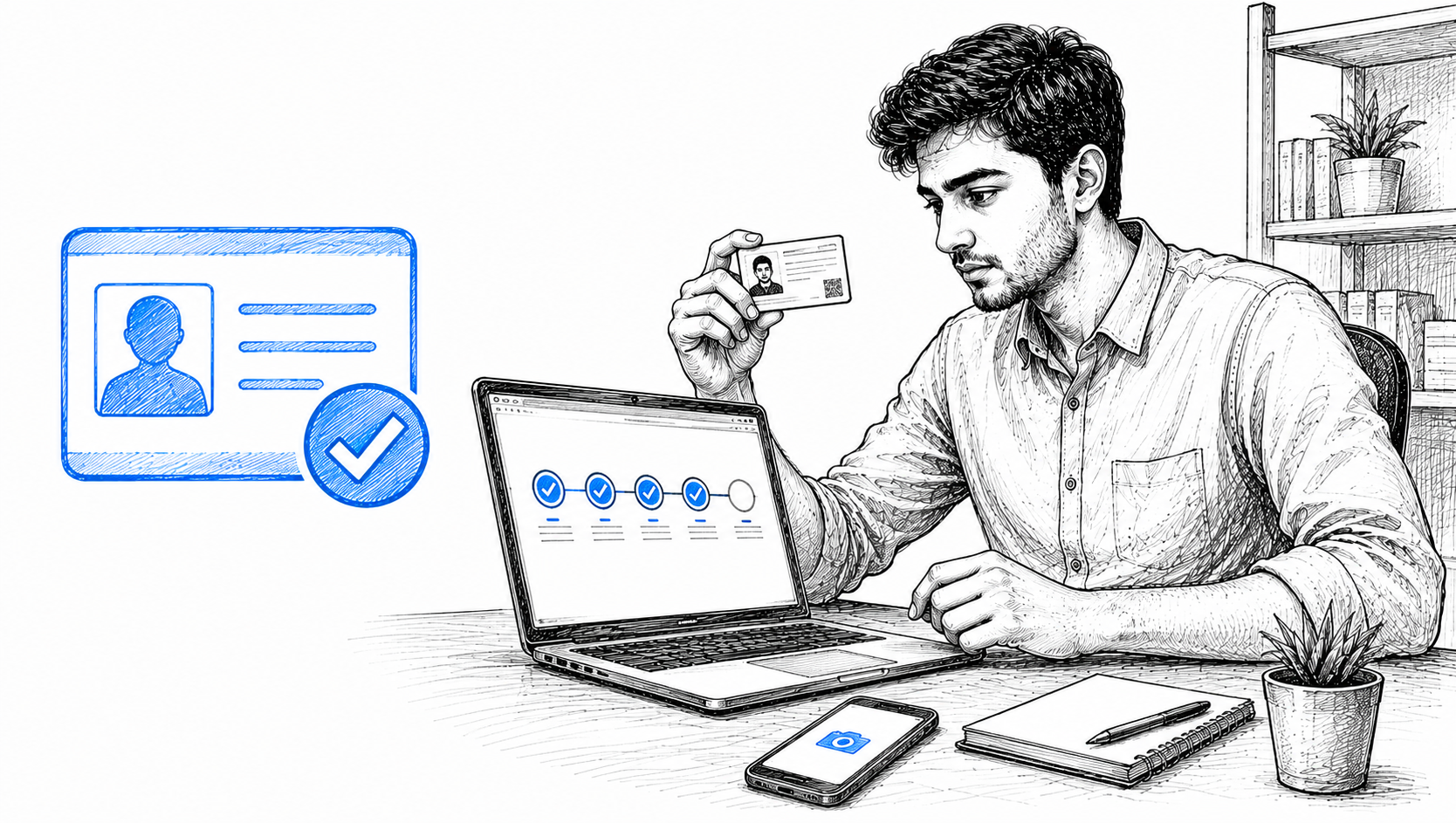
Identity verification in hiring is the process of confirming that a candidate is actually who they claim to be, distinct from a background check, which confirms facts about a person’s history rather than the person’s identity itself. It matters more than it used to because remote hiring removed the in person moment where a mismatch used to be obvious, a document handed across a table, a face seen without a screen in between. Here is what identity verification in hiring actually looks like in practice, broken into the steps most implementations follow.
The process starts when a candidate provides basic identifying information as part of their application, name, contact details, and the government issued identification they will later be asked to verify. This step sets the baseline that later steps will check against.
The candidate submits a photo or scan of a government issued ID, a passport, driver’s license, or national identity card. The verification system checks the document itself for signs of tampering or forgery, confirms the document format matches a known valid template for that issuing country, and extracts the identifying details for comparison against what the candidate provided at application.
The candidate is asked to take a live selfie or short video, which is compared against the photo on their submitted document to confirm the same person is present in both. Liveness detection specifically checks that this is a live person in the moment, not a photo of a photo or a prerecorded video, which is what closes the door on simple photo based impersonation attempts.
The system checks the extracted identity details against independent data sources where available, and looks for risk signals such as a location that does not match the claimed address, a document type unusual for the claimed nationality, or patterns previously associated with fraud attempts. This step is where most fabricated or synthetic identities get flagged, since a single convincing document is easier to fake than a document that is also internally and externally consistent.
Verification does not have to end once an offer is accepted. Many implementations repeat a lighter identity check at the point someone actually starts work, confirming the person who shows up on day one is the same person who was verified and interviewed, which specifically closes the door on bait and switch schemes where a different, unverified person shows up to actually perform the job. Glider’s own ID Verify solution builds this ongoing confirmation into the process rather than treating verification as a single, one time gate.
A background check looks backward, confirming employment history, education, and criminal record for a person whose identity is assumed to be accurate. Identity verification looks at the present moment, confirming the person going through the process is a real, consistent individual in the first place. Skipping identity verification and relying on a background check alone means an organization may be running an extremely thorough history check on someone who is not actually who they claim to be.
Identity verification answers who the candidate is. It does not answer whether they can do the job, that is what a structured skill assessment platform is for, and pairing the two closes both the identity gap and the competency gap that resume review alone tends to miss.
Identity verification in hiring is not a single click gate at the top of the funnel, it is a short sequence of checks, document, biometric, cross reference, and ongoing confirmation, each closing a different way a fraudulent identity could otherwise get through.
Identity verification in hiring is the process of confirming a candidate is actually who they claim to be, typically through document checks, biometric matching, and cross referencing, distinct from a background check which confirms facts about a person’s history.
The typical steps are information collection at application, document verification, biometric matching and liveness detection, cross referencing and risk scoring, and ongoing or day one confirmation once the candidate actually starts work.
Identity verification confirms the person is a real, consistent individual in the present moment, while a background check confirms facts about that person’s history, such as employment, education, or criminal record, assuming their identity is already accurate.
It is not universally legally required in most jurisdictions, but it is increasingly treated as a practical necessity for remote hires specifically, since remote hiring removes the in person moment that used to make identity mismatches easy to catch.
Common technologies include document authentication software, biometric facial matching, liveness detection to confirm a live person rather than a photo or recording, and risk scoring systems that cross reference identity details against independent data sources.

Second device cheating is when a candidate uses a phone, tablet, or second monitor outside the webcam’s view during a proctored online assessment to look up answers, message someone for help, or mirror their screen to a helper. It is one of the hardest forms of assessment fraud to stop with software alone, because the […]

Contingent worker identity verification is the practice of confirming that a freelancer, contractor, or gig worker is who they claim to be before they are onboarded, not just screened on paper. Most companies apply this scrutiny to full time employees and skip or shortcut it for contingent talent, which is exactly the gap fraud actors […]

A structured interview scorecard is a standardized form that lists the specific competencies a role requires, gives every interviewer the same rating scale to judge candidate answers against, and forces a written justification for each score. It exists to replace gut feeling with evidence, so five interviewers evaluating the same candidate land on comparable, defensible […]