Make talent quality your leading analytic with skills-based hiring solution.
Candidate fraud detection is the process of identifying job applicants who misrepresent their identity, credentials, skills, or interview performance in order to get hired. It covers everything from a resume that overstates a degree to a fully staged video interview run by someone other than the actual applicant. As remote and hybrid hiring has become the default, candidate fraud has moved from an occasional background check problem to a front line screening challenge that touches almost every stage of the hiring funnel, from application through final interview.
The stakes are higher than a single bad hire. A fraudulent candidate who makes it through screening can gain access to sensitive systems, customer data, and company credentials, sometimes as part of an organized scheme rather than an individual’s resume padding. Talent acquisition teams need a repeatable way to catch these signals early, and that is exactly what a modern candidate fraud detection process, backed by the right technology, is built to do.
At its core, candidate fraud detection means verifying that the person who applied, the person being interviewed, and the person who eventually shows up for the job are all the same individual, and that what they claimed about their skills and experience holds up under scrutiny. It combines process controls (structured interviews, reference checks, credential verification) with technology controls (identity verification, AI proctoring, video authentication, skills testing) to catch mismatches a recruiter alone would likely miss, especially in a fully remote hiring pipeline.
Several trends have combined to make this a board level concern rather than a niche HR issue:
Remote roles carry disproportionate exposure to these tactics; teams hiring for distributed positions should also review our dedicated breakdown of remote hiring fraud risks and prevention for channel specific guidance.
This is the most familiar form: fabricated degrees, exaggerated job titles, invented certifications, or employment dates that do not line up with reality. It is also the easiest to catch with basic verification, which is why it is often used as a smokescreen alongside more sophisticated tactics.
Large language models can now produce resumes tailored precisely to a job description, complete with fabricated but highly plausible achievements and metrics. These documents pass keyword based applicant tracking system filters easily, which means resume screening alone is no longer a reliable fraud filter.
Synthetic video and voice tools can overlay a different face or voice onto a live video call, or generate a fully synthetic interviewee. This is one of the fastest growing fraud vectors in remote hiring and is difficult to catch without dedicated detection technology, since the visual and behavioral cues look convincing to an untrained reviewer.
Here, a more skilled person takes over live coding tests, technical assessments, or even the final interview on behalf of the actual applicant, who then shows up to do the actual job. This is especially common in technical and IT roles where skills assessments carry a lot of weight in the hiring decision.
In the most serious cases, a fraudulent applicant uses someone else’s real identity, including stolen personal information, to apply and interview. This overlaps with broader employment fraud schemes and can carry legal and data privacy consequences well beyond a bad hiring decision. For a broader view of how these schemes operate across the hiring pipeline, see our guide to fake candidate profiles and how to spot them.
Manual review does not scale against fraud tactics that are themselves powered by AI. Modern candidate fraud detection increasingly relies on technology working alongside recruiters rather than replacing their judgment:
Glider AI brings these capabilities together in one platform built specifically for talent acquisition teams. Glider AI offers AI powered skills assessments that measure real ability rather than self reported claims, integrated video interviewing that captures and analyzes candidate behavior, and remote proctoring that monitors assessment sessions in real time for signs of impersonation, unauthorized collaboration, or proxy test taking. Combined with identity and skill verification built directly into the assessment and interview flow, Glider AI gives recruiting teams a single, auditable trail confirming that the candidate who applied is the same person who tested, interviewed, and was ultimately hired. For organizations building a broader fraud resistant hiring strategy, our hiring fraud prevention guide walks through how detection technology fits into a company wide prevention program.
Candidate fraud detection is the process of verifying that a job applicant’s identity, credentials, and demonstrated skills are genuine and consistent across every stage of hiring. It combines process controls like structured interviews and reference checks with technology such as identity verification, remote proctoring, and AI powered skills assessments to catch mismatches recruiters might otherwise miss.
Candidate fraud has grown sharply alongside remote hiring and generative AI adoption, with recruiters across industries reporting rising encounters with fake resumes, proxy interviewees, and AI generated application materials. The shift to remote and asynchronous hiring has removed many of the in person checks that once made fraud easier to spot.
Common signs include inconsistent audio or video quality, difficulty answering follow up questions about their own resume, reluctance to share video or switch camera angles, and a gap between strong assessment scores and weaker live conversational answers on the same topics. No single sign is definitive, but multiple signs together are a strong indicator.
Yes. AI based detection tools can analyze video and audio for the subtle artifacts deepfake generation leaves behind, such as unnatural lip sync, lighting inconsistencies, or unusual audio patterns, and can flag these in real time during live interviews or assessments rather than only after the fact.
Proxy interviewing is when someone other than the actual job applicant, typically a more skilled stand in, completes the interview or technical assessment on the applicant’s behalf. The real applicant then shows up to start the job, creating an immediate and often serious skills gap.
Companies typically verify identity by matching government issued ID to the person appearing live on video, using biometric or facial verification during assessments, and confirming consistency across the application, assessment, and interview stages. This is most effective when done before high stakes stages of the process, not only at final offer.
Warning signs include employment dates that do not add up, credentials that cannot be independently verified, generic or overly polished language typical of AI generated content, and job titles or achievements that seem disproportionate to the candidate’s actual interview performance.
It can be, particularly when it involves stolen identities, forged credentials, or organized schemes to gain access to sensitive company systems and data. Even when it falls short of a criminal act, candidate fraud is a serious violation of hiring policy that typically results in immediate disqualification or termination.

Global hiring fraud hotspots are the countries and regions where documented candidate fraud and identity verification risk run highest, based on named industry indices rather than assumption. In 2026, that data points consistently in one direction: fraud vulnerability is concentrated in markets with weaker centralized identity infrastructure and fast growing digital hiring volume, led by […]
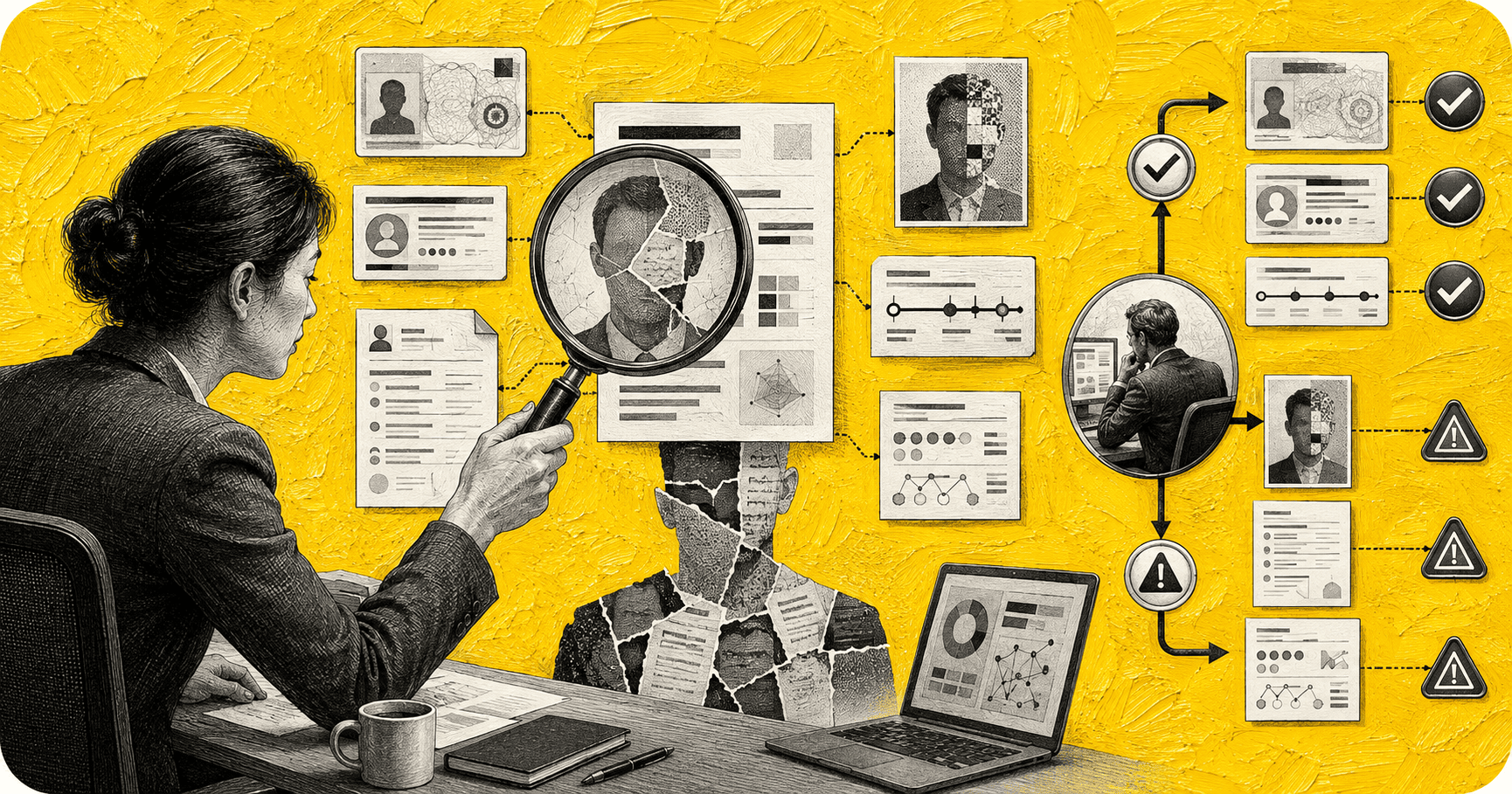
A synthetic candidate is a job applicant who does not exist as a single real person at all. The persona is assembled, usually by combining stolen or purchased personally identifiable information (PII) with an AI generated resume, an AI generated or composite photo, and an invented work history, into a package that looks, on paper […]

Hiring overqualified candidates is not automatically a mistake, but it is a decision that carries real, well documented risk if the role and the offer are not restructured around it. Recent survey data shows most employers already do this regularly: 70 percent of hiring managers say they typically consider candidates who are overqualified for the […]