Make talent quality your leading analytic with skills-based hiring solution.
ID Verify, in the broadest sense, refers to any process that confirms a job candidate is genuinely the person they claim to be, matching their face, government issued identification, and application details against each other at key points in the hiring journey. It has become one of the fastest growing categories in recruiting technology for a simple reason, remote hiring removed the in person moment where a mismatch used to be obvious, and identity based hiring fraud has grown enough that HireRight’s 2026 Global Benchmark Report lists identity fraud and candidate discrepancies among the top concerns HR, risk, and talent acquisition leaders report from the past year (HireRight 2026 Global Benchmark Report).
This guide covers what identity verification actually does in a hiring context, the methods behind it, how it differs from a standard background check, and what to weigh when your organization is evaluating an ID verify solution.
A resume and a friendly interview used to be enough of a filter when almost every process included at least one in person touchpoint. Fully remote hiring removed that, and the gap has been noticed and exploited. Gartner’s HR research practice has projected that by 2028, as many as one in four job candidate profiles worldwide could be fake, and 6% of candidates in a recent Gartner survey admitted to some form of interview fraud already (Gartner, July 2025).
At the more serious end, the FBI’s Internet Crime Complaint Center has specifically warned employers about deepfake video and stolen personal information being used to secure remote positions (FBI IC3 PSA, 2022). Identity verification is the most direct countermeasure to both patterns, because it addresses the question underneath every other check: is this actually the person we think it is.
Most modern ID verify systems combine a few core techniques, and it is worth understanding each before evaluating a vendor.
Glider’s own ID Verify product brings these techniques together specifically for hiring teams, and the companion ID Verify FAQs post walks through common implementation questions in detail for teams ready to evaluate it directly.
The two are complementary, not interchangeable. A background check typically looks backward, confirming employment history, education, and criminal record for the person named on the application. Identity verification confirms, in real time, that the person sitting in the interview or completing the assessment is that same named person in the first place.
A background check run against a stolen or borrowed identity will often come back clean, because it is genuinely checking a real person’s history, just not the history of the person actually applying. That is precisely why identity fraud has become a distinct, named concern in HireRight’s benchmark data rather than something background checks alone are expected to catch.
Pairing identity verification with AI proctoring during the assessment itself, and with a genuine skill assessment rather than a self reported skills list, gives hiring teams overlapping coverage instead of a single check that fraud actors only need to beat once.
Identity verification is no longer a niche compliance step reserved for high security roles, it is quickly becoming a baseline expectation for any hiring process that runs remotely at any real volume. The organizations getting the most value from it are not treating it as a one time gate at the top of the funnel, they are re confirming identity at the moments that matter, and pairing it with proctoring and skills data so the full picture of a candidate, not just their ID, holds together.
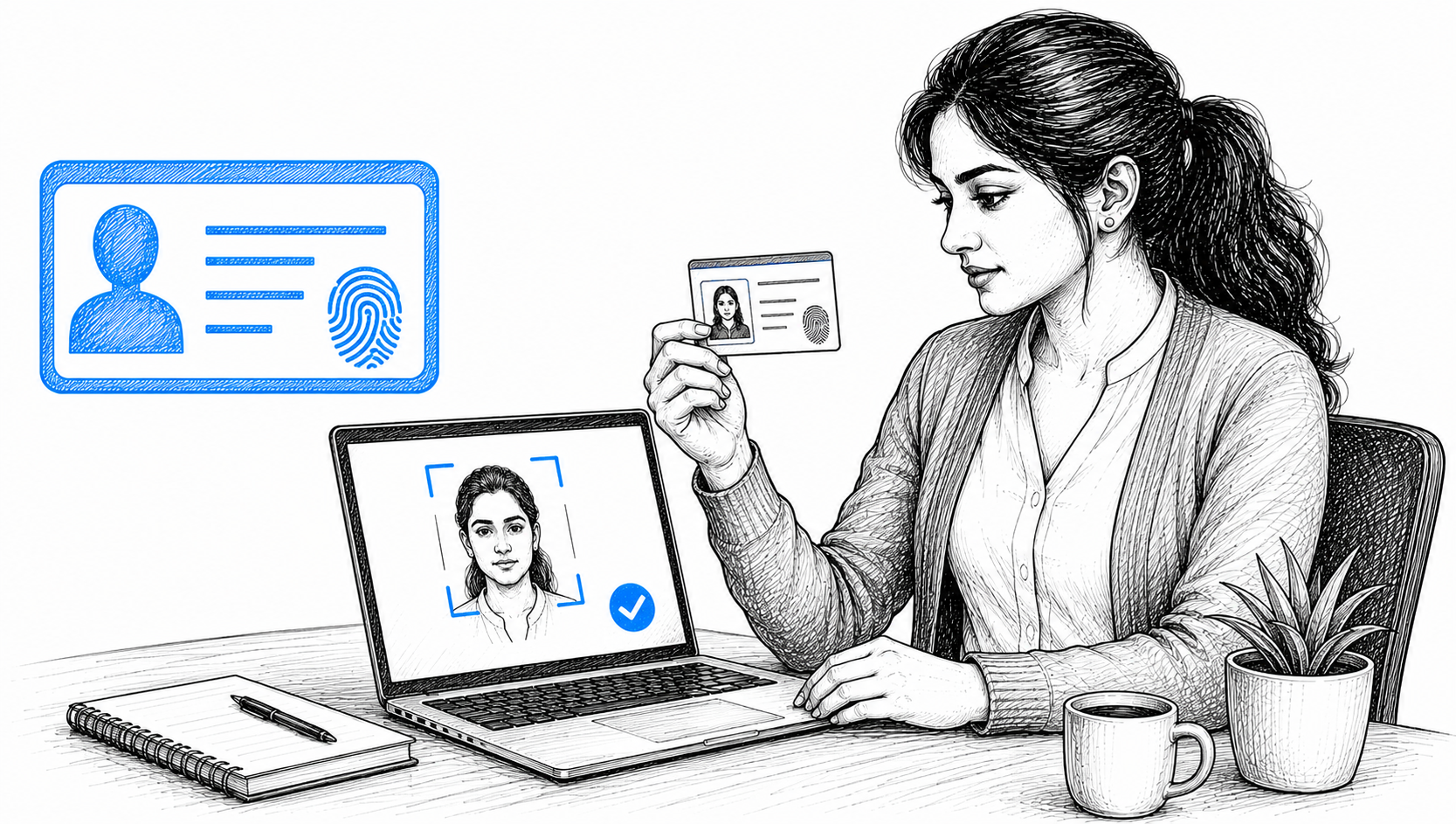
ID verification in hiring is the process of confirming that a job candidate is genuinely who they claim to be, typically by matching a live photo or video of the candidate against a government issued ID and their application details, often at multiple points during the hiring process.
It generally combines government ID document checks, biometric facial matching between the candidate and their ID photo, and liveness detection to confirm a real person is present rather than a photo, recording, or deepfake, sometimes repeated at more than one stage of the hiring funnel.
Requirements vary by industry, role, and jurisdiction, some regulated industries and government contracts mandate specific identity checks, but even where it is not legally required, more employers are adopting it voluntarily given the rise in remote hiring fraud.
A background check verifies a candidate’s history, employment, education, and criminal record, for the person named on the application, while ID verification confirms that the person actually applying and interviewing is that same named person, addressing a different, earlier question in the process.
Modern biometric verification combining facial matching with liveness detection is highly accurate for legitimate use cases, though accuracy depends on the specific technology and image quality, which is why leading solutions layer in additional checks like document verification and re verification at later stages rather than relying on one single scan.
Liveness detection, a core component of most modern ID verification tools, is specifically designed to catch the visual and behavioral signals that distinguish a live person from a deepfake or recorded video, which is why the FBI has pointed to identity verification as a meaningful countermeasure to the deepfake hiring fraud it has documented.
Government issued photo identification is most common, passports, driver’s licenses, and national ID cards, matched against a live selfie or video capture of the candidate during the verification step.

Second device cheating is when a candidate uses a phone, tablet, or second monitor outside the webcam’s view during a proctored online assessment to look up answers, message someone for help, or mirror their screen to a helper. It is one of the hardest forms of assessment fraud to stop with software alone, because the […]

Contingent worker identity verification is the practice of confirming that a freelancer, contractor, or gig worker is who they claim to be before they are onboarded, not just screened on paper. Most companies apply this scrutiny to full time employees and skip or shortcut it for contingent talent, which is exactly the gap fraud actors […]

A structured interview scorecard is a standardized form that lists the specific competencies a role requires, gives every interviewer the same rating scale to judge candidate answers against, and forces a written justification for each score. It exists to replace gut feeling with evidence, so five interviewers evaluating the same candidate land on comparable, defensible […]