Make talent quality your leading analytic with skills-based hiring solution.
Somewhere in the daily rhythm of most HR organizations, there is a quiet disconnect. Recruiters are sourcing, screening, scheduling, and following up. Dashboards are filling with metrics. And yet, quarter after quarter, hiring managers are still uncertain about the candidates they see. Time to fill stretches longer than it should. A promising hire leaves within a year. The cycle begins again.
The problem is not that HR teams are not working hard. It is that most hiring processes are built around activity rather than outcome. And in a business environment where every headcount decision carries real financial weight, the distinction matters enormously.
This is starting to change. A growing number of HR and talent acquisition leaders are rethinking the fundamentals of how hiring gets done, shifting from a model that measures effort to one that measures results. Understanding what that shift looks like, and why it is overdue, is worth the conversation.
Ask a recruiter what they did last week and you will hear a familiar list: job postings reviewed, resumes screened, phone screens completed, interviews coordinated. These are the building blocks of traditional recruiting, and they are measured relentlessly. ATS dashboards track application volume. Recruiters are evaluated on time to fill. Hiring velocity becomes a proxy for effectiveness.
The trouble is that none of these activities directly measure whether a hire worked out. A recruiter can screen 300 resumes, move 20 candidates through five rounds of interviews, and still produce a hire who underperforms and exits in eight months. The activity was there. The outcome was not.
This activity centric model also concentrates effort in exactly the wrong places. Recruiters spend most of their time on early funnel steps, sifting through applications that may not be a genuine match, only to hand off a shortlist that hiring managers still do not feel confident about. The process creates friction without creating clarity. And when the hire fails, the organization simply absorbs the cost and starts over.
Most hiring cost estimates are underestimates. They account for agency fees or recruiter time, but not for the full picture. Take a relatively common strategic hire, a Product Manager at a US enterprise company with 10,000 or more employees. The actual cost, when all components are tallied, ranges from $20,000 to well over $40,000 per hire.
Recruitment agency or external sourcing fees typically run between $15,000 and $35,000 on their own. Add recruiter time and tooling costs of $3,000 to $6,000, skills assessments and screening at $1,000 to $3,000, interview coordination expenses of $1,000 to $2,000, and background verification fees, and the number grows quickly. Most organizations have never added these up for a single hire, let alone across a class of roles.
Now consider what happens if that hire fails in the first year. Every dollar gets spent again. The search restarts, often urgently. The team carries the weight of a vacant or underperforming role for another 45 to 70 days. Knowledge transfer does not happen cleanly. The hiring manager loses confidence in the process. And none of this shows up in a cost per hire report.
Early attrition is not a rounding error. For organizations hiring at scale across product, engineering, and operations functions, it is one of the most significant and least tracked sources of waste in the business.
Given the stakes, why does so much uncertainty persist? The answer lies in how most hiring decisions actually get made.
Resumes remain the primary screening tool in most organizations. A recruiter reviews a document that the candidate assembled, interpreting experience based on job titles, employer names, and self described accomplishments. There is no verification of whether the skills listed reflect current capability, whether the work described was actually done by this person, or whether the individual who wrote the resume is even the same person who will show up to interview.
Proxy interviews are a growing concern that many teams are reluctant to acknowledge openly. With the rise of remote hiring, it has become easier for candidates to have a colleague or professional stand in during video interviews, particularly at the screening stage. By the time the issue is discovered, if it is discovered at all, the organization has already invested significant resources.
Interview fatigue compounds the problem. When hiring panels review six to ten candidates across multiple rounds, the quality of evaluation degrades. Interviewers fall back on pattern matching, gut feel, and culture proxies that are often more reflective of familiarity than actual fit. The candidate who presents well in conversation advances. The one with the deeper technical foundation but a quieter presence does not.
Perhaps most critically, most organizations have no structured data on why a hire succeeded or failed. Without that signal, it is nearly impossible to improve the process. Each search starts from scratch, making the same assumptions, using the same flawed filters.
The emerging response to these challenges is a reframe of what recruiting is supposed to produce. Rather than optimizing for process efficiency, outcome based hiring focuses on delivering a specific end result: a validated, assessed, interview ready candidate that a hiring team can make a confident decision about.
This model flips the accountability structure. Instead of measuring how many resumes were reviewed or how quickly a role moved through stages, the question becomes: what is the quality of the hire, and is there data to explain why?
Outcome based hiring also forces a different kind of rigor into early funnel stages. Candidate verification, skills assessment, and structured behavioral evaluation are not add ons. They are core filters that happen before a human recruiter or hiring manager invests meaningful time. The idea is straightforward: the business should be making decisions, not managing a process.
CHROs and talent acquisition leaders at larger organizations are beginning to evaluate hiring not just on speed and volume, but on quality of hire metrics that connect back to performance, retention, and team productivity. That shift in accountability is driving demand for a fundamentally different kind of hiring infrastructure.
Artificial intelligence has been part of recruiting conversations for years, but much of the early wave of AI tools addressed narrow slices of the problem: resume parsing, job board integration, chatbot scheduling. Useful, but insufficient.
The more meaningful application of AI in hiring operates across the full funnel, from candidate discovery to final evaluation. Modern AI driven platforms like AI Recruiter work from a single starting point, a job description, and automate every step that typically consumes recruiter bandwidth before the first qualified human conversation happens.
The workflow typically begins with intelligent candidate discovery. Rather than matching on keywords, deep JD to resume intelligence identifies relevant candidates across multiple talent pools based on actual role requirements. From there, automated engagement confirms candidate interest and surfaces intent signals through role specific screening questions. A resume tells you what someone has done. Engagement data tells you whether they actually want this role.
Identity and profile verification addresses the proxy interview problem directly. AI ID verification systems can now confirm that the same individual is present at every stage of the hiring journey, catching mismatches before they become onboarding surprises. Skills assessments then move evaluation from impression to evidence, with candidates completing role specific capability tests before any hiring team member reviews them.
AI video interviews represent perhaps the most consequential development in this stack. Structured interviews conducted by agentic AI evaluate technical depth, communication clarity, and behavioral fit, then generate a detailed evaluation report for each candidate. The hiring team receives pre evaluated candidates with full interview intelligence rather than an unstructured pile of recordings to review.
At every stage, full funnel hiring intelligence accumulates. Resume match scores, engagement signals, assessment results, and interview analysis are all structured and transparent. There is no black box. Hiring managers can see the data behind a recommendation, which changes the nature of the conversation in final stage interviews considerably.
The practical impact on hiring operations is substantial. Organizations that have shifted to this model are seeing 40 to 60 percent reductions in cost per hire, driven largely by reduced agency dependence and the elimination of manual screening labor. Time to hire is compressing by 30 to 50 percent. A process that previously took 45 to 70 days to produce a finalist slate is moving significantly faster, without sacrificing candidate quality.
Recruiter productivity changes considerably. Manual screening of 200 to 500 resumes per role, which was previously a baseline expectation for most senior searches, drops by roughly 80 percent when AI driven sourcing and filtering are handling early funnel work. Recruiters shift from managing process steps to reviewing outcomes and advising on decisions.
For hiring managers, the experience shifts from being asked to evaluate candidates with incomplete information to receiving a structured dossier on each person. Assessment results, video interview analysis, identity verification status, and engagement indicators arrive together. The decision point moves from uncertain to evidence based.
Quality of hire, which was previously a qualitative judgment made in retrospect, becomes something that can be anticipated and measured prospectively. That is the operational definition of outcome based hiring in practice.
The most expensive hiring outcome is not a difficult search. It is a hire who leaves in twelve months. Yet most talent ROI conversations end at time to fill and cost per hire, two metrics that tell you nothing about what happened to the business after onboarding began.
When candidates are evaluated on real capability and genuine role alignment rather than resume presentation, the fit is more durable. Employees who are placed into roles they are actually qualified for, and that match their behavioral and motivational profile, stay longer. They ramp faster. They contribute more meaningfully to team performance. The connection between hiring quality and retention is direct, even if most organizations have not built the reporting to prove it.
There is also a workforce development dimension to this conversation that is underutilized. Platforms like AI Recruiter extend the same capability assessment logic to existing employees, mapping current skills against evolving role requirements and surfacing development and mobility opportunities before the employee starts looking externally. When internal advancement is visible and accessible, attrition decreases. When it is invisible, people leave to find the growth elsewhere.
The long term ROI math changes substantially when you account for reduced regrettable attrition, lower rehiring cost, a stronger internal talent pipeline, and workforce development that does not require incremental headcount budget. These are not soft benefits. They are measurable reductions in recurring cost that compound over time.
Outcome based hiring is a recruiting model that measures success by the quality and durability of the hire, such as performance and retention, rather than by process activity like resumes screened or time to fill.
For a strategic role like a Product Manager at a large enterprise, the full cost including sourcing, screening, coordination, and verification typically runs from $20,000 to over $40,000, and that entire cost is repeated if the hire fails within the first year.
AI platforms automate candidate discovery, engagement, identity verification, skills assessment, and structured video interviews, giving hiring teams evidence based, pre evaluated candidates instead of an unstructured pile of resumes.
Organizations commonly report 40 to 60 percent reductions in cost per hire, 30 to 50 percent faster time to hire, and roughly an 80 percent drop in manual resume screening work.
No. The same skills based evaluation logic can be applied internally to map current employee capabilities against evolving role requirements, supporting mobility and reducing avoidable attrition.
The shift from activity based recruiting to outcome based hiring is not primarily a technology story. It is a strategic reorientation of what HR organizations are accountable for delivering to the business.
Businesses are increasingly holding HR and talent functions to the same standard as any other operational investment: what is the return? How do we know it worked? What would we do differently next time? Those questions are difficult to answer when hiring is measured by activity volume. They become tractable when hiring generates structured, stage by stage data on candidate quality and decision rationale.
Talent acquisition leaders who make this transition will find themselves in a different kind of conversation with their business partners. Not a status update on open roles, but a discussion about hiring quality, workforce capability, and the organizational factors that determine whether talent investments pay off.
That is a conversation worth having, and Glider AI’s skill assessment platform is part of the infrastructure that supports it.

Global hiring fraud hotspots are the countries and regions where documented candidate fraud and identity verification risk run highest, based on named industry indices rather than assumption. In 2026, that data points consistently in one direction: fraud vulnerability is concentrated in markets with weaker centralized identity infrastructure and fast growing digital hiring volume, led by […]
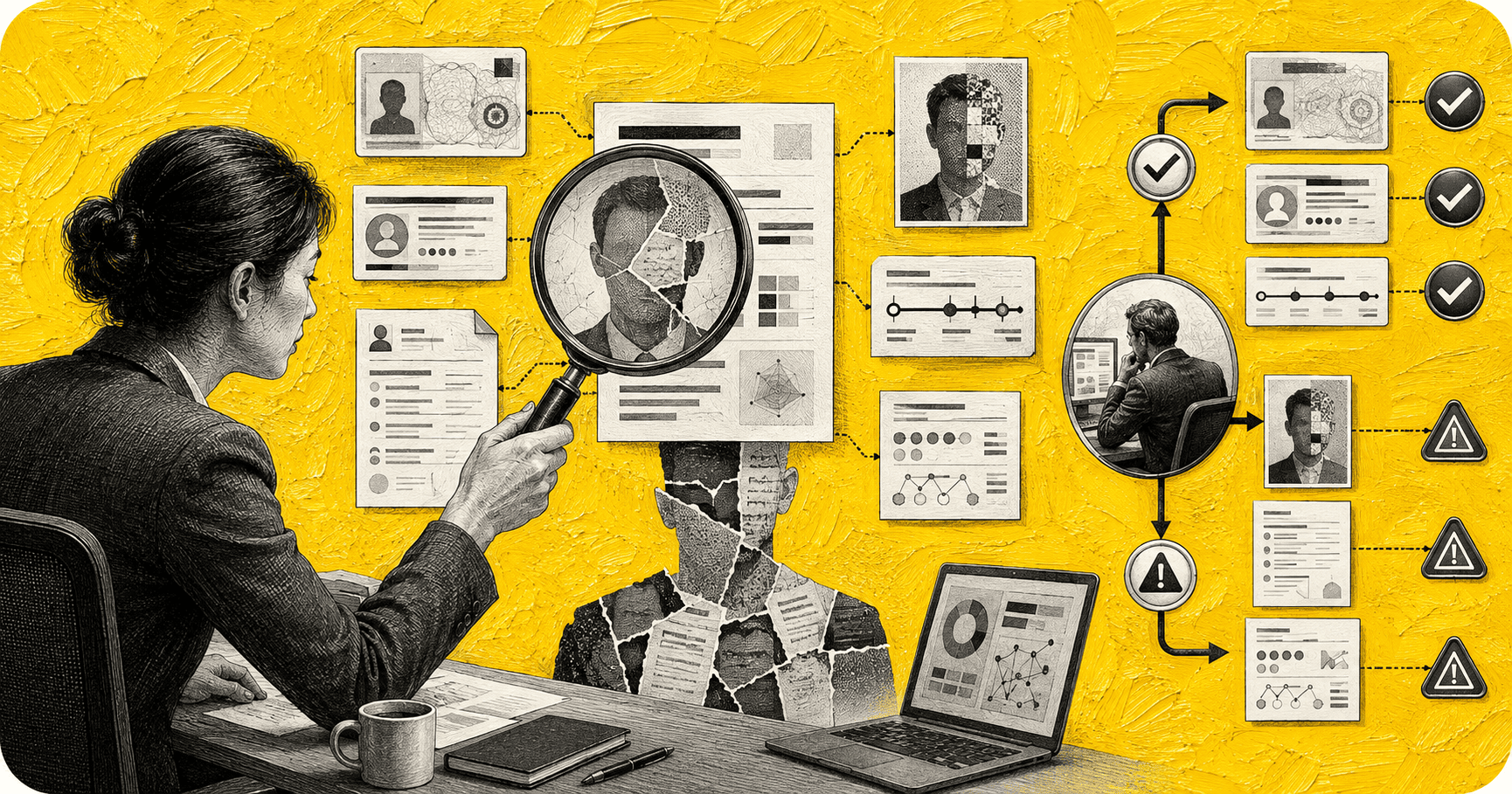
A synthetic candidate is a job applicant who does not exist as a single real person at all. The persona is assembled, usually by combining stolen or purchased personally identifiable information (PII) with an AI generated resume, an AI generated or composite photo, and an invented work history, into a package that looks, on paper […]

Hiring overqualified candidates is not automatically a mistake, but it is a decision that carries real, well documented risk if the role and the offer are not restructured around it. Recent survey data shows most employers already do this regularly: 70 percent of hiring managers say they typically consider candidates who are overqualified for the […]