

Make talent quality your leading analytic with skills-based hiring solution.
Every open role now pulls in more applicants than a recruiting team can screen by hand. The hiring manager ends up paying the cost: hours of first round interviews with people who can’t do the job, or who aren’t who they say they are.
The AI Recruiter from Glider AI and Findem is built to remove that interview tax. Findem finds and matches candidates. Glider then engages, verifies, assesses, and interviews them, so only people vetted on skill, integrity, and identity reach a hiring manager’s calendar. Plenty of people search for this as “airecruiter,” one word. Either spelling, the question is the same: what does an AI recruiter actually do, and where should humans stay in charge?
Quick answer: an AI recruiter is a set of AI agents that handles the repetitive middle of hiring: first contact, screening, skills assessment, identity checks, scheduling, and first round interviews. Glider’s version evaluates candidates on what they do, using hardcoded questions and your rubric, and leaves every hiring decision with your team.
An AI recruiter, sometimes written as airecruiter, is software that does the work a recruiter would do between “this person looks like a match” and “this person is ready to meet the hiring manager.” That stretch is where most recruiting hours go: calls to check interest, screening questions, test links, chasing calendars, and first round interviews.
Glider’s AI Recruiter is not a sourcing tool. Sourcing and matching happen in Findem. Glider picks up after candidates are identified and runs the post sourcing workflow, with your team setting the bar and making the calls.
Most tools labeled AI recruiting automate one step. A chatbot answers questions. A resume parser ranks keywords. A video tool records answers. Each step gets faster, but the hiring manager still meets candidates nobody has properly vetted.
Three gaps show up again and again:
The AI Recruiter follows Glider’s modules in order: Engage, Verify, Assess, Interview, and Learn after the hire.
The AI voice recruiter calls candidates right after Findem matchmaking. Candidates who prefer text get the same conversation through a chatbot over SMS, WhatsApp, email, or web. It captures interest, intent, availability, salary expectations, and relocation willingness, plus light competency screening, without a human on the call.
ID Verify captures and matches four identity signals: photo ID, live selfie, location, and audio biometric. The match runs again at each stage, from assessment to first round interview to second round interview to onboarding. A mismatch raises a flag before the offer, not after onboarding. Every check is logged, which gives you an audit trail for compliance review. For more on the fraud side, see our guide to detecting fake resumes.
Candidates show their skills in hands on tasks rather than describing them. Glider’s skill assessment software offers 35+ interactive question types and 100+ simulations, drawn from a bank of 200,000 questions across 250+ technologies and 200+ non tech roles. Formats include live coding in a WebIDE, Jupyter Notebooks, MySQL, diagramming, and open ended video or text answers scored against a rubric, with human override.
AI proctoring is transparent and configurable. Candidates consent to each step, and every flag is factual data for a recruiter to review, not an automatic rejection.
Glider’s AI interview software runs in three modes:
The autonomous mode is defensible because it isn’t improvised. Questions are hardcoded, delivered conversationally, and scored against specific rubrics.
After the hire, the same skills data supports development: AI role play, skill gap analysis, skill benchmarking, mastery tracking, and certification.
Inside the Findem platform, Glider powers four named agents:
Findem agents handle the work upstream. The Calibration Agent aligns hiring managers using live labor market data and real candidate examples. The Application Boost Agent finds matching candidates and runs personalized outreach and follow ups.
Infosys has run more than 30,000 AI interviews with Glider. About two thirds of candidates were rejected by the AI based on task performance, and the AI outcome matched the hiring manager’s decision 80 percent of the time.
That last number matters most. Autonomy is only useful when the hiring manager would have made the same call.
For recruiters, the AI Recruiter takes the first call, the test link, and the calendar chase off the plate. Recruiters spend their time on candidates who have already shown the skills, on hiring manager alignment, and on closing offers.
For hiring managers, the calendar fills with fewer, better first round interviews. Every candidate arrives with verified identity and task results attached.
For candidates, the process moves faster and judges them on what they can do, in line with Glider’s view that competency should count for more than credentials. Not every candidate will finish an assessment. Completion rates of 65 to 80 percent are normal, and experienced candidates in the 5 to 10 year range push back more. That is prioritization by design: your team spends time on the candidates who engage.
The AI Recruiter fits high volume hiring and evergreen roles best, especially tech, sales, and customer support roles with 1 to 12 years of experience. It is not built for executive hiring.
Use this list with your hiring managers before launch:
Security and legal teams will ask early. Glider holds SOC 2 Type II and ISO 27001 certification, encrypts data at rest, and supports GDPR, CCPA, ADA, and EEOC requirements. Candidates can request data deletion. Rubrics, workflow rules, branding, and thresholds are configurable, and the platform connects to ATS and VMS systems through integrations and an open REST API, with 24×7 support and a dedicated customer success team.
An AI recruiter is a set of AI agents that engages, screens, assesses, verifies, schedules, and interviews candidates before a human interviewer gets involved. Glider’s AI Recruiter works with Findem, which handles sourcing and matching.
“Airecruiter” is a common one word search for “AI recruiter.” It refers to the same thing: software that automates the screening and interviewing stages of hiring.
No. It removes repetitive work such as first calls, test links, and scheduling. Recruiters and hiring managers still set the criteria and make every hiring decision.
In Infosys’s use of Glider, across 30,000+ AI interviews, the AI outcome agreed with the hiring manager’s decision 80 percent of the time.
Glider matches photo ID, live selfie, location, and audio biometric at every stage from assessment to onboarding, and proctoring logs activity such as tab switching and pasted code. Flags go to a recruiter for review rather than rejecting candidates automatically.
Glider reduces bias by using hardcoded questions instead of improvised ones and scoring answers against specific rubrics. Candidates are judged on task performance, not just on how well they talk.
High volume, high velocity, and evergreen roles in tech, sales, and customer support, typically with 1 to 12 years of experience. It is not suited to executive hiring.
If your hiring managers are spending their week on first round interviews that go nowhere, start with one role and one rubric. Explore the AI Recruiter product page or visit Glider AI to book a demo.
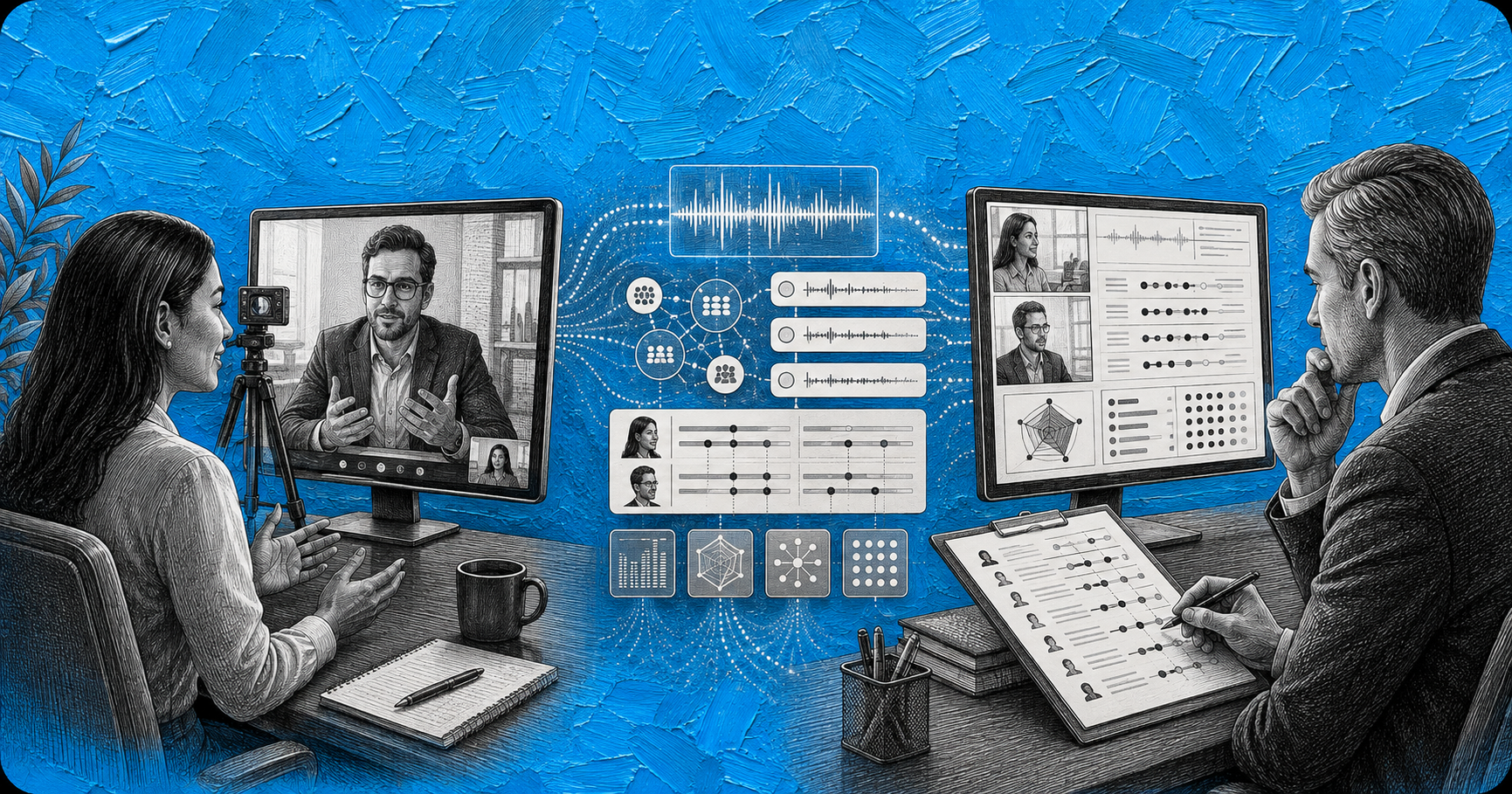
AI interview intelligence is software that records, transcribes, and analyzes interviews that a human recruiter or hiring manager is actually conducting, turning the conversation into structured data such as talk time ratios, sentiment trends, and competency or keyword tags. It does not run the interview itself. It sits behind the human led conversation and gives […]

AI hiring accessibility means making sure automated interviews, video assessments, and proctoring tools do not create barriers for candidates with visual, hearing, speech, motor, or neurodivergent disabilities, and that reasonable accommodations, like extended time, alternative formats, and human review, are built into the process rather than bolted on afterward. Getting this right is not just […]

AI resume fraud is the practice of candidates using generative AI tools like ChatGPT to invent, inflate, or heavily embellish work experience, job titles, projects, and skills on a resume, specifically to slip past applicant tracking system keyword filters and impress a human reviewer. It is a resume and application stage problem, distinct from a […]
