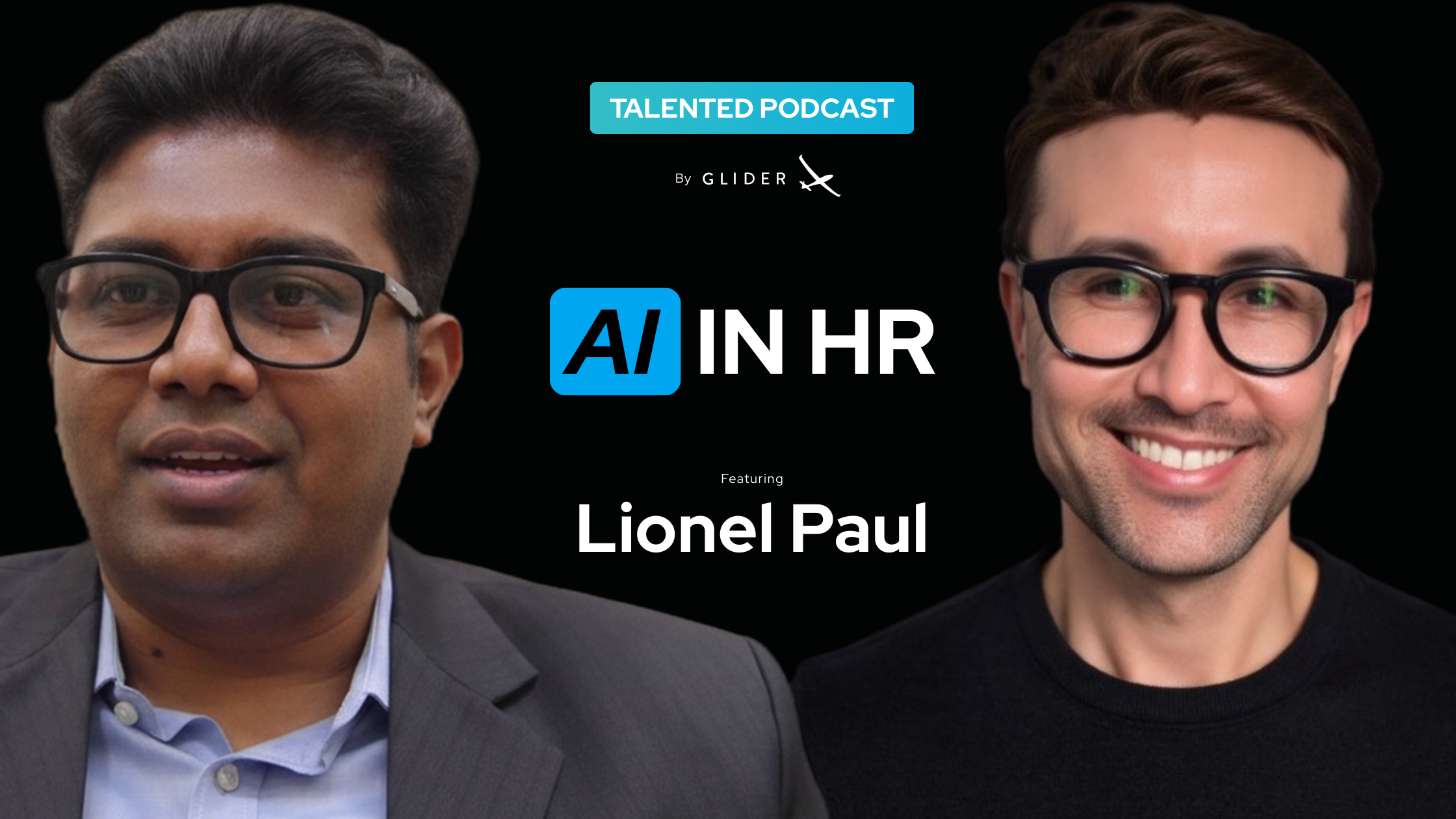
Make talent quality your leading analytic with skills-based hiring solution.
Featuring Lionel Paul David, Global CHRO, WaterTech India
As the Global Chief Human Resources Officer at WaterTech India, Lionel Paul David has spent the past two years driving transformation across HR, communications, and ESG for one of India’s fastest-growing manufacturing brands. Previously acquired by Walbur Pinkers, WaterTech is expanding from polymer bathware into pipes, fittings, and sanitaryware, and Lionel is helping its workforce evolve just as quickly.
Raised by two working parents who taught him both discipline and freedom, Lionel says his career choice was inevitable:
“I always wanted a career that improves the life of people around me.”
In a recent conversation with host Joseph Cole, Lionel explored how AI is reshaping recruitment, talent management, and the very identity of HR leaders, and why the next era of work will still need a deeply human core.
AI’s acceleration isn’t new, but its impact on people processes is unprecedented. For Lionel, 2022 marked the “breakout year” when large language models flipped the table on how humans interact with machines.
“With GPTs and agents, the interaction now feels like talking to a person, not a device. Businesses naturally want to see how this can go mainstream, and the first place they’re testing it is talent acquisition.”
From automated scheduling to intelligent sourcing, Indian companies began experimenting early, some as far back as 2017. Post-COVID, that experimentation exploded. Hiring went virtual, deepfake candidates appeared, and the need for faster, smarter screening became urgent.
Lionel breaks down AI’s current role in recruitment into four universal use cases, regardless of company size or industry.
These efficiencies echo Gartner’s 2025 prediction that by 2026, 30% of organizations will have automated over half of their network operations.
Despite the progress, Lionel is adamant that automation cannot replace discernment.
“AI can’t interpret an unconventional career path, understand caregiving breaks, or read a candidate’s hesitation. Those need human judgment.”
He outlines four areas where people must stay in the loop: assessing cultural fit, interpreting complex context, building relationships and negotiations, and evaluating deeper behavioral traits like coachability or self-awareness.
AI should augment, not automate, these moments.
Beyond hiring, Lionel sees AI advancing rapidly in learning and skill validation.
“With the half-life of skills shrinking, companies need to skill at scale. Traditional methods won’t work. AI platforms can personalize learning and continuously validate progress.”
India’s tech-enabled workforce makes it a proving ground for these solutions.
One of Lionel’s strongest convictions is organizational ownership.
“AI should never sit only with the CIO. It’s not a technology agenda; it’s a leadership agenda.”
HR leaders, he says, must co-own AI transformation by managing change and building new digital capabilities. The CHRO’s role is to ensure adoption is ethical, inclusive, and effective, not just efficient.
The biggest danger isn’t AI itself; it’s misuse. Lionel warns against automation bias, where recruiters accept machine judgments without question.
“End of the day, AI is made by humans. If we stop questioning it, we risk reputational damage and lose trust with top talent.”
Candidates also face new pressures, from impersonal processes to gaming algorithms with keyword-stuffed résumés. Transparency and empathy, Lionel argues, are the antidotes. Clear communication and hybrid models, where automation handles logistics and humans handle connection, will win long-term loyalty.
By 2030, Lionel predicts three major shifts:
“Hiring will feel less like a test and more like a preview of work.”
New iCIMS research reveals that Gen Z is eager to showcase their skills but continues to face a challenging job market and growing hiring disconnects.
Lionel closes with advice for the next generation of HR leaders.
“Don’t fear AI. Be tech-curious. Double down on empathy and ethical judgment. And understand the business, not just people practices.”
Future CHROs, he says, will be orchestrators of intelligence, blending human insight with digital tools to drive purpose and performance.
“AI is not here to replace humans. It’s here to replace tasks. If we embrace it with the right intent, it will elevate our profession to focus on purpose, culture, and human potential.”
AI is changing how companies hire, develop, and engage people, but not why. For Lionel Paul David, the why remains deeply human: helping people grow, connect, and create value.
The HR leaders who thrive through 2030 won’t compete with algorithms; they will co-pilot with them, designing systems that keep empathy, ethics, and experience at the center.
Stay tuned for more leaders like Lionel who are putting AI into action and proving that the future of work is still, unmistakably, human.
Joseph Cole (00:23)
So Paul, thanks for joining. Why don’t you introduce yourself, share who you are, your professional background and who you work for.
Lionel Paul David (00:39)
Thank you, Joseph. It was nice being here with you. Thanks for having me here with you. hello to all your listeners who regularly tune into your podcast. And if at all somebody is tuning in for the first time, I’ve listened to Joseph Cole and this talented podcast and it’s a fantastic podcast to listen to. It’s kind of keep listening to it. To quickly introduce myself, I’m right now the CHRO of WaterTech India.
The company got recently acquired by Walbur Pinkers a couple of years back. It’s a market leader in the polymer bathware space. And we’re doing some interesting pivots in terms of entering into pipes and fittings, chrome plated and sanitary ware business as well. So it’s largely a manufacturing organization that kind of has its own supply chain networks to cater to the total Indian subcontinent. Okay, so that’s who we are.
And I lead HR, eternal communications and ESG for WaterTech India, part of the leadership team here. been about close to two years, driving a lot of transformational work with my fellow CXO colleagues here. That’s a quick introduction about me. what, maybe I’ll kind of keep what is not there in the public domain and kind of introduce a few things about myself. I was raised as a single child in a nuclear family where both parents worked while my parents raised me with strict values, but they also gave me the freedom to choose. So as an angstor, I always wanted a career that ⁓ improves the life of people around. Since it’s not a surprise that I ended up in HR, function which is expected to be the conscience keeper of the business and at the same time bring the best out of people. So I’m married to Mahiba who is a software engineer and we are happy parents of two children. Son is in grade nine, daughter in Grade 7. So that’s a quick intro from my side.
Joseph Cole (02:36)
Amazing. You also belong to an HR organization. Do you want to share any info about that as well?
Lionel Paul David (02:42)
Yeah, so like I’ve been actively volunteering for National HRD Network in India, one of the largest network of human resource professionals that’s advancing the work in the field of human resources in India. And right now, interestingly, NHRD is also globally expanding. So they’ve got a footprint in Singapore and ⁓ Middle East. And now very recently, they’ve also got a European chapter. Very soon, I’m sure they’ll also have an American chapter. Josephine, when that happens, I’ll keep you informed.
Joseph Cole (03:14)
Excellent. Well, thank you for that. Okay, so let’s set the stage. AI is ubiquitous. It’s everywhere. It might be the topic of the century at this point, and it’s constantly evolving. The speed at which it advances is truly mind-blowing. So from your perspective, why is AI becoming such a hot topic in recruitment and acquisition, talent management today?
Lionel Paul David (03:39)
So let me try to give you one of the simplest possible explanations. So the fascination that machines can think and act on their own has been there since industrial revolution. So I first heard about machine learning in 2010 when I was an early adopter of MOOCs, but the breakout year in my view is 2022 when the large language models and GPTs have flipped the table. So let me explain how. So over the last five decades, the man-machine interaction, especially using computer devices, have become mainstream. And during this period, people have developed an understanding of how this man-machine interaction is, and it is in a certain way. But with the evolution of AI in the form of GPTs and agents, we see that the interaction is very similar to that of a person and not that of a machine. So overall, like you rightly said, there was an explosion of AI all around.
So obviously, businesses would want to kind of understand use cases for practical adoption and build leverage to start with AI going mainstream. So the first place I’ve seen many companies leverage AI seem to be in the space of talent acquisition followed by talent management.
Joseph Cole (04:59)
Awesome. What are some of those use cases that AI is becoming more more prevalent, at least in those disciplines, and maybe specific to India?
Lionel Paul David (05:10)
Okay, so like if you see there have been AI tools in India since 2017, 18 onwards, okay. So there are companies that have pioneered adoption as early as 2017 and 18. If I speak specifically in context of HR, again, it started with a lot of tools in the recruitment space, but that space has completely evolved. If you see from 2017, 18 to today, it’s a completely wall space. One of the first spaces that I actually used AI was in the employee engagement space. So where we had implemented something what we today call as an agent AI, right? So we had implemented an bot which can basically converse with people, understand engagement, understand employee pulse, employee sentiments and all of that. Then the simplest of the use cases right immediately after that, that we had done was in 2018.
This was to help people understand policies. Okay, because nobody wants to sit and go through the HR policy document. So it might be very sacrosanct to us, but for the user, it can be very painful to sit and flip through lot of documents, right? So we just created a conversational bot, which can again help them to understand policies more in a Q &A format, right? And I’ve seen a lot of cases since 2015, 16 onwards where people have been using in the space of scheduling interviews and conducting interviews, assessments. So that’s been how it’s been evolving since 2015, 2016, especially in the case of India. given that, if you look at the ATS adoption, right, because if we talk about recruitment, we have to go back to ATS.
ATS adoption has been there since 2005 with exploded in India. So by around 2015, many companies already had an ATS which is integrated to their HRMS. So given that, ATS was mainstream by 2015. You can say like many companies started using tools to kind of augment what their talent acquisition teams capability in space of recruitment. like, in terms of like, know, parsing of profiles and like, you know, making nodes and I’m in creating records because to kind of port what’s happening in the interview, put it as a record and transfer it to the HRMS and make it available for future. So those were the things that, you know, the early adopters were using, but the landscape is completely different today.
Joseph Cole (07:56)
Right. Based on that, I’m just curious, this isn’t on the script, but what is your perspective on the adoption of AI in India or the maturity of AI adoption specifically with an HRTA in India?
Lionel Paul David (08:13)
Okay, so like very large companies have been using AI since 2015, 16 in some form or the other without realizing it is AI. Many of them would have got the context about AI from maybe 2018, 2019 types. Okay. What I understand from those who are analysts in the industry is that the explosion happened post COVID. Okay.
Joseph Cole (08:25)
Yeah.
Lionel Paul David (08:43)
Where the country was completely shut down and you had to do everything virtually, but still like, you know, there were things to be delivered in terms of still hiring was going on, especially in the tech space. Okay. So that’s where like we had our own set of problems and challenges in India, especially for a very large subcontinent like India. You know, you’re hiring people who are bringing in very, very diverse backgrounds to work.
Okay, so like for example, we had cases where people were using fake resumes, fake profiles, lip syncing, so many other problems that recruiters used to face when completely the interview process went virtual. So a bulk of the use cases and majority therefore happened to start in the talent acquisition process in India to start with.
And then from there, if you see today, the second space in which AI is being leveraged in India at a high maturity level is in the learning space. Because India also houses a very large tech enabled workforce. So therefore, with the half life of skill kind of going down, so you need to kind of be able to skill at scale. So the conventional methodologies are not going to work. therefore, companies are using platforms to argument skilling. So that’s the second space. And the third space is around because when you’re skilling people, you also need to do validations. Now traditional assessments may not work. So that’s another space in which I’m seeing a lot of work being done. So like, these would be my top three if you ask me.
Joseph Cole (10:30)
Yeah, and then I guess from a personnel standpoint, how I mean, what is the reception to AI within HR, at least from your perspective, you work with, you know, the Indian organization for HR professionals. So, you know, like, how are people seeing AI in your profession?
Lionel Paul David (10:50)
Okay, so there’s both, I would say it’s two-pronged. Okay, so like very large organizations are able to invest time and resources into AI. Okay, but if you ask me, the use cases of AI, especially the broad ones, okay, are so simple that it’s so easy for adoption. Okay, so there are many people, especially with a very large, medium and small size enterprises, especially the small businesses, the medium size enterprises in India, okay, which form a very bulk of our diverse economy. There’s a little bit of skepticism there. I’m not talking about the tech based startups. That’s a very different scene out there. But if you ask me, especially in the traditional manufacturing based sectors and you know, in other formal traditional sectors, there’s a little bit of skepticism. right? There’s a little bit of anxiety, right? So, I think we are seeing a lot of mainstream use cases. For example, every second HR conference talks something about AI. So like there are enough demos and like, you know, platforms that are being available, lot of knowledge sharing is happening. So I’m sure the community will, you know, leave the anxiety behind very soon and start seeing, you know, use cases that are you know, very practical and useful for them irrespective of the size and scale of organizations that come from.
Joseph Cole (12:25)
Right, no, makes sense. So let’s talk about AI’s role in recruitment. In your opinion, which parts of the recruitment process are best suited for AI automation and which still require human judgment?
Lionel Paul David (12:41)
I keep it again, very broad stroked in my response. So irrespective of the industry, size and scale of the organization, the hiring volumes for a year, because I know there are organizations in India where they hire about like 5,000, 10,000, 15,000 people a year. Irrespective of all of that, I see largely four common use cases. So first is I did speak about the mainstream use of ATS in India is about two decades. And if I recall it right, there was an explosion of tools catering in the space in India from 2015 onwards, which means today that option is beyond the large corporates. So that’s a good thing. So over time, companies would have built very large internal database of applicants and AI can be used to match candidates to these open positions as in when they have it from these databases, reach out to them. Seek the interests of these candidates and also in parallel do sourcing and candidate discovery from other external sources. So you can bolt on your AI to so many other tools and then kind of do candidate discovery from different sources, especially tapping into passive talent. And the biggest shift will be in the area of using AI to improve the quality of sourcing, narrowing down the candidates who demonstrate a close reflection to the success profiles for a role, which otherwise would have consumed a lot of time and effort. And the second example where we can use AI in talent acquisition for me, I’ll give you example from my own organization, WaterTech India. As a fast growing organization, we felt the need to add AI to do a primary level of functional assessment and do the gatekeeping. So since 2024, we have an AI tool that we used to do these assessments, at least for the roles that we do mass hiring. So in 2025, after one year of using this tool and having a fair understanding of how this is working and helping us in the whole talent acquisition process, we have started using this tool for specific cases of niche skill hiring as well. So the assessment report that we get immediately at the end of the candidate completing the functional assessments allows us to track different things like, for example, how much is the time taken? It is proctored, so it also uses language processing models to share insights about the personality traits of the candidates based on the language he’s using in the response. And for me, largely, the single biggest use case in this particular application for me is the assessment report serves as a base on which we can build the interview.
By narrowing down specific focus areas on which we would like to know the candidate much better. So, and it works both ways. because both the rollout of AI based assessments, both sides, both the candidate side and the hiring side come to the interview with an improved sense of familiarity because during the functional assessments, they get a fair sense of, you know, what the job role in real will look like, what kind of problems he or she is going to solve. So like they come with a lot more practical familiarity. The third is a no-brainer. So getting AI to do the scheduling, follow-ups, reminders, also generating the initial graphs of job description, using it more as an administrative assistant. And the fourth and large part of where we can use AI as a use case in TA is to analyze data. I did speak about companies today should have a significant amount of data about candidates and all of this. So they should be able to analyze data and provide insights on sourcing effectiveness, pipeline strength for both critical, non-critical roles, ⁓ mass roles, niche roles, time to hire, analyze blind spots specific to any talent acquisition member or a hiring manager, and flag potential biases. So these are broadly the four use cases. So first, it starts with sourcing and candidate discovery. Second is the preliminary screening and vetting. Third is using AI as an administrative assistant for talent acquisition team members. And fourth one is data analysis and reporting. So irrespective of the size of the organization, which industry you belong to, these four are very, very common in my view. Now coming to the other part of your question, which part of TA still needs human judgment? Here again, I will keep it to four use cases that are broad enough to be implemented by all, if not already done. So the first is to use AI to augment the human judgment around assessing culture and team fit. Because end of the day, how does the personal values of the candidate align to that of the organizational values? Understanding what values the candidate holds dear and significant, right?
Under what circumstances does this candidate thrive? Is it aligned with the role, the team and the stakeholder context? While AI itself can do many of these analysis, it’s very important to use AI to augment human judgment in this particular case. The second one is the complex contextual interpretation. So like for example, last week I had a recruiter do a screening interview and reject a candidate. I felt the way the person has done it is very, similar to how an AI would have rejected. Okay, that’s kind of a little scary. Okay, because what AI will not do is it will not understand an unconventional career path that does not match with the job description and the linear career path that you normally have as a design, right? Because when you create success profiles in organizations and say, this is ideally who can be successful in this role. Now there’s a limited data set and then AI tries to be smart in understanding what this is and then kind of filters out people. Now, if there is somebody with a very unconventional career path who does not match the description of the linear career path that is traditionally there, yeah, I believe that person out. A person with a good track record of delivering impeccable results in startup environments. Now this person could have shifted jobs every two years. Now AI can flag it red and say frequent role change, so rejected. And let’s say third, a person with caregiving responsibilities whose breaks could not be well understood by AI. Now this requires contextual interpretation by humans. So this is where humans need to come into picture. And third is relationship building and negotiation.
Now, a recruiter brings valuable skills like understanding body language. Now during the conversation, there’s a hesitation or enthusiasm or acceptance and accordingly tailor the approach in pushing towards a mutually beneficial closure. And also recruiter who’s a good brand ambassador can ensure that the right alignment of vision mission values are in place and then push for a closure, right? So this is where Relationship building and negotiation is better left in my view to humans. Of course you can use AI to augment some of these decisions, but it should be largely led by humans. And the fourth and final one is having started my journey in talent acquisition, I’ve been using behavioral event interviews or what’s called as BIs for about close to two decades. Now human traits like coachability, self and situational awareness, depth around non-negotiable skills aligned to the success profile of a role.
In my view, needs a human intervention. Now the hiring manager or the talent acquisition professional or a business leader should use AI to augment the above scenarios to make better decisions and not leave it completely to AI.
Joseph Cole (21:05)
Yeah, no, I agree with that. Somewhat related to this and just more curious about it. Have you seen a change in terms of because of AI being able to do so many different tasks and the hard skills? Have you seen more of a flip in terms of like companies looking at the soft skills of an employee?
Lionel Paul David (21:24)
Absolutely, yes. I gave you an example as to how our assessments are flipped right. In a very traditional model where you’ll have multiple rounds of discussions and all of that, right? Now, you can use AI to kind of completely build the whole narrative, right? How did this person perform in a functional assessment done by AI? Then AI can also be the virtual assistant who tracks and synthesizes.
Joseph Cole (21:31)
Yeah.
Lionel Paul David (21:52)
The outcomes of each rounds of interviews so that you don’t need to do very detailed, lengthy, repetitive interviews all over again. Like for example, you start losing the candidate’s interest by around third round if he’s kind of getting asked the same set of questions again and again. So like it can be very frustrating to people, right? So in other words, if you’re using AI, okay, to kind of curate this entire experience of the candidate, okay, then what you are doing is like, okay, there are enough nuggets as the interviews progress. each person involved in the hiring process understands, okay, so this is how this person is performed in the functional assessment. This is what he or she has said in the previous round of interview and then kind of focus on very, very relevant specific things, right? And then kind of pick things from there.
Joseph Cole (22:43)
Awesome. So what then is HR, TA, talent management, right? And maybe they’re all separate or you could probably group them together. Like what is the new value prop given AI?
Lionel Paul David (22:58)
Okay, so I call it as keeping the human in the loop. Right? So that’s going to be the biggest value that people need to bring to the table. Okay. So like, instead of sitting and spending a lot of time on sourcing or screening, sitting back and understanding why somebody is best suited for my organization, right?
So like, for example, how do I ensure that I tailor make the entire conversation, the candidate journey to kind of really understand if I’m bringing the right resource into the organization? Now, when these tools are not there, right, you’re scrambling for time because you have SLAs, have turnaround times, you know, cannot miss those. So like you have deadlines. So probably the quality of what you do gets compromised, especially when you’re dealing with scale. Okay. Now in organizations, we’re not dealing with scale also. So the number of people who are custodians of this process may not be huge. So, so any which ways you’re crunched for bandwidth, that’s where like using AI to argument kind of really helps. I gave you a talent acquisition example. Now let me talk about typical HR business partner, right? Now, let’s say you have a bot that can do milestone based discussions and conversations with employees, right? So that you could have workforce who are working different time zones and all of that. Now, instead of trying to stretch beyond your regular time, you can have your AI assistant doing the entire conversations for you and then summarize it to tell you like, know, if everything is okay and not okay, then you can have a simple follow-up conversation instead of going full length. Now these are ways in which you can use AI to your advantage so that you are involved in more higher order thinking skills and like you are the human in the loop rather than just somebody who’s just managing a process.
Joseph Cole (25:21)
I like that. obviously AI impacts so many different people, so many departments. It’s critical as you put that there is a human side and I believe HR does that. But who owns AI in the enterprise and what part does HR have in that ownership if they even own it?
Lionel Paul David (25:43)
Okay, I’ve been a very strong proponent that it should not be the CIO who owns AI. Okay, AI is broadly a leadership agenda, right? AI is not a technology agenda. So while the technical nuances around security, data, and integration with tools and all of that is where CIOs can bring their experience, but HR professionals at large have a huge role to play in two spaces specifically when it comes to AI deployment. First is as people who understand people, you are in a position where you can influence change and manage change at a much better level compared to any other person on the CXO table.
So how do you facilitate change from an AI transformation agenda in an organization, right? That’s the first thing the CHR should be thinking. And he should be a co-partner with the CIO in that, right? In terms of driving and augmenting this change. The second most important thing is to also build the skills, right? Because ultimately it’s not about just the tools.
And if your processes don’t change and like, you know, if people do not know how to leverage and get the best out of it, then it’s as good as a wasted, you know, effort, resources down the drain. So the most important part is to ensure that it’s not about just the shiny little toy that’s available for everyone, but it’s also about how people will optimally use it. Right. So to drive that change, to drive the transformation, to build that skill. I think that’s where the CHRO and the STEAM comes into the picture. And like I said, AI is not a single person’s agenda in a company. It’s basically a leadership agenda.
Joseph Cole (27:53
I like that. What advice then would you give to other HR leaders where they don’t believe that they have a seat at the table with AI? I mean, it could be very deep, but also like, I think obviously for the sake of a podcast, what general advice would you give to make sure you have a at the table?
Lionel Paul David (28:14)
So it’s like this, right? So like if you’re a CHRO who can keep looking at use cases on your own, right? I mean, what is it going to cost you to do demos and like do a proof of concepts? Nothing, close to nothing, right? So if you can do that and then take it back to your board and say like, here is how I see
AI playing a role in our organization. Here is how it can augment our human process. Here is how it can give us leverage from a business standpoint. I think any board will sit up and listen.
Joseph Cole (28:53)
Right. And I think what’s interesting is HR obviously, again, provides that human perspective, but I think you are also uniquely able to provide the risks, you know, also from that human perspective that I think the other technical more the tech, you know, more the technical leaders probably wouldn’t think about.
Lionel Paul David (29:14)
Yeah. So if the change is managed very poorly. are risks. OK. So like what are the change management risks that you know if the leadership does not own the agenda then like obviously it’s going to be a very very siloed approach and then you’re looking at it from a very very functional perspective and not from a leadership perspective right.
So that’s something that really can get avoided if the HR on the table can assess those risks of implementation, deployment, and how it can ⁓ manifest post the handling of the change.
Joseph Cole (29:59)
Okay, cool. So let’s unpack the risks a little more specific to AI in recruiting. So what are the biggest risks of using AI in recruitment and skills validation for companies and for candidates?
Lionel Paul David (30:14)
Yeah, that’s a very good question. So I’m sure the listeners of your podcast will have a fair understanding of the biases that have kept into algorithms. And because end of the day, it’s still a product made by humans. So as we start relying more on these tools, sometime we forget to apply human judgment. I gave you an example of how it worked very recently in one of the hiring decisions. So this happens when the person who’s responsible for using these tools forgets that it is used just to be used as a supplement to strengthen the process and ⁓ assumes that it is safe and okay to just completely rely on AI. Now let’s say there are mistakes because of the biases that are there. The first risk is that the brand suffers a reputational damage and a significant erosion of trust.
So the tool that was supposed to aid in better and efficient hiring decisions can do the opposite, distance the candidates, especially the top talent whom you’re targeting to be less attractive to the brand. The second is, especially in the context of very large talent markets like India, is what I call as the automation bias or in a simple word, over dependency on the tool, especially when the tools are still getting better or having their own imperfections to complete the initial screening, thereby filtering out highly qualified candidates who are potential hires. So for me, these are the top two risks for the companies. Now for the candidates, the first risk in my view, which I’ve witnessed several people go through is the frustration with a completely automated process, which is totally impersonal, and the candidate has no way of making a human connection to resolve some of the genuine issues or concerns they have in the whole process. So the other, the second risk that from a candidate standpoint that we have is the pressure to game the system by making their resumes, interview responses completely optimized for keywords and algorithms to process them forward with high scores. Now imagine you receive a report with a very high score. The resume looks like a perfect match for the job role. The video recording of all the answers to the questions thrown by the automated platform is just perfect. How sure can you be when somebody who’s really game the system for the algorithm will remain top of the game in the role, especially if the role is very dynamic and every day brings a fresh sort of curve balls. So the bottom line for me is to use AI to argument and not to automate. So ensure as I said, there’s a human in the loop, a thinking conscious alert human being who can spot outliers, validate the recommendations being made by AI. And also the other key is to getting a diverse data set on which the tools are being trained. Because if you are using AI tools, then ensure that the tools are getting trained on as much as possible diverse data set.
Joseph Cole (33:52)
No, it’s good. I like what you said, leverage AI to augment, not necessarily automate everything. I think that’s a critical piece of it. It’s interesting because we’ve did some research and there’s also third party research about it that candidates actually pretty willing to go through the process of AI, meaning that they’re given a fair chance in the interview process.
Because oftentimes without AI even, people are eliminated before, right? Before anyone has been able to talk to them. So I’m then curious then, there is still some resistance for candidates to go through a purely AI process. How can organizations build trust with candidates that, you know, going through this process, this new process that has AI involved, how do they build trust with the candidates who are kind of concerned about it?
Lionel Paul David (35:16)
Potential risk that you want to look at from a candidate journey standpoint, right? Because let’s say the word is that, okay, this company keeps inviting applicants, but AI does the screening and then you don’t hear from them. And like, you know, we do not even know what they are doing. The whole process is so impersonal. There’s no way to really get to the organization. If at all there is a potential flaw in the way the thing, the process is being run.
Joseph Cole (36:25)
Good advice. So let’s look at the future outlook. 2030 is only five years away at this point, and it’s going to be four years away very soon. What do you predict in the recruitment and skills validations space will look like with AI?
Lionel Paul David (36:44)
Yeah, so if you ask me to look at the future just a few years down the line not decades away I see three big shifts. The first is hyper-personalization. Today we still talk about hiring in batches or funnels. By 2030, I believe AI will create unique hiring journeys for each candidate. The assessment they take, the kind of role recommendations they receive, even the recruiter interactions will be dynamic and individualized.
Second is skills becoming the primary currency. Traditional markers education, pedigree, linear experience will lose relevance. AI will continuously map the skills of employees inside the organization and the skills needed outside, and the matching will be instantaneous. Like Netflix recommends a show, organizations will recommend new internal roles or learning paths before the employee even feels the need.
And the third shift is from screening to simulation. Instead of telling us about their skills, candidates will increasingly demonstrate them through live job simulations run by AI whether you’re a sales rep handling a customer scenario or a finance professional solving a real business problem. So hiring will feel less like a test and more like a “preview of work.”
So overall, recruiting will become more fair, faster, and more grounded in real capability if we deploy AI responsibly.
Joseph Cole (38:24)
I love that perspective. So what, last question for you what advice would you give to newer HR and TA professionals who are entering the field? There’s so much change happening, and many entry-level roles are evolving. What guidance would you give them if they want to be a CHRO like yourself?
Lionel Paul David (38:46)
Yeah, very important question. I would say three things.
First become tech-curious. Don’t fear AI. Don’t assume it’s only for data scientists. HR professionals who lean into technology will lead the future. Try tools, run pilots, measure impact that curiosity will differentiate you.
Second double down on human skills. AI can screen résumés, schedule interviews, analyze behavior. But empathy, ethical judgment, the ability to influence leaders, build trust in employees those are still very uniquely human. That is where your value will magnify.
Third, understand the business. The best future HR leaders aren’t just good at people practices — they deeply understand revenue models, customer expectations, and market shifts. When you speak the language of the business, you earn your seat at the table.
And maybe a bonus build a network. Communities like NHRD changed my career. The more you exchange, the more you grow.
Joseph Cole (39:55)
Yeah, great advice. Before we close things off today, Paul, anything else that you want to share?
Lionel Paul David (40:05)
Just one simple thought AI is not here to replace humans, it’s here to replace tasks. And if we embrace it with the right intent, it will elevate our profession to focus on purpose, culture, and human potential.
So stay open, stay ethical, and stay learning. The future of HR is exciting and we are right in the middle of shaping it.
Joseph Cole (40:36)
Excellent. Well thanks Paul.
AI Is Transforming Recruitment. Here’s What HR Leaders Need to Know. Hiring is no longer about speed and scale alone. It’s about precision, experience, and knowing what AI should and shouldn’t decide. On a recent episode of the Talented podcast, host Joseph Cole interviewed Anshu Uppal, an HR transformation leader based in India with two […]
How AI Is Redefining HR Roles, Not Just Supporting Them When Joseph Cole from Glider AI spoke with Deeraj Malhotra, VP of HR at Birlasoft, the conversation quickly moved beyond AI hype to something more practical: how HR roles are actually evolving inside organizations. For a long time, HR was designed to keep things running […]
AI Has Changed Hiring Forever: HR Must Become a Security Function Hiring is undergoing a transformation that few HR teams are prepared for. What once felt like a talent challenge has rapidly evolved into a cybersecurity challenge unfolding inside the hiring process itself. That shift came into focus during a recent episode of The Talented […]