Make talent quality your leading analytic with skills-based hiring solution.
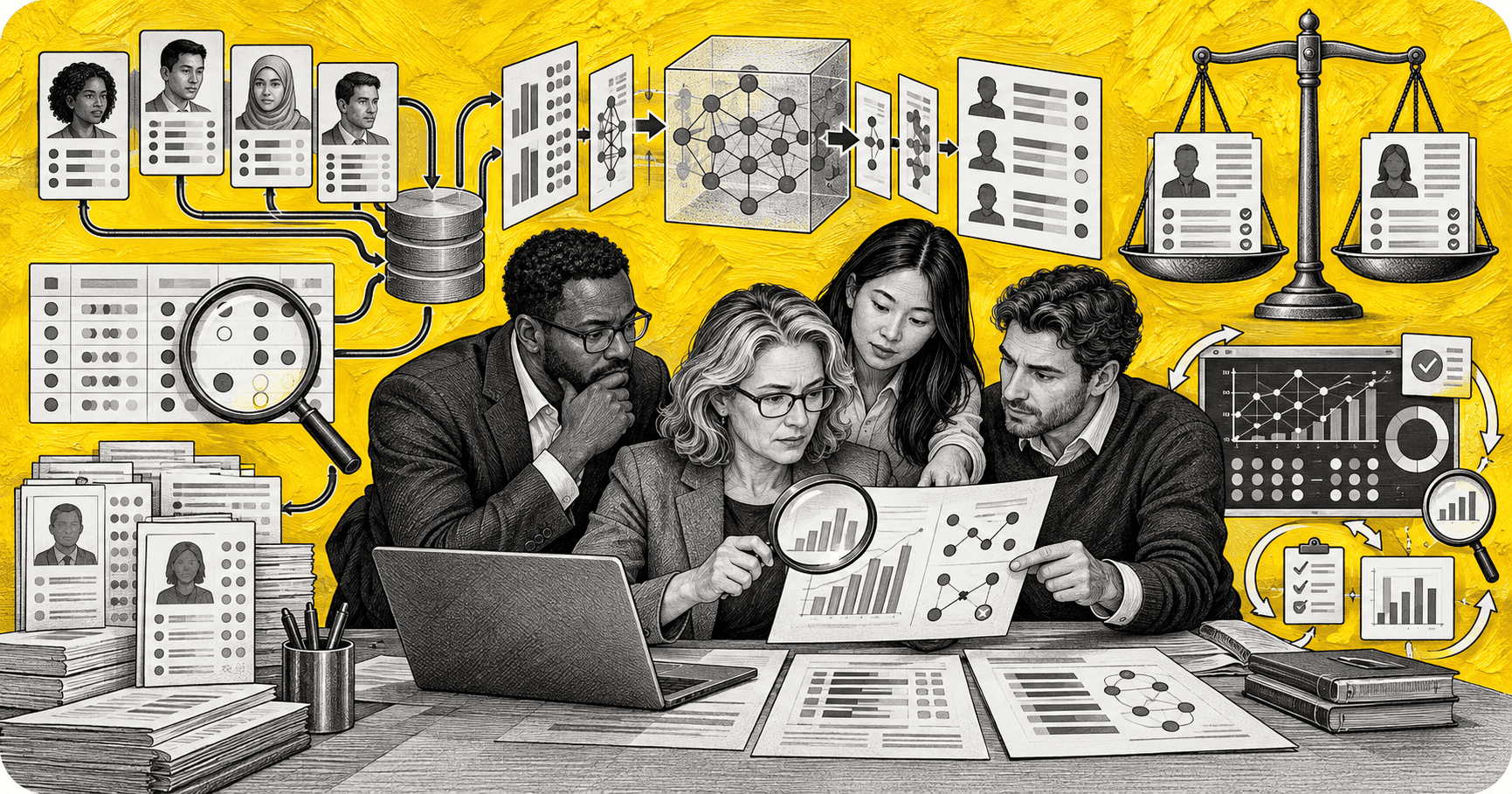
Every hiring algorithm learns from somebody’s past decisions. If those decisions favored certain schools, zip codes, or career paths, the model learns to favor them too, and it does so at a scale no single recruiter ever could. To mitigate AI bias and discrimination, you have to treat the AI as a decision maker that needs the same scrutiny you’d give a new interviewer: clear criteria, consistent questions, and someone checking the outcomes.
Below: where algorithm bias comes from, five strategies, and a checklist for your next vendor review.
To mitigate AI bias and discrimination in hiring:
Keep a human in the decision making process, with the authority to override the model.
Bias occurs when a model’s outputs systematically favor or penalize a group for reasons unrelated to the job. In hiring, the most common cause is training data that reflects historical patterns. If a company spent ten years hiring software engineers mostly from three universities, a resume screening model trained on those hires will learn that the university is a signal of success. It isn’t. It’s a record of who got hired.
The model doesn’t need to see gender, age, or ethnicity to discriminate. It finds proxies: a gap year, a women’s sports team on a resume, a commute distance, certain verbs in a cover letter. Removing the protected field from the dataset doesn’t remove the pattern.
Algorithm bias also comes from design choices. What the model is told to predict matters. A model trained to predict “who got an offer” inherits every human bias in past interviews. A model trained to predict “who passed a job relevant coding task” has a much narrower and more defensible target.
Knowing the types of bias makes identifying bias far easier during a vendor review or an internal audit.
Human biases and machine biases feed each other. A biased model shapes who gets interviewed, those interview outcomes become the next round of training data, and the loop tightens. Bias mitigation has to address both sides.
Start with the data, because every downstream fix depends on it. Ask your vendor, or your own data team, four questions:
If the answer to the last question is “we haven’t checked,” that’s your first finding. A model trained on a decade of resumes and offer decisions almost always reflects historical patterns somewhere in its feature weights.
Diverse and representative training data is the most direct way to address biases at the source. That means the data covers the full range of candidates you want to hire, across backgrounds, career paths, and geographies, not just the profile of your current team.
In practice:
Representative data doesn’t fix a badly defined target. If the model still predicts “looks like past hires,” better data only makes it better at copying the past.
The strongest protection against AI bias and discrimination is to change what the AI evaluates. Resumes are full of proxies. Work samples are not. When a candidate writes working code, resolves a simulated support ticket, or explains a SQL query, the evidence is the work itself.
This is the approach behind Glider’s skill assessments and AI interviews. Interview questions are fixed in advance rather than improvised by the model, delivered conversationally, and scored against a specific rubric. Candidates are evaluated on what they do, not just what they say. Every candidate for the same role gets the same questions and the same scoring criteria, which is the core of a structured, defensible process.
Rubric scoring also makes the decision making process explainable. When a hiring manager asks why a candidate scored lower, the answer points to specific rubric criteria and the candidate’s actual response, not an opaque number.
A model that passed a bias audit at launch can drift. Your applicant pool changes, roles change, and the people using the tool change how they use it. Pre launch testing is necessary, but it isn’t enough.
Monitor these at least quarterly:
Regulation is moving in the same direction. New York City’s Local Law 144 requires an independent bias audit for automated employment decision tools before use, and the EU AI Act treats AI used in recruitment as high risk. Even where no law applies yet, a documented monitoring process is your best evidence of good faith.
Human oversight only works if the human has real information and real authority. A recruiter rubber stamping a ranked list isn’t oversight. A recruiter reviewing the evidence behind a score, with the ability to override it, is.
Glider’s proctoring follows this principle. AI proctoring flags such as a tab switch or pasted code are recorded as factual data, not automatic disqualifications. A recruiter reviews the monitoring report, with video and timeline markers, before any decision. The system logs who marked a flag as a non issue, so accountability runs both ways. The same logic applies to open ended answers: the rubric produces a score, and a human can override it.
Train your reviewers on confirmation bias and automation bias specifically. The goal is a process where people question the model when it surprises them and when it agrees with them.
Copy this list into your next vendor review or quarterly audit.
Data
Evaluation design
Monitoring
Human oversight
Candidate transparency
AI bias in hiring is when hiring algorithms systematically favor or penalize candidates from certain groups for reasons unrelated to job performance. It usually comes from training data that reflects historical hiring decisions, or from models that score proxies like schools or job titles instead of skills.
Audit the training data, build diverse and representative datasets, evaluate candidates on job relevant tasks with a fixed rubric, monitor selection rates by group after launch, and keep a human accountable for every decision with the power to override the AI.
Yes, when it standardizes the process. Asking every candidate the same questions and scoring answers against the same rubric reduces the variation that lets human biases creep in. Our post on how AI recruitment can reduce bias in hiring covers this side in more depth. The catch is that the AI itself has to be checked, which is what this guide is about.
Historical bias, representation bias, measurement bias, confirmation bias, and automation bias. Historical and measurement bias cause the most harm in resume screening, because the model learns to copy past hires and to reward proxies.
In some places, yes. New York City’s Local Law 144 requires an independent bias audit of automated employment decision tools and notice to candidates. The EU AI Act classifies AI used in recruitment as high risk. Check the rules in each location where you hire, and keep documentation either way.
Run a full audit before launch and whenever the model, the role, or the candidate pool changes significantly. Review selection rates and override data at least quarterly.
Pick one open role with high volume and pull the last quarter’s selection rates by stage. If you can’t produce that data today, that’s the first fix. If you can, compare it against the checklist above and see which box is hardest to tick.
If you’re evaluating tools, ask to see the rubric and the evidence behind a sample score. Glider evaluates candidates on real tasks with structured questions, rubric scoring, and human review built in. For broader context on fair hiring, see our diversity hiring solutions.

Introduction In the quest for a more equitable workplace, companies across industries are striving to reduce bias in their hiring processes. Bias, whether conscious or unconscious, can significantly impact the diversity and inclusivity of an organization. It affects who gets hired, who gets promoted, and ultimately, who thrives within a company. AI adoption in HR […]
The world is slowly waking up from the shackles of Covid. As it restructures to the imperative changes, there are individuals and institutions that need the most help, compassion and solidarity in the time of crisis. Like the UN says, Covid is a test of societies, governments, institutions and individuals. In term of individuals, DE&I and its […]
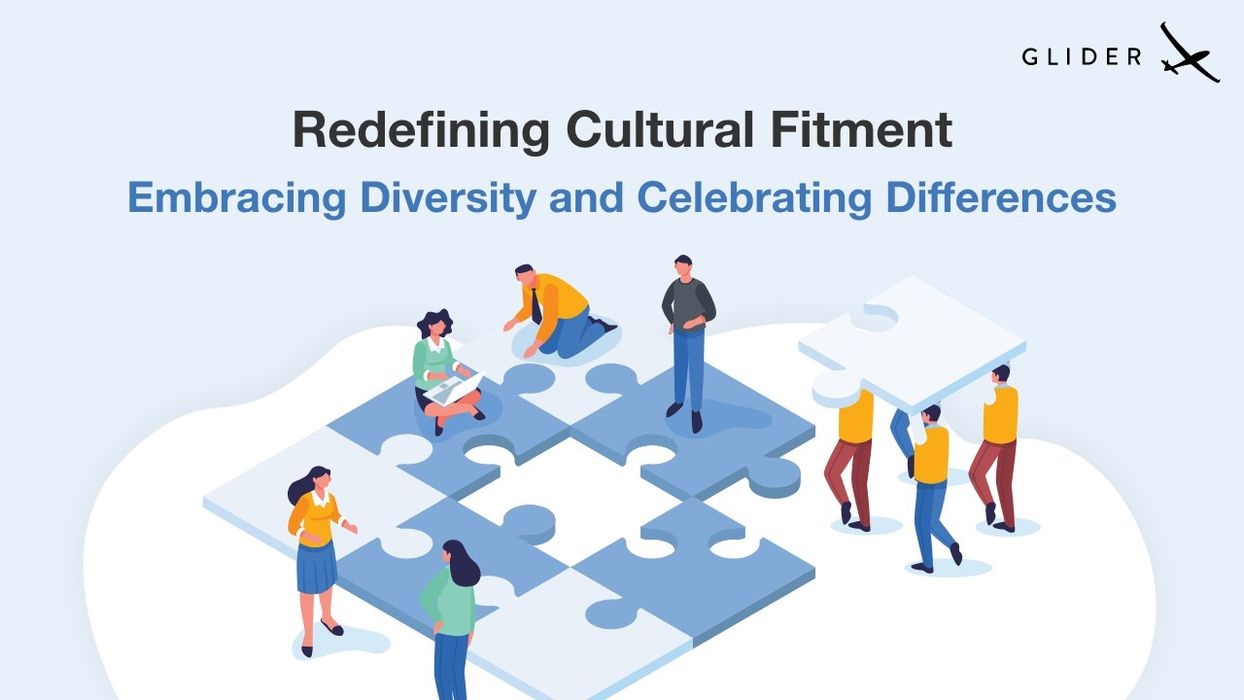
The definition of cultural fitment is discreet, based on a company’s ideologies and principles. In many cases, companies look for employees who match their requirements and have the qualities to “blend in” with the prevalent culture. “Maintaining the culture that you’ve built for your company is the goal of most business owners. Even before they […]