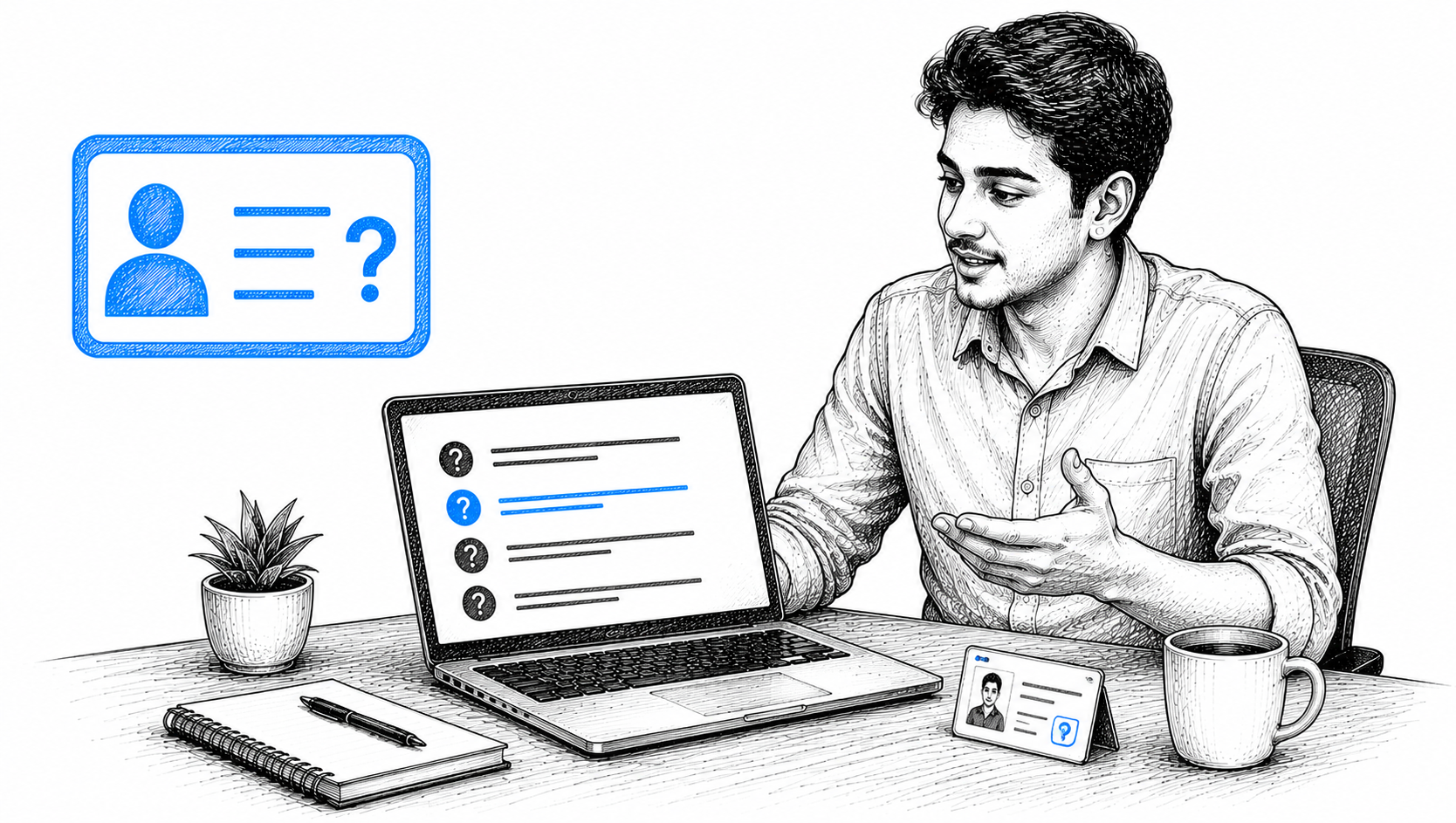
Make talent quality your leading analytic with skills-based hiring solution.
Hiring teams are facing a new kind of applicant problem. Proxy candidates who sit in for someone else, AI generated resumes, deepfake video interviews, and duplicate applicants cycling through the same job requisition under different names are no longer rare edge cases. Multiple 2026 industry reports point to a sharp rise in interview fraud, and remote and contract heavy pipelines are the most exposed. Candidate identity verification exists to close that gap before a bad hire ever reaches an offer letter.
Candidate identity verification is the process of confirming that the person completing an assessment, interview, or onboarding step is a real, unique individual and is who they claim to be. It sits earlier in the funnel than a background check and answers a simpler, more urgent question: is this actually the applicant sitting behind the screen.
A modern identity verification step is built to run inside the existing hiring flow rather than as a separate errand for the candidate. A typical flow looks like this.
The candidate uploads a government issued ID such as a passport, driver license, or national identity card. The system checks the document for tampering, mismatched fonts, altered photos, and other forensic red flags, often reading the machine readable zone found on passports and many national IDs. A live selfie or short video is captured and matched against the ID photo using facial recognition, with liveness detection to confirm a real person is present rather than a static photo, a printed mask, or a screen replay. Metadata such as device fingerprint and geo IP location is checked for consistency with the candidate profile and application history. The full result is typically returned in under a couple of minutes, so it does not add real friction to the candidate experience.
Because verification happens before or alongside a skill assessment or interview, recruiters get a clear identity signal at the exact moment it matters most, not weeks later after an offer has already gone out and a new hire shows up for day one.
A few converging trends have pushed identity verification from nice to have to essential.
Remote and hybrid hiring removed the in person moment where a recruiter could simply look at a candidate and match a face to a resume. Skills based and interview heavy pipelines increasingly rely on video and assessment platforms, which proxy candidates try to exploit by having someone else sit the test or the interview on their behalf. Generative AI has made it dramatically easier to fabricate a convincing resume, clone a voice, or run a real time deepfake overlay during a video call, so a confident, well spoken candidate on screen is no longer proof of anything.
Federal authorities have even warned employers directly about this exposure. The FBI has issued public alerts about fraudulent remote IT workers using stolen identities to gain employment, describing coordinated schemes that combine identity theft with insider access risk once the fraudulent hire is on payroll. That warning underscores that candidate identity verification is not just an HR nicety, it is a security control that belongs alongside other pre hire safeguards.
Catching fraud early. Verifying identity at the top of the funnel stops proxy candidates and duplicate applicants before they consume recruiter time, occupy an interview slot, or reach a paid assessment credit.
Protecting assessment and interview integrity. When identity is confirmed going into a skill assessment or an AI interview, the score or transcript that comes out actually reflects the person you plan to hire, not a stand in.
Reducing compliance and audit exposure. Encrypted, audit ready verification records help HR and legal teams demonstrate due diligence for regulated roles, staffing engagements, and cross border hiring.
Speeding up trustworthy decisions. A verification step that completes in a couple of minutes lets recruiters move fast without trading away confidence in who they are actually evaluating.
Extending protection past day one. Re verification at onboarding closes the loop between the person who was assessed during the interview process and the person who actually logs in to start the job.
These two checks answer different questions, and neither replaces the other. A background check looks backward. It confirms employment history, education, criminal records, and other facts about a person once you already know who that person is. Candidate identity verification looks forward. It confirms, in real time, that the individual in front of the camera or completing the assessment is a genuine, unique person and matches the identity on file, before you invest further time or trust in that candidate.
Used together, identity verification and background screening give recruiting and talent acquisition teams a fuller picture: confirmation of who someone is, plus confirmation of what that verified person has actually done.
Not every verification tool is built for high volume hiring. When evaluating a solution, look for these capabilities.
Broad document coverage across a large number of countries, which matters for any organization hiring internationally or through a distributed contractor workforce.
Document forensics paired with biometrics. The strongest solutions combine AI powered document authentication with facial matching and liveness detection, rather than relying on a single check that is easier to defeat on its own.
Deepfake and spoofing resistance. As synthetic media keeps improving, the platform should be built to catch injected video, photo replays, voice cloning artifacts, and other spoofing attempts, not just a simple mismatched face.
Speed and candidate experience, since verification should complete in minutes on mobile or desktop so it does not become a drop off point in an otherwise smooth application funnel.
Native integration into the rest of the hiring stack. The best results come when identity verification connects directly into AI powered proctoring, skill assessments, and AI guided interviews, instead of running as a disconnected point solution, and when it also plugs into the ATS or VMS your team already uses.
Compliance posture, including GDPR, SOC 2, and CCPA aligned handling of biometric and document data, along with clear, exportable audit trails for every verification event.
Identity verification works best as one layer inside a broader enterprise hiring strategy rather than a standalone checkbox. Paired with proctored assessments and structured interviews, it gives recruiting and talent acquisition teams a consistent, defensible answer to a question that only gets harder to ignore as hiring moves further online: are we actually hiring the person who applied.
Fraud attempts will keep evolving alongside the tools candidates use to fake their way through a pipeline, so identity verification cannot be a one time gate at the top of the funnel. It needs to travel with the candidate through assessment, interview, and into onboarding. Explore the full Glider AI product overview to see how identity verification fits alongside assessments, interviews, and onboarding in one connected platform, so every stage of the hiring journey is checked against the same trusted identity.
Candidate identity verification is a real time check that confirms a job applicant is a genuine, unique individual and matches the identity they claim during an assessment, interview, or onboarding step. It typically combines a government issued ID scan with a live selfie or video and liveness detection. This catches proxy candidates and impersonation before a hiring decision is made.
A background check looks backward at a known person’s history, such as past employment, education, or criminal records. Identity verification looks forward and confirms, before that history is even checked, that the person in front of the camera is really who they say they are. Employers generally need both, used at different points in the funnel.
Strong identity verification tools use liveness detection alongside facial recognition, which checks for natural movement, depth, and behavior that a static photo, printed mask, or injected video feed cannot reproduce. Some platforms add facial behavior analysis during the interview itself. Together these checks make it far harder for a deepfake overlay or a photo replay to pass as a real applicant.
Most platforms accept common government issued documents such as passports, driver licenses, and national identity cards. Better solutions support documents from well over a hundred countries and read the machine readable zone found on many IDs to cross check the printed data. This matters most for organizations hiring across borders or through distributed contractor pools.
A well built verification step typically completes in under a couple of minutes on a mobile phone or desktop browser. The candidate uploads or scans an ID, takes a quick selfie or short video, and the system returns a result almost immediately. That speed keeps the check from becoming a drop off point in the application process.
Yes. Many platforms support a day one or onboarding re verification step, which confirms that the person who shows up to start the job is the same person who was assessed and interviewed. This closes a gap that a single upfront check cannot, especially for remote roles where nobody meets the new hire in person.
Reputable identity verification platforms are built to align with data protection frameworks such as GDPR and CCPA, along with security certifications like SOC 2, and they encrypt biometric and document data with audit trails for every check. Employers should still confirm a vendor’s specific compliance posture and data retention practices before rolling out verification globally.
In a connected hiring stack, identity verification runs before or alongside a skill assessment, a proctored test, or an AI guided interview, so the identity confirmed at that step is tied directly to the results produced. This is typically delivered through native product integration plus pre built connections into common ATS and VMS platforms, rather than as a disconnected standalone tool.
Traditional Technical Skill Assessments and Live Coding Interviews only tell part of the story. They can show whether a candidate can code, but not how they’ll solve real-world problems, especially in an AI-powered workplace. That’s why we built AI Assistant by Glider AI. AI Assistant for technical hiring brings AI directly into the assessment and […]
The Future of Skills-Based Hiring & Talent Development Skills-based hiring is no longer a trend—it’s a necessity. Many companies are moving from traditional degree-based hiring to a model prioritizing verified, job-ready skills. However, implementing skills-based hiring and developing a workforce capable of adapting to new challenges comes with significant obstacles. Glider AI is now available […]
As the recruiting industry combats a new level of sophistication in candidate fraud, a challenging economic landscape, and a rapidly expanding talent pool, Glider AI has introduced new features to make your experience more rewarding and the hiring process more efficient than ever before! Glider Connect Sequence and automate candidate engagement Glider Connect can now […]