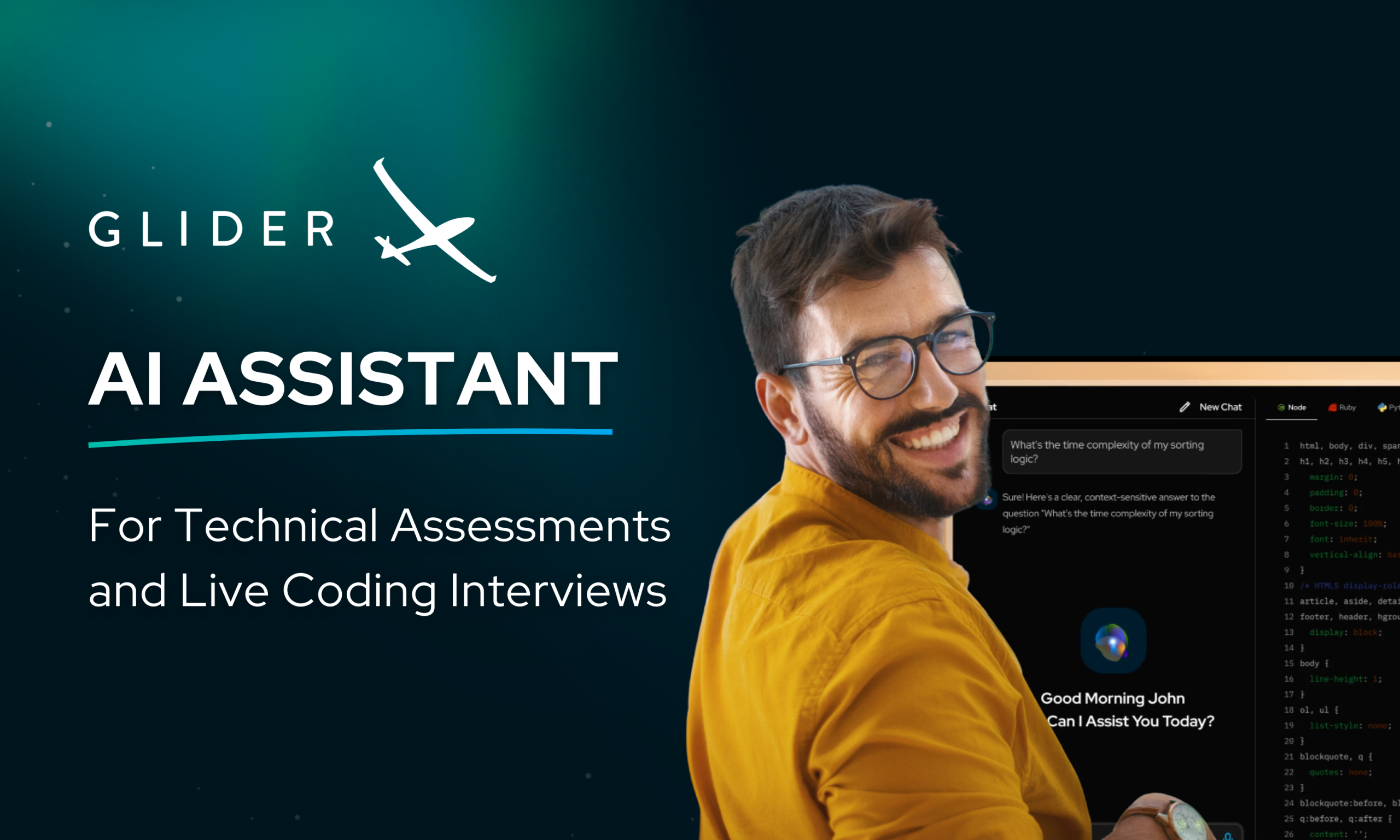
Make talent quality your leading analytic with skills-based hiring solution.
Traditional Technical Skill Assessments and Live Coding Interviews only tell part of the story. They can show whether a candidate can code, but not how they’ll solve real-world problems, especially in an AI-powered workplace. That’s why we built AI Assistant by Glider AI.
AI Assistant for technical hiring brings AI directly into the assessment and interview experience, so hiring teams can evaluate not only technical skills but also how candidates use AI in their work. The goal is to make technical evaluation closer to the way modern engineers actually solve problems on the job.
The best engineers and developers will be those who can work with AI, not depend on it. If hiring teams still rely only on code-only assessments, they miss an increasingly important part of job readiness: whether a candidate can question AI output, apply judgment, debug effectively, and use assistance without giving up ownership of the solution.
Developers already use AI tools as part of day-to-day work. Technical hiring therefore needs a way to evaluate AI collaboration in a controlled environment rather than simply banning AI or allowing unrestricted outside assistance. AI Assistant helps make that behavior visible during the evaluation itself.
AI Assistant is Glider AI’s embedded support agent inside Technical Skill Assessments and Live Coding Interviews. It guides candidates in real time, offers proactive nudges or debugging help, and captures interactions to reveal how candidates think, problem-solve, and collaborate with AI.
Because the experience is built into the assessment and interview workflow, recruiters can evaluate technical ability and AI readiness together instead of treating AI usage as an invisible or uncontrolled part of the process.
During technical assessments, candidates can use AI Assistant in a controlled environment that reflects how AI may be used on the job. This gives hiring teams a more complete view of how a candidate interprets a challenge, improves a solution, and responds when the first approach does not work.
This approach keeps the focus on demonstrated skill rather than frustration, while still giving recruiters evidence of whether the candidate can critically evaluate and apply AI-generated guidance.
In Live Coding Interviews, AI Assistant can support the candidate without replacing the interviewer. The interviewer still leads the session, while the assistant provides context-aware nudges and makes the candidate’s response to guidance easier to observe.
For technical hiring teams, this creates a more realistic interview environment and adds context that a final code output alone cannot provide.
AI Assistant for technical hiring gives recruiters and hiring managers another layer of evidence when evaluating candidates. Instead of looking only at whether the code works, teams can see how a candidate frames a problem, asks for clarification, reacts to feedback, validates AI suggestions, and improves a solution.
Those behaviors matter in AI-enabled engineering teams because strong performance depends on judgment as much as speed. A candidate who can use AI effectively while still reasoning independently may be better prepared for real-world technical work than someone who simply reaches the correct answer.
Glider AI leaders see AI Assistant as more than a feature—it represents a shift in how enterprises can approach technical hiring. By combining technical skill validation with visible AI collaboration, organizations can evaluate whether candidates are both code-ready and AI-ready in the same workflow.
As AI becomes part of everyday technical work, the strongest hiring process will not measure whether candidates can avoid AI. It will measure whether they can use it responsibly, critically, and effectively. That is the value of AI Assistant for technical hiring: making real-world problem solving visible before a hiring decision is made.
An AI Assistant in technical hiring is an AI-powered companion integrated into technical assessments and live coding interviews. It can guide candidates during tasks while giving hiring teams visibility into how candidates reason, debug, respond to feedback, and collaborate with AI.
AI Assistant operates inside a controlled hiring environment. This allows the organization to observe AI interactions as part of the evaluation instead of allowing untracked outside assistance that can make it difficult to determine what the candidate actually did.
The purpose is to support problem solving rather than replace it. Candidates can receive nudges, clarification, suggestions, and debugging guidance, while hiring teams can still evaluate how they interpret and apply that guidance.
Yes. Glider AI Assistant is designed for Technical Skill Assessments and Live Coding Interviews, allowing hiring teams to evaluate AI collaboration at more than one stage of the technical hiring process.
In addition to coding ability, teams can observe problem solving, debugging, critical thinking, coachability, response to feedback, and how effectively a candidate works with AI.
AI is increasingly part of engineering workflows. Measuring AI readiness helps hiring teams understand whether a candidate can use AI as a practical tool while still applying independent judgment and technical expertise.

Take home assignment outsourcing happens when a candidate has someone else, a freelancer, a friend, or a paid ghost writing service, complete their take home coding, design, or writing test for them. Because the assignment is done alone, on the candidate’s own schedule, and away from any interviewer or proctor, nothing about the format itself […]

Leaked interview questions are exact, or nearly exact, copies of a company’s real assessment or interview questions that have been collected, compiled, and shared, often for a price, so that later candidates can memorize the answer before they ever see the question live. This is a test bank leak: a candidate is not solving a […]
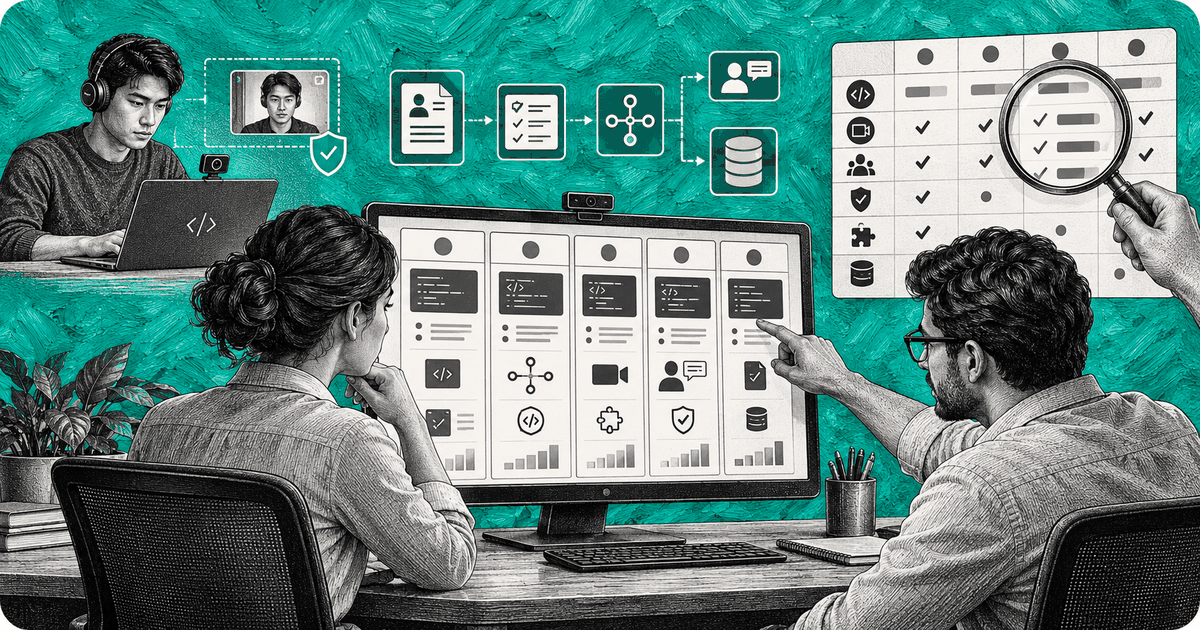
You posted one backend role and got 900 applicants. Some can code. Some can explain their code. A few used a proxy test taker last time they applied somewhere. The tool you choose for the first screen decides which of those people reach your hiring managers, so picking it is worth more than an afternoon […]