Make talent quality your leading analytic with skills-based hiring solution.
When hiring for success, do you look for talent or skill? What impresses you more, a person or a resume? It is a long lasting debate in HR circles, and opinions remain divided among employers. One thing is certain: while skills can be trained in almost anyone, attitude is much harder to teach. When push comes to shove, is it better to hire or train?
A 2025 TestGorilla survey of more than 1,000 U.S. and U.K. hiring decision makers found that 60 percent of employers say soft skills matter more today than they did five years ago, a sign that the “hire for attitude, train for skill” philosophy has only grown more relevant, not less, in the AI hiring era.
To a handful of forward thinking employers, personality remains the main criterion for choosing new hires. But “hiring for attitude” is not a new idea; HR specialists have researched its potential for years, though it took time for the philosophy to become methodical and defensible rather than just a gut call.
Hiring for talent poses a real challenge in the context of unbiased HR. Employers who practice it are aware of this risk; what compels them to accept it is the potential of employees with trainable talent. Under this philosophy, the ideal candidate has exceptional personal traits that can be molded and elevated over time.
Employees with trainable talent tend to share three qualities:
Together, these traits let a new hire learn and advance in virtually any position. In a specific profession, such an employee may have no vocational education or prior experience, but also no history of burnout, bad habits, or friction with past employers to unlearn.
Because this is an employee with a “where there’s a will, there’s a way” mindset who is eager to make the most of the opportunity, you will rarely need to worry about their work ethic, commitment, or fit with the team.
It is a common misconception that experienced hires are easier to train. Consider this: an employee coming from another company, where they spent years working the same role you have hired them for, may have a harder time unlearning old habits and adopting your approach. A capable talent hire, on the other hand, often brings stronger motivation to learn.
While an experienced hire may approach onboarding as “back to the old drawing board,” a talent hire is often genuinely excited to open a new chapter in their career and has already engaged with your onboarding material.
This is not to say talent hires need no training at all. New hire training is crucial for developing high quality products and solutions, especially as technology continues to evolve quickly. Presuming they are smart and committed, talent hires are usually easier to train precisely because they carry less to unlearn.
When “hiring for attitude” first emerged as an HR philosophy, employers relied mostly on instinct and a handful of tested evaluation techniques. Modern hiring technology has changed that, but several manual methods remain effective on their own.
Pay attention to the questions candidates ask. A candidate’s questions often reveal more than their answers: strong candidates want to know how things really work, driven by genuine curiosity rather than a desire to impress. That curiosity is usually a good sign.
Ask candidates what they already know about your organization. Someone who has researched your brand ahead of the interview and can speak to your specific culture is showing an authentic desire to join, often because their personal values already align with it.
Everything about a role can be taught except passion and intrinsic drive. If you choose to hire for attitude and train for skill, adjust your interview process accordingly: swap standard questions for ones that reveal what actually motivates a candidate, and consider structured exercises or scenario based interviews. Look for who a candidate is, not only for what they can already do.
The “hire for attitude, train for skill” philosophy is widely associated with Southwest Airlines’ hiring practices, as reported in a well known 2011 Harvard Business Review case study: the airline has long said it would rather hire an eager, customer oriented mindset and shape it to the role than try to change habits formed at a company with a very different culture. More than a decade later, and well into the AI hiring era, that argument still holds.
Today’s hiring process is both faster and more consistent thanks to modern technology. At Glider, we offer hiring solutions that use artificial intelligence to rank candidates and evaluate them through real world tasks, simulations, and structured interview questions tailored to different roles and psychometric assessments that look deeper into a candidate’s personality and working style.
Unbiased hiring should matter to every organization. If you decide to hire for talent and train for skill, pay extra attention to how you evaluate candidates: personality based evaluation can introduce both conscious and unconscious bias, so using AI backed, structured evaluation helps rule out gender and age bias and base decisions on consistent data rather than gut feel, making the process both more efficient and more accurate.
Hiring for attitude is a genuinely challenging technique. Because it rests on personality evaluation, it requires a careful balance between judging candidates on their real traits and misjudging them due to evaluator bias. The right process and technology make that balance far easier to strike.
Should you hire for talent or train for skills?
For most roles, a blended approach works best: hire for trainable qualities like intelligence, work ethic, and cultural fit, then train for the job specific technical skills, since skills are generally faster and cheaper to teach than attitude.
What does “hire for attitude, train for skill” mean?
It is a hiring philosophy that prioritizes a candidate’s personality, coachability, and cultural fit over their existing technical experience, on the theory that the right attitude combined with training produces a stronger long term employee than technical skill alone.
How can AI help with hiring for talent and attitude?
AI backed interview and assessment tools can standardize how candidates are evaluated on personality and working style, reducing conscious and unconscious bias compared to unstructured gut based interviews, while still surfacing the technical skill data needed to make a balanced hiring decision.
Glider’s recruitment platform is designed to prioritize competency over credentials, helping organizations evaluate both technical skill and the softer, harder to teach qualities like attitude and cultural fit, objectively and efficiently. Use Glider AI Skill Intelligence to build a structured, bias resistant hiring process that works whether you are hiring for proven skill or trainable talent.
Go ahead and build a stronger talent and skills hiring process with Glider AI today!
Schedule a Demo or contact us at info@glider.ai

Global hiring fraud hotspots are the countries and regions where documented candidate fraud and identity verification risk run highest, based on named industry indices rather than assumption. In 2026, that data points consistently in one direction: fraud vulnerability is concentrated in markets with weaker centralized identity infrastructure and fast growing digital hiring volume, led by […]
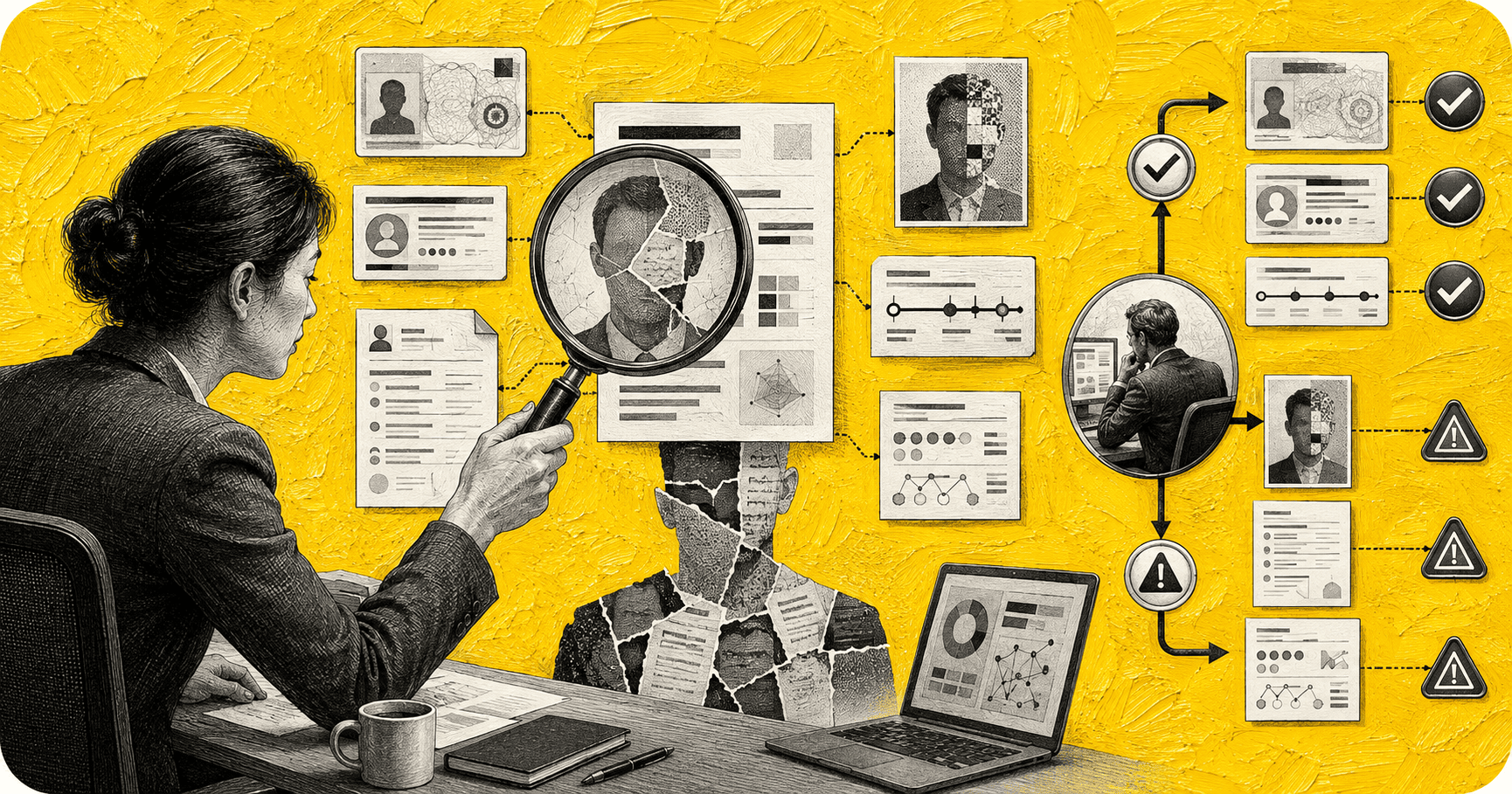
A synthetic candidate is a job applicant who does not exist as a single real person at all. The persona is assembled, usually by combining stolen or purchased personally identifiable information (PII) with an AI generated resume, an AI generated or composite photo, and an invented work history, into a package that looks, on paper […]

Hiring overqualified candidates is not automatically a mistake, but it is a decision that carries real, well documented risk if the role and the offer are not restructured around it. Recent survey data shows most employers already do this regularly: 70 percent of hiring managers say they typically consider candidates who are overqualified for the […]