Make talent quality your leading analytic with skills-based hiring solution.
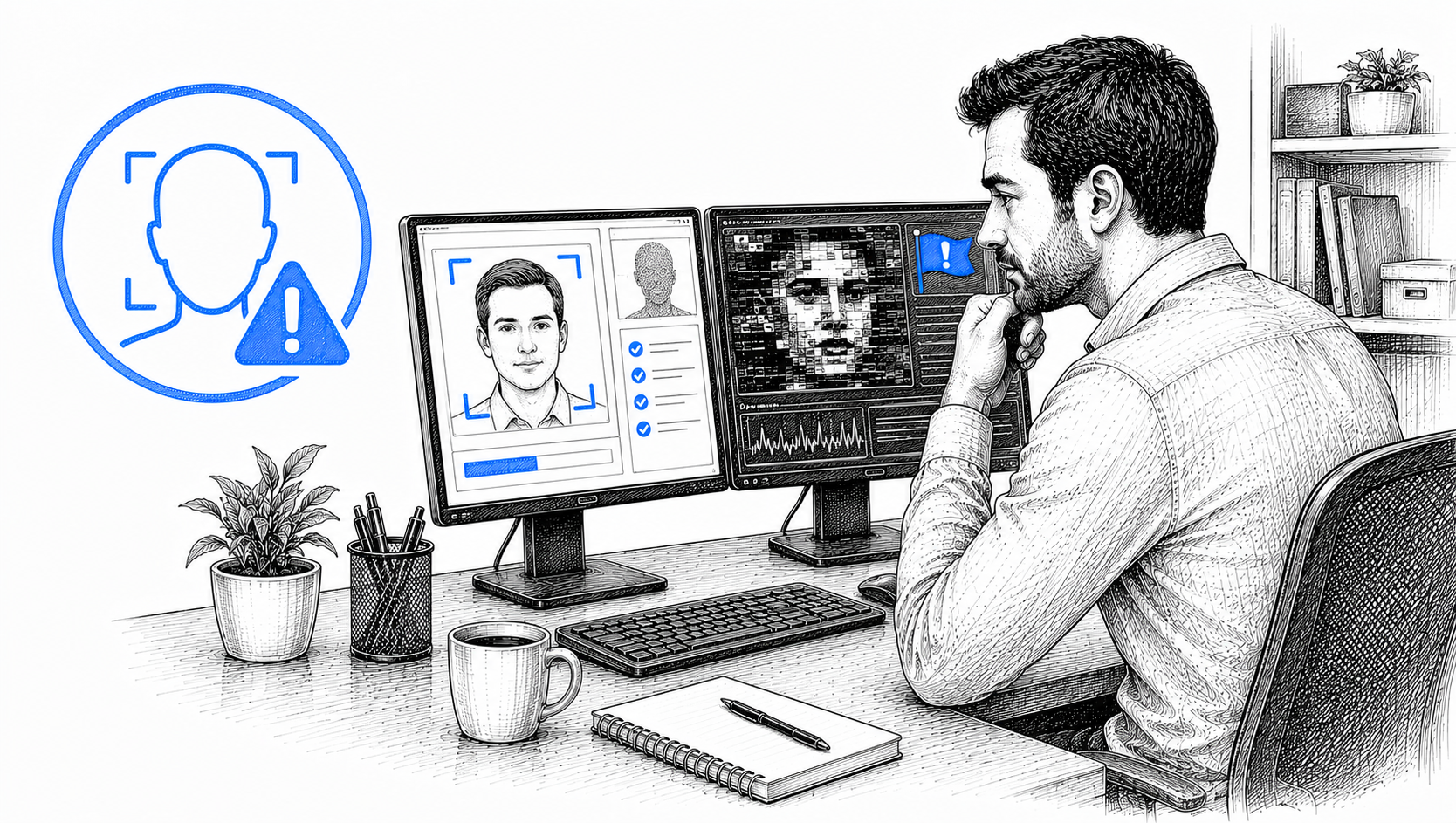
Remote hiring made it possible to interview and onboard talent from anywhere, but it also opened a door for a new kind of scam. Deepfake candidate fraud happens when someone uses AI generated video, audio, or a fabricated identity to pose as a different, often more qualified, person during a job interview or on the job itself.
What used to sound like science fiction is now a documented, government flagged threat, with real time face swap technology good enough to fool hiring managers on a standard video call. This guide covers what deepfake candidate fraud is, real documented cases including the ongoing North Korean IT worker scheme, why it matters for hiring teams beyond just IT roles, how to spot it, and how identity verification and proctoring technology close the gap that a human interviewer alone cannot catch.
Deepfake candidate fraud is broader than a single trick. It generally shows up as one of a few tactics working together: a real time video feed altered so a fake face is mapped onto a live webcam stream, AI voice synthesis that mimics a different person’s speech patterns, a fabricated resume with invented credentials and work history, prerecorded answers swapped in during technical screening, or a completely forged professional profile used to build false credibility before the interview even happens.
The goal in most documented cases is not just to get hired under a false identity; it is to get network access, a paycheck, or both, while the real person behind the operation stays hidden.
The clearest, best documented case of deepfake candidate fraud is the ongoing North Korean IT worker scheme. The FBI issued a public alert on July 23, 2025 warning US businesses that North Korean IT workers are using fraudulent employment, including AI generated video during virtual interviews, to evade sanctions and generate revenue for the regime, while leaning on US based facilitators to help with hosting laptops, running interviews, and setting up financial accounts. The alert’s most cited practical tip is strikingly simple: the FBI recommends asking a suspicious interview candidate to wave a hand in front of their face on camera, since that motion can visibly glitch a live deepfake overlay.
That warning escalated further in 2026. On July 31, 2026, eleven nations issued a coordinated joint advisory, including the United States, Japan, South Korea, France, Germany, Italy, and the Netherlands, describing operatives using “real time video inference” during interviews, meaning the deepfake model runs live on the call through a virtual camera driver rather than a prerecorded clip, making it look identical to a normal webcam feed to an untrained interviewer.
It was the first time European governments formally co signed this specific warning, underscoring that this is no longer a US only or IT only problem. Reporting tied to the advisory has referenced billions of dollars in North Korea linked cryptocurrency theft and hundreds of millions in salary revenue funneled through fraudulent remote IT jobs, figures that come from government and threat intelligence sources rather than a single independently audited number, and should be treated as directional context on scale.
Deepfake candidate fraud started concentrated in IT, cybersecurity, and finance roles, largely because those roles offer remote access to sensitive systems, but the underlying technology does not stay confined to one job category. Any role hired primarily through video interviews, especially fully remote positions with limited in person contact, carries some exposure.
The direct costs are obvious: a bad hire under a false identity can mean stolen data, sanctions exposure, fraudulent payroll, and the cost and disruption of rehiring. The less obvious cost is trust. Once a hiring team has been fooled once, every remote candidate becomes a question mark, which slows down the entire pipeline for legitimate applicants.
Fraud operations tend to follow a repeatable pattern rather than a single trick. Typically the fraudster gathers source photos and video of a real or invented identity, uses face swap or deepfake generation software to build a model, layers in AI voice synthesis to match the target’s speech, and rehearses with mock interviews before deploying the setup live.
Some operations go further, using a live human “front” to attend in person steps while a different, more technically qualified person handles the actual coding assessment behind the scenes, which is a related but distinct fraud pattern from a pure video deepfake.
Visual and Audio Red Flags Lip sync that lags slightly behind the audio, unnatural or absent blinking, missing eye reflections, lighting and shadow that does not match the stated background, and brief distortion around the face during fast head movement are all common tells in a live deepfake feed.
Behavioral Indicators Watch for a candidate who avoids simple physical requests on camera, gives generic answers to spontaneous follow up questions, seems to be reading rather than speaking naturally, or has a professional history that cannot be verified through independent channels.
Verification Steps Cross check the candidate’s identity documents against their social media presence and any publicly listed work history, verify education and past employment directly with the source rather than trusting a resume, and compare the candidate’s face and voice across every interaction, not just the final interview.
Questions to Test for Deepfakes Ask the candidate to turn their head fully to the side, wave a hand in front of their face as the FBI advisory recommends, hold an object up to the camera, or answer an unscripted, role specific technical question that a prerecorded or scripted response would not anticipate.
No single tactic catches every case, so layering defenses matters. Recommended practices include deploying AI powered fraud and liveness detection during video interviews, requiring multi factor identity verification tied to a government issued ID before extending an offer, conducting at least one live, spontaneous technical conversation rather than relying only on asynchronous or prerecorded assessments, running independent background and credential checks, and requiring an in person meeting or a verified in person equipment delivery address for sensitive, high access roles.
This is exactly where purpose built hiring technology closes the gap a human interviewer cannot close alone. Glider’s AI Proctoring monitors live and recorded interview sessions for the same visual and behavioral anomalies described above, flagging suspicious face or environment changes in real time instead of relying on an interviewer noticing a glitch mid conversation. ID Verify adds a dedicated identity verification layer, matching the candidate’s face and government issued ID against their live video presence at key points in the process, so the person who shows up for the technical interview is verifiably the same person who gets the offer and the same person who logs in on day one.
Pairing identity verification and proctoring with live AI interview conversations and hands on skill assessments makes it far harder for a fabricated identity or a coached stand in to make it through the full pipeline undetected.
Deepfake generation is only going to get more convincing, and government advisories through 2026 confirm the threat has already moved from a single country’s IT sector to a coordinated, multi nation concern spanning finance, technology, and remote knowledge work broadly.
Hiring teams that treat identity verification and proctoring as a standard step in every remote hiring process, rather than an exception reserved for suspicious cases, will be far better positioned as this threat keeps evolving.
Deepfake candidate fraud is when someone uses AI generated video, voice, or a fabricated identity to impersonate a different person during a job interview or while working remotely, typically to gain network access, a paycheck, or both under false pretenses.
Fraudsters typically run a live deepfake model over their webcam feed during the interview, use AI voice synthesis to mimic a target person’s speech, and pair this with a fabricated resume and professional profile to build credibility before and during the hiring process.
Watch for lip sync delays, unnatural blinking, missing eye reflections, lighting that does not match the stated background, and distortion during fast head movement, and test suspicious candidates by asking them to wave a hand across their face or turn fully to the side on camera.
Yes. In documented cases like the North Korean IT worker scheme, deepfake hiring fraud has been tied to sanctions evasion and fraudulent employment, which can expose the hiring company to legal and compliance risk even when the company itself did not know the hire was fraudulent.
The FBI issued a public alert on July 23, 2025 warning US businesses that North Korean IT workers use fraudulent employment, including AI generated video during interviews, to evade sanctions, and recommended simple on camera tests like asking a candidate to wave a hand in front of their face to expose a live deepfake overlay.
AI proctoring monitors live and recorded interview sessions for the visual and behavioral anomalies common in deepfake video, such as lighting inconsistencies, facial distortion during movement, and mismatched audio and lip movement, flagging suspicious sessions for human review.
IT, cybersecurity, and finance roles have been the most documented targets, largely because they offer remote access to sensitive systems, though the same tactics can be used against any role hired primarily through remote video interviews.
Identity verification matches a candidate’s face and government issued ID against their live video presence at multiple points in the hiring process, making it much harder for a fabricated identity or a coached stand in to pass through the pipeline undetected.

Hiring is broken. Not because companies lack tools or effort, but because the signals used to make decisions can’t be trusted. Resumes are inflated, interviews are inconsistent, and now AI has made it even easier for candidates to generate answers, code, and even entire personas on demand. At the same time, the industry is moving […]
Fraud in hiring doesn’t fade because you catch it. It fades when you make it pointless. Across millions of Glider AI validated technical assessments conducted over multiple years, one pattern stands out: And it matters now. Investigations by The Wall Street Journal and Bloomberg recently exposed how remote workers using stolen identities embedded themselves inside […]
The year Skills based hiring became non-negotiable If 2025 proved anything, it is that the old way of hiring does not survive economic pressure. Budgets stayed tight. Headcount stayed constrained. Every hire had to justify itself quickly. At the same time, AI adoption accelerated faster than trust, governance, or data quality could keep up. For […]