Make talent quality your leading analytic with skills-based hiring solution.
Hiring teams don’t have the luxury of slow, single track interview loops anymore. Roles need to be filled faster, candidates are spread across time zones, and hiring managers expect signal, not just a gut feeling. That’s why video interviewing software has gone from a “nice to have” to a core part of the recruiting stack. Gartner and Deloitte have both flagged HR technology, including video interviewing platforms, as one of the fastest growing categories in enterprise software.
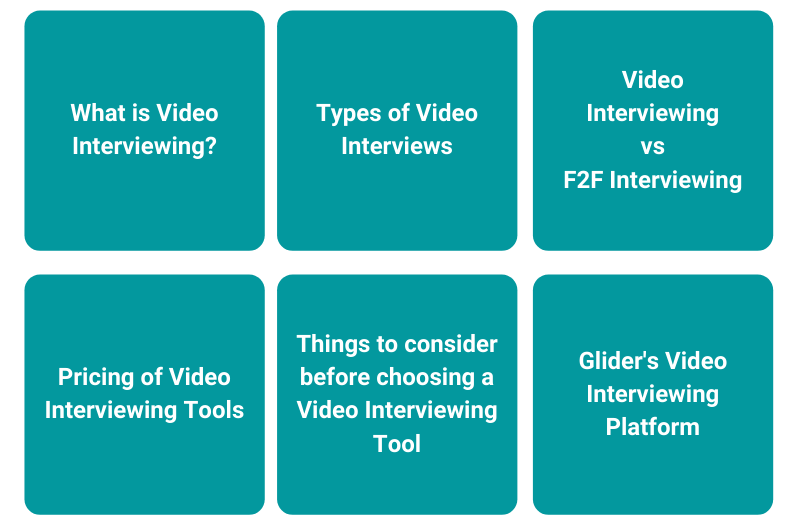
This guide breaks down what video interviewing software actually is, the different formats available (one way, two way, and coding specific), how it stacks up against phone and in person screening, what it typically costs, and exactly what to look for before you commit to a platform.
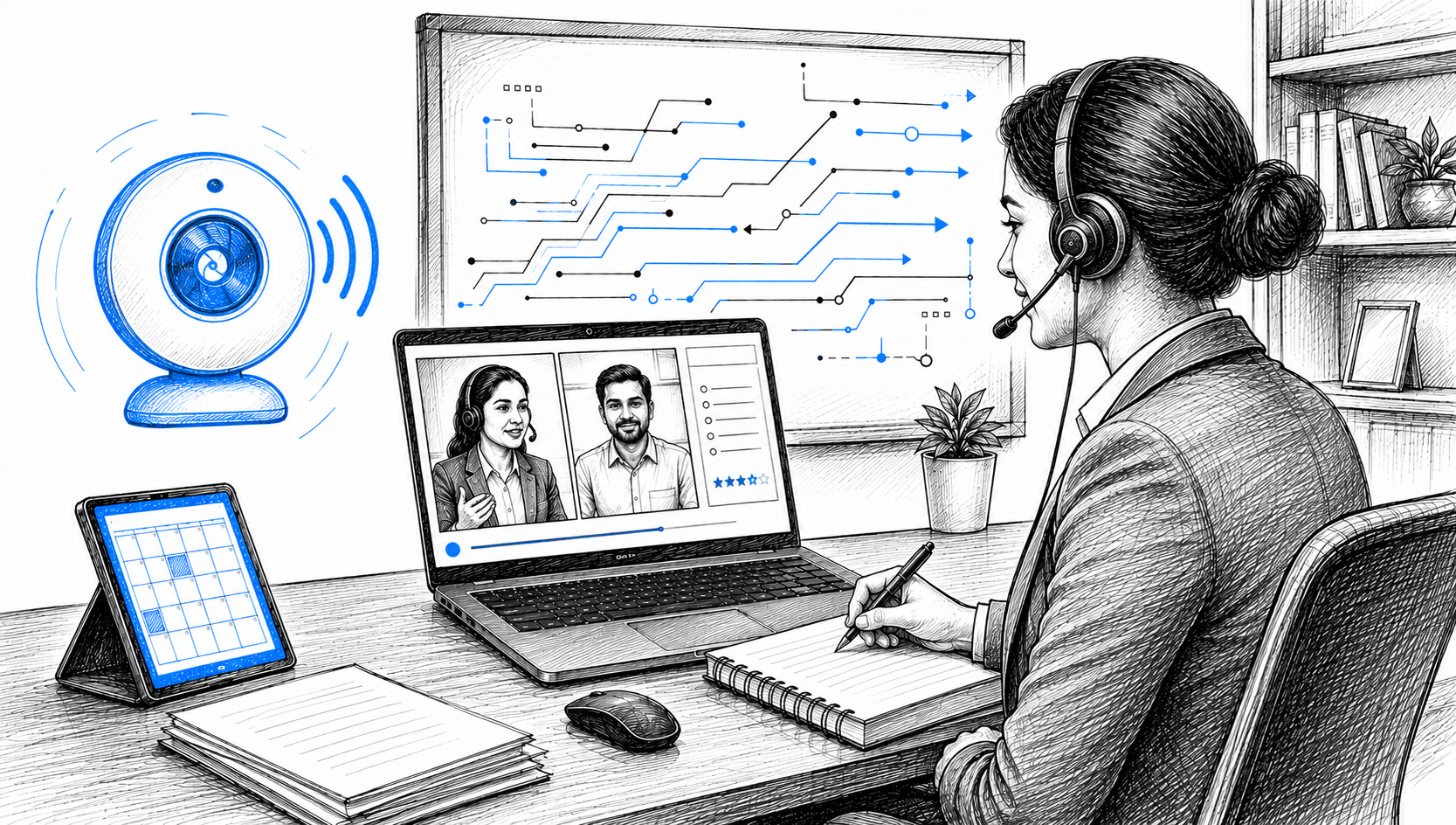
Video interviewing software is a digital platform that lets recruiters and hiring managers screen, interview, and evaluate candidates remotely, without requiring both parties to be in the same room, or even the same time zone. Instead of scheduling a physical interview, candidates respond to questions on camera, either live with an interviewer or asynchronously on their own time, and hiring teams review, score, and share that footage across the interview panel.
Because everything happens on a shared platform, video interviewing also creates a consistent, auditable record of every interview, useful for compliance, for reducing bias through structured scoring, and for helping hiring managers compare candidates side by side instead of relying on memory.
Not all video interviewing software works the same way. Most platforms, including Glider, support three core formats, and knowing the difference matters when you’re choosing a tool.
In a one way video interview, candidates record responses to a set of pre written questions within a set time window. There’s no live interviewer on the other end; recruiters review the recordings on their own schedule. This format removes time zone friction almost entirely and is especially useful for high volume early stage screening, where a recruiter might otherwise need to conduct dozens of short phone screens.
Two way (live) video interviews are the digital equivalent of an in person interview. Candidate and interviewer connect in real time over video. This format works best for later stage conversations where rapport, communication style, and real time problem solving matter more than screening speed.
For engineering and technical roles, a standard Q&A format isn’t enough. Coding specific video interviews combine live or recorded video with a shared code editor, letting candidates solve real problems while interviewers (or Glider’s automated evaluation) assess both the solution and the thought process. Pairing this with a broader technical skill assessment gives hiring teams a much more reliable signal than a resume or a generic interview alone.
Format | Best For | Time to Screen | Interviewer Presence |
One way | High volume early screening | Fastest | Not required (async review) |
Two way | Later stage, culture and communication fit | Moderate | Required (real time) |
| Coding or technical | Engineering and technical roles | Moderate | Optional (can be automated) |
Traditional phone screens and in person interviews still have a place, but they don’t scale well. According to Glassdoor, scheduling friction from phone screening alone can add over a week to a hiring timeline, time that compounds across every open role a team is trying to fill.
Video interviewing software closes that gap in a few concrete ways:
That said, phone screening isn’t obsolete. Many teams still use a short call to confirm basics (compensation expectations, notice period, work authorization) before investing in a full video interview. The two aren’t mutually exclusive; video interviewing software typically replaces or supplements the later, more evaluative stages of screening.
Before signing a contract, run any shortlisted video interviewing software through this checklist:
Glider combines one way and two way video interviewing with built in skill, personality, and behavioral assessments, live coding interviews, and remote proctoring, all inside a single platform that integrates with the ATS you already use. Instead of stitching together separate tools for screening, assessment, and interviewing, hiring teams get one auditable, structured workflow from first screen to final decision.
If you’re evaluating video interviewing software for your team, you can schedule a demo to see how the one way, two way, and coding interview formats work together, or explore Glider’s interview software FAQs for platform specific questions.
Video interviewing software is a platform that lets recruiters and hiring managers interview candidates remotely over video, either live (two way) or through pre recorded responses (one way), instead of requiring an in person or phone only conversation.
A one way video interview has candidates record answers to preset questions on their own schedule, with no live interviewer present. A two way video interview happens in real time between the candidate and interviewer, similar to a video call.
Yes. It reduces scheduling delays, removes geographic constraints, and creates a consistent, reviewable record of each candidate’s responses, which helps hiring teams compare candidates more objectively than relying on interviewer memory alone.
Most platforms price per completed interview, per user seat, or through custom enterprise contracts based on hiring volume. Exact costs vary by vendor and feature set, so it’s best to request a current quote rather than rely on a fixed number.
It can for many teams, but the two are often complementary. A short phone call is still commonly used to confirm basics like compensation and availability before moving a candidate into a full video interview.
Reputable video interviewing platforms are built to support compliance with regulations like the EEOC and GDPR through structured, consistent questioning and secure data handling, but compliance requirements vary by region, so confirm specifics with your legal or HR compliance team and the vendor.
Prioritize ease of use, feature depth (scoring, note taking, mobile access), ATS integration, compliance and security standards, and vendor track record, then confirm all of it fits your hiring volume and budget.
Yes. Platforms with built in coding interview environments let engineering candidates solve real problems on camera, giving hiring teams a stronger signal than a standard Q&A interview alone.

Finding the right candidate starts long before the in-person interview. The Phone Screening Interview is often the first real opportunity to evaluate a candidate’s skills, experience, and fit for your team. Done well, it saves time, reduces bias, and ensures only qualified candidates move forward in the hiring process. Phone screening interviews have evolved from […]
When it comes to hiring, the interview is still the moment that makes or breaks a decision. But the way companies run interviews has hardly changed in decades—manual scheduling, inconsistent formats, and interviewer bias all create inefficiencies that slow down hiring and frustrate candidates. That’s why more organizations are turning to interview software to modernize […]
What Are AI Guided Interviews? A Guide to Structured, Consistent Hiring Live interviews are one of the most important parts of hiring, but they are also one of the least consistent. Two recruiters can run completely different interviews for the same role, leading to uneven candidate experiences and unreliable data. Hiring managers often struggle to […]