Make talent quality your leading analytic with skills-based hiring solution.
Quick answer: video interviews let recruiters screen more candidates in less time, ask every candidate the same questions, and share recorded answers with hiring managers instead of chasing calendar slots. The biggest benefits of video interviews show up early in the interview process, before a hiring manager spends an hour on a call with someone who was never a fit.
A single job posting can pull in hundreds of applicants in a day. Phone screens do not scale to that, and face to face first rounds scale even less. Video interviews close that gap, as long as you pick the right format and run it with a clear rubric. This guide covers both. Keep the infographic below as a one page summary, then use the sections that follow to put it into practice.
[Infographic: Benefits of Adding Video Interviews in Your Recruitment Process. Keep the existing image here, with alt text “Infographic showing the benefits of adding video interviews in your recruitment process.”]
A video interview is any interview where the candidate and the employer connect over video instead of meeting in person. There are two main types:
Most teams use both. One way formats handle the first screen at volume. Live formats handle the deeper conversation with a shortlist.
| One way (on demand) | Live video interviews | |
|---|---|---|
| Scheduling | None. Candidates record when it suits them | Both sides need a shared slot |
| Best stage | First screen, high volume roles | Second round, final round, senior roles |
| Consistency | Every candidate gets identical questions | Depends on the interviewer |
| Follow up questions | Not possible in a basic recorded format | Natural, in real time |
| Review | Recorded answers can be shared and rewatched | Only if the session is recorded |
A third option now sits between the two: AI interviews, where an AI interviewer asks the questions, follows up on answers, and scores responses against a rubric. Glider’s AI video interviews work this way, with questions set in advance by the hiring team rather than improvised by the model.
With an on demand interview, nobody waits for a free hour on three calendars. A candidate who works days can record answers at night.
Some candidates freeze in a panel room. Recording at home, at their own pace, lowers that pressure, and you see a truer version of how they communicate.
A structured set of questions, asked the same way every time, makes comparisons fair. It also gives you a record of exactly what each person was asked, which matters when a hiring decision is reviewed later.
Recorded answers can be shared with a hiring manager or a panel, who watch them when they have a gap rather than blocking out a meeting. Several reviewers can score the same answer and compare notes.
A live phone screen exists only in the recruiter’s notes. A video can be rewatched when two reviewers disagree, or when a strong candidate resurfaces for a different role months later.
Portfolios, code samples, and project walkthroughs can sit alongside the video. Pairing a short interview with a hands on skills assessment tells you far more than a resume.
Identical questions and a written rubric reduce the room for gut feel. Video does not remove bias by itself, so train reviewers to score answers against criteria rather than impressions of the room behind the candidate.
Candidates notice when an employer respects their time. A clear, mobile friendly video step tells them the rest of your interview process is organized too.
Staffing firms and MSP teams feel every one of the benefits above, only faster. Contingent roles open on short notice, clients expect a shortlist in days, and the same req can need ten or fifty people at once. The benefits of using video interviews in your contingent staffing process come down to four things:
For a deeper look at this topic, read our full guide to the benefits of using video interviews in your contingent staffing process and the four elements of contingent hiring.
Use this list before you add video to a live req.
Need question ideas? Start with our list of online video interview questions and the screening interview guide for recruiters.
Glider AI runs video interviews in three modes. One way video interviews let candidates record at their own pace; answers are transcribed automatically and scored against a rubric, with no scheduling and room for thousands of candidates at once. AI guided interviews keep a human interviewer in the room while the platform suggests questions in real time. Autonomous AI interviews run the full conversation, assign coding tasks, and evaluate what candidates actually do. At Infosys, Glider has run more than 30,000 AI interviews, with an 80 percent agreement rate between the AI outcome and the hiring manager’s decision.
Every flag from proctoring and identity checks is data for a recruiter to review, not an automatic rejection. Glider integrates with your ATS or VMS, and supports SSO and an open REST API. See the full AI interview software overview.
They cut scheduling time, give every candidate the same questions, let hiring managers review recorded answers on their own time, and make it practical to screen large applicant pools before anyone books a face to face meeting.
An on demand interview is a one way video interview. The candidate gets a link, sees each question, and records answers whenever it suits them within a deadline. The recruiter reviews later.
Neither is better overall. Live video interviews allow real time follow up questions and suit later rounds. One way interviews suit early screening at volume. Many teams use one way first, then live for the shortlist.
Contingent roles move fast and often come in batches. Video lets staffing recruiters screen a full slate quickly, apply one standard across the team, and show clients the candidate directly instead of a written summary.
Many candidates prefer recording on their own schedule to taking a call during work hours. Completion drops when the step is long or unclear, so keep it short and explain what happens next.
Three to five questions with one to three minutes per answer is a common range. That keeps the whole step under about 15 minutes for the candidate.
Video alone does not stop impersonation. Pairing it with identity verification, such as matching a photo ID and live selfie across interview stages, is what catches a proxy candidate before the offer.
If your recruiters are still phone screening every applicant, start with one high volume req and a one way video step. Then compare time to shortlist against your current process. See how Glider AI interview software works.

Global hiring fraud hotspots are the countries and regions where documented candidate fraud and identity verification risk run highest, based on named industry indices rather than assumption. In 2026, that data points consistently in one direction: fraud vulnerability is concentrated in markets with weaker centralized identity infrastructure and fast growing digital hiring volume, led by […]
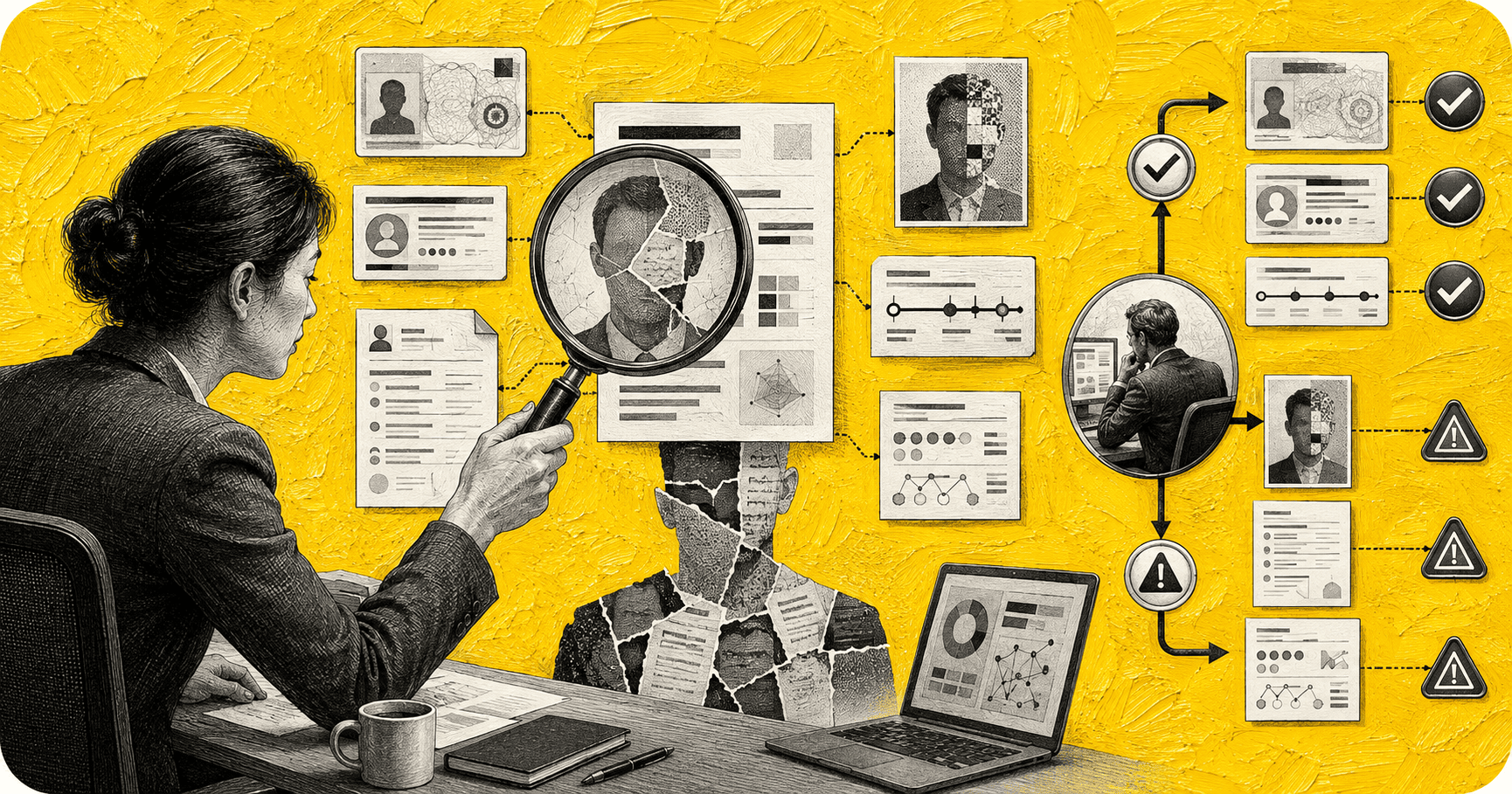
A synthetic candidate is a job applicant who does not exist as a single real person at all. The persona is assembled, usually by combining stolen or purchased personally identifiable information (PII) with an AI generated resume, an AI generated or composite photo, and an invented work history, into a package that looks, on paper […]

Hiring overqualified candidates is not automatically a mistake, but it is a decision that carries real, well documented risk if the role and the offer are not restructured around it. Recent survey data shows most employers already do this regularly: 70 percent of hiring managers say they typically consider candidates who are overqualified for the […]