
Make talent quality your leading analytic with skills-based hiring solution.
Candidate fraud is the loudest story in hiring right now. It was the eighth most common thing buyers raised when nobody prompted them.
If you have been to a talent conference this year, you already know what hiring is supposed to be worried about. Fake candidates. Deepfaked interviews. North Korean operatives on the payroll.
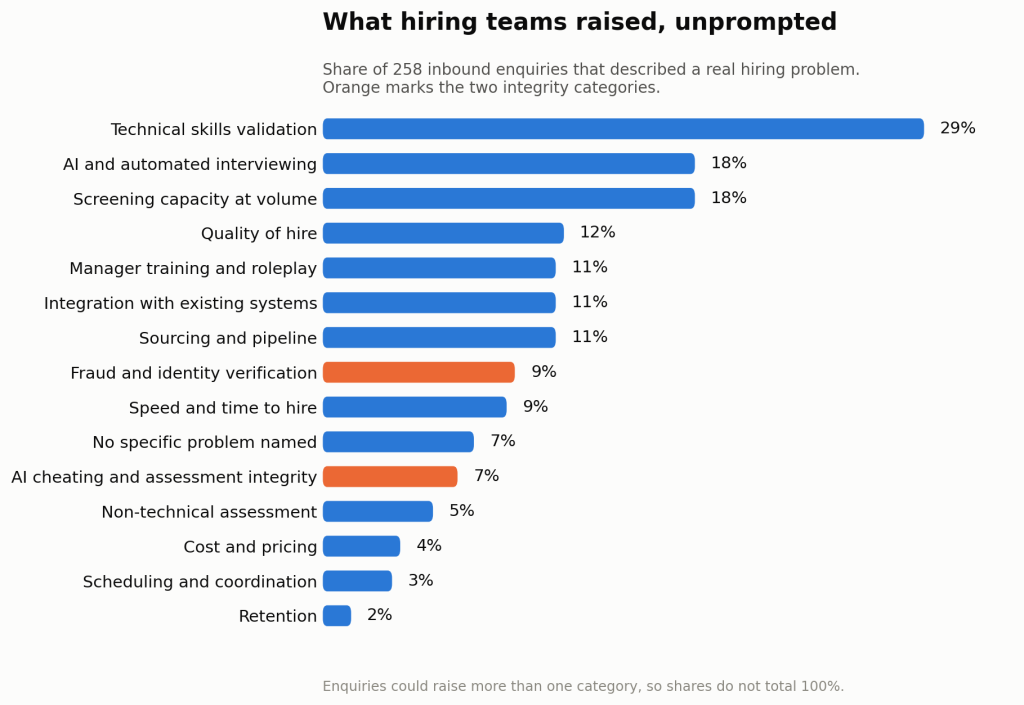
So we went and counted. Across 304 enquiries that hiring teams sent us through our own forms, 258 described a real problem in their own words. Fraud and identity verification showed up in 9% of them. Candidates cheating with AI, 7%.
The thing these enquiries raised most, at 29%, was much less cinematic. They cannot tell whether a candidate can actually do the job.
Skills validation, screening capacity, and someone to run the first interview. Those three sat at the top: technical skills validation in 29% of enquiries, AI or automated interviewing in 18%, and screening capacity at volume in 18%. Everything else landed in single digits or the low teens.
Before the findings, a word about what this data can and cannot carry. These are inbound enquiries. They are shaped by who chose to write to a company that sells hiring technology, which makes them a demand signal rather than a census of the profession. What they capture better than a survey does is what a hiring leader reaches for first, in their own words, with no answer options in front of them.
That distinction turns out to matter a lot.
Skills validation dominates because it is the problem that survives everything else you buy. Solve sourcing and you still cannot tell who can do the job. Automate scheduling and you still cannot tell who can do the job. Among the technology and software companies in this sample the figure climbs to 43%, and among large employers of 1,000 to 9,999 people, 39%.
The asks were specific in a way that tells you these are live problems rather than idle browsing.
Coding environments. Live technical rounds. Role-specific simulations. Non-technical assessment for marketing and customer service roles. And repeatedly, one platform that could do both halves instead of two that each do one.
None of that is a new complaint, which is rather the point. The World Economic Forum’s Future of Jobs Report 2025 found skills gaps to be the primary barrier to business transformation. Employers cited them at 63%, ranking first in 52 of the 55 economies covered. Only 29% of businesses expect talent availability to improve by 2030, down from 39% in 2023.
So the gap is widening while the tooling improves. That is a strange combination, and it deserves its own investigation.
Candidate fraud ranked eighth, at 9%, behind systems integration and manager training. Assessment integrity ranked tenth at 7%. Put the two together and remove the overlap, and integrity of any kind appears in fewer than one in six enquiries.
Now, this is where you are entitled to push back, because the external evidence points hard the other way. Gartner predicts that by 2028, one in four candidate profiles worldwide will be fake. The US Justice Department announced in June 2025 that North Korean IT workers had obtained employment at more than 100 US companies. Greenhouse found in November 2025 that 91% of US recruiters have spotted candidate deception.
All of that is real. None of it is what teams say when you hand them a blank text box.
The first reading is that buyers are behind the threat. Fraud is a risk you discover rather than a risk you anticipate, and a team that has not been hit has no reason to name it. Gartner’s 2Q25 survey of 3,000 candidates found 6% admitted to interview fraud outright, either posing as someone else or having someone else pose as them. A team not asking about that is not a team that is safe from it.
“Candidate fraud creates cybersecurity risks that can be far more serious than making a bad hire,” says Jamie Kohn, Senior Research Director in the Gartner HR practice. Which is the argument for treating fraud as a line on your risk register rather than a line on your buying list. The cost of missing it does not scale with how often anyone mentions it.
The second reading is that the industry has over-rotated. Vendors sell what frightens people, and deepfake detection frightens people more than a test library does. If fraud were the operational emergency the noise implies, you would expect it to clear 9% of unprompted enquiries.
Both readings land in the same place for you as a talent leader. Inbound demand will not tell you what your fraud exposure is. You have to go and measure it in your own funnel.
Fraud and verification appeared in 22% of enquiries from staffing, recruitment and consulting firms, against 8% from technology companies. By size, mid-market organisations of 200 to 999 people raised it in 23% of enquiries, compared with 8% of enterprises above 10,000 and 7% of firms under 200.
The staffing skew has a clean mechanism behind it. When an agency submits a candidate to a client and that candidate turns out to be someone else, the agency loses the account. A direct employer making the same mistake has made a bad hire. Those consequences are not remotely symmetrical, and the party carrying the reputational liability is the party asking about verification.
The mid-market figure is harder to explain, and it comes with a caveat: 22 enquiries sit in that band, so a handful of records moves the percentage by several points. Treat it as a hypothesis to test rather than a finding to plan around.
Candidate fraud and AI cheating are two different problems wearing the same word, and the data pulls them apart cleanly. Direct employers raised AI cheating in 9% of enquiries against 1% for staffing firms. Fraud and identity ran the other way, at 10% for staffing firms and 9% for employers, with the sharper split showing up by industry.
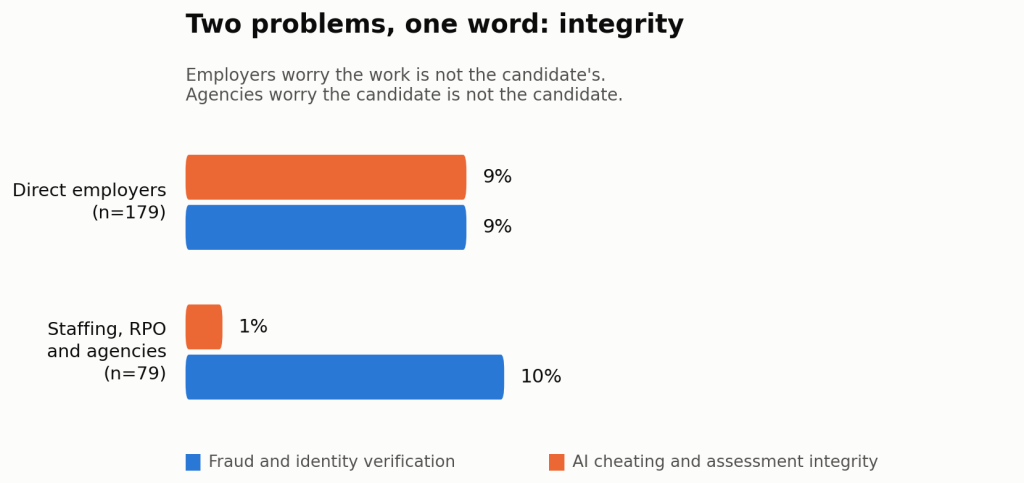
Identity fraud asks whether this person is who they claim to be. AI cheating asks whether this work is theirs. The first is a security question and verification answers it. The second is a test-design question, and proctoring can make it worse: if the underlying task is one an AI can complete, banning the tools the job actually uses inverts the filter you were trying to build.
Consumer and retail companies raised AI cheating most, in 19% of enquiries, with industrial and manufacturing close behind at 18%. Technology companies raised it in 7%. The sector most associated with coding tests worries about it least, which most plausibly means they have already priced it in and moved on.
Scale-wise, TestGorilla’s 2025 research found that of job seekers who took a skills test in the previous year, 17% said they had cheated. Seven in ten of those used AI to do it.
Small companies describe a throughput problem and enterprises describe a systems problem. Screening capacity appeared in 24% of enquiries from organisations under 200 people, dropping to 12% at enterprises above 10,000. The enterprise pattern inverts: systems integration at 16%, and manager training and roleplay at 20%, the highest of any size band.
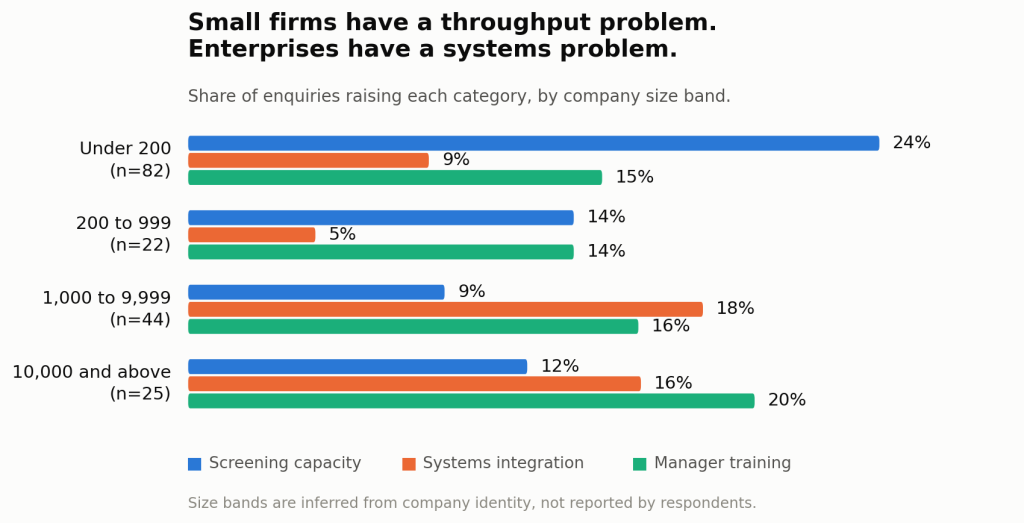
The self-reported numbers inside the enquiries make the squeeze at the small end vivid. A two-person talent team reported spending 16 working weeks on interviews in a single year. An insurance graduate programme described 8,000 applicants for 24 hires, a ratio of 333 to one. One company runs 40 to 50 interviews a day. Another processes roughly 100,000 assessments a year.
Enterprises are not exempt from volume. They have simply bought something for it already, so their question has moved on: does the next tool fit the stack, and can their managers use it? Aptitude Research found in November 2025 that 62% of employers now use AI in talent acquisition, up from 40% in 2020. But 44% use it across only 1% to 25% of their workflow, and a mere 6% have automated more than three quarters. Adoption is broad and shallow, which is exactly what an integration-shaped question set looks like from the inside.
Financial services broke almost every pattern, raising manager development, systems integration and speed each in 30% of its enquiries, roughly triple the overall rate on the first two. There are only 10 enquiries in that segment, so read it as a question worth asking rather than an answer.
The sturdier oddity is what happens when nobody names a problem. In 7% of enquiries the writer named a product category, “screening” or “assessment” or “interviews”, and stopped there. And of the original 304 submissions, 46 were not hiring enquiries at all: vendor pitches, support tickets, job seekers, and one person asking for spiritual guidance.
That 15% noise rate matters if you plan to read your own inbound as a market signal. A meaningful share of what lands in a lead form is not a buyer, and it does not announce itself as anything else.
Three things, ordered by how much they would change a 2026 plan.
Split your integrity questions in two. Identity verification and AI-resistant assessment design solve different failures and belong in different workstreams with different owners. Teams that conflate them buy proctoring and think fraud is handled, or buy identity checks and think cheating is handled. Neither is true.
Measure your own fraud exposure instead of inferring it. Nine percent of buyers raising it tells you precisely nothing about your funnel. Sample your last hundred technical screens and count how many candidates you can positively identify at both the assessment and the interview. That number is your answer.
Ask what your assessment would still measure if the candidate used every tool available to them. If the honest answer is nothing, then the task is the problem and the candidate is not. The teams in this data asking for role-specific simulations rather than generic tests have already worked that out.
The technology that addresses all three now exists in a recognisable shape. Verified identity at each stage of the funnel. Assessments built around demonstrated work rather than recallable answers. AI running first-round conversations at a volume no human panel could staff, and evidence that survives an audit afterwards.
The question to put to any of it is whether the platform is validating something or merely processing something faster. Speed applied to an unreliable signal does not fix the signal. It just produces unreliable hires sooner.
Which is the quieter finding sitting underneath all 258 enquiries. Almost nobody wrote in asking to hire faster. They wrote in asking to be more certain.
A few hundred records supports directional segment comparisons but not precise ones. In this analysis, segments of 40 or more records, such as technology and software, small companies, and staffing firms, carry reasonable weight. Segments of 10 to 20 records shift several percentage points on a single entry and should be treated as hypotheses.
No. Inbound demand captures what buyers volunteer, which is a different and complementary thing from what they select when a survey lists the options. Surveys measure recognition. Unprompted text measures salience. Fraud scores high on the first and low on the second, and both readings are accurate.
Both purchases buy back scarce senior time. An AI first round removes screening hours from hiring managers, and roleplay simulation removes coaching hours from senior leaders. Enterprises in this data raised manager development more than any other size band, at 20%, which fits organisations whose real constraint is management attention rather than applicant flow.
Adoption of the mechanism is running ahead of belief in it. TestGorilla reported in 2025 that 85% of employers use some form of skills-based hiring and 53% have dropped degree requirements. Yet only 32% of those same employers think degrees matter less than they did five years ago, and 41% say they matter more. The tooling is arriving faster than the conviction.
The 333-to-one applicant-to-hire ratio one respondent reported for a graduate programme. Volume at that scale is not a staffing problem a bigger recruiting team fixes. It is a structural problem that only changes if the first evaluation stops requiring a human.

AI interview intelligence is software that records, transcribes, and analyzes interviews that a human recruiter or hiring manager is actually conducting, turning the conversation into structured data such as talk time ratios, sentiment trends, and competency or keyword tags. It does not run the interview itself. It sits behind the human led conversation and gives […]

AI hiring accessibility means making sure automated interviews, video assessments, and proctoring tools do not create barriers for candidates with visual, hearing, speech, motor, or neurodivergent disabilities, and that reasonable accommodations, like extended time, alternative formats, and human review, are built into the process rather than bolted on afterward. Getting this right is not just […]

AI resume fraud is the practice of candidates using generative AI tools like ChatGPT to invent, inflate, or heavily embellish work experience, job titles, projects, and skills on a resume, specifically to slip past applicant tracking system keyword filters and impress a human reviewer. It is a resume and application stage problem, distinct from a […]