
Make talent quality your leading analytic with skills-based hiring solution.
Resumes tell you what a candidate says they can do. A technical skills evaluation tells you what they can actually do. As technology moves faster than most job descriptions can keep up with, a resume and a conversational interview alone are no longer enough to confirm that a candidate can perform the role, especially for engineering, data, and IT positions where the cost of a bad hire shows up fast.
This guide walks through what a technical skills evaluation actually is, why it matters, and the exact steps to run one that is structured, fair, and predictive of real job performance.
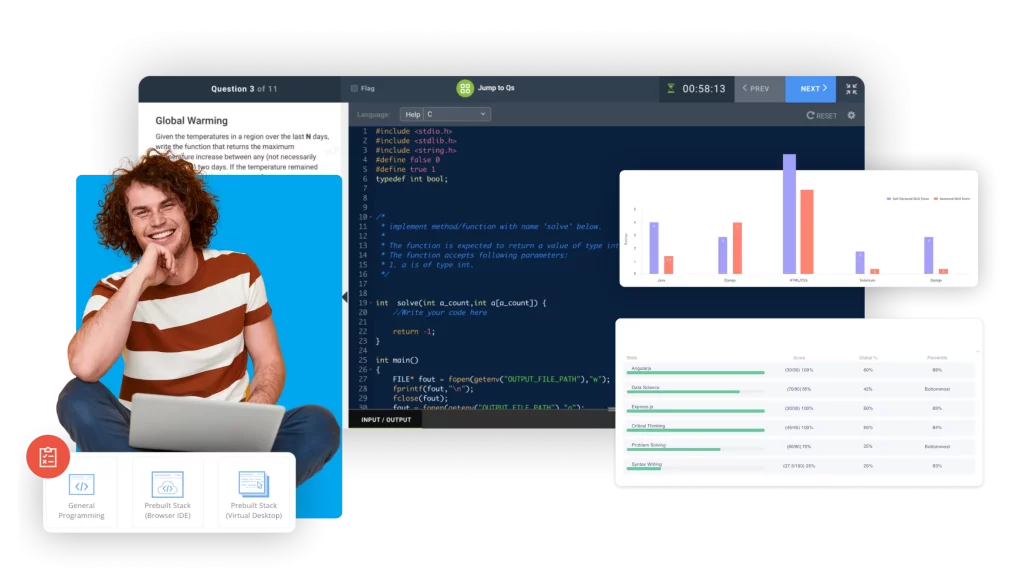
A technical skills evaluation combines coding tests, technical interviews, and practical tasks that simulate real job scenarios, designed to verify a candidate’s proficiency in the specific programming languages, tools, and technologies the role actually requires. Unlike a generic quiz, a well built evaluation asks candidates to do something close to the job itself, not just answer questions about it.
A structured technical evaluation earns its place in the hiring process for four concrete reasons:
1. Define the requirements Before building or choosing an assessment, get specific about what the role actually needs: which languages, frameworks, seniority level, and problem types matter most. A generic evaluation built for “a developer” will miss the mark for a senior backend engineer versus a junior full stack hire.
2. Choose the right tools Pick a technical skill test platform that offers customization, automated scoring, and standardization across candidates, rather than a one size fits all quiz bank. The tool should let you adjust difficulty and content to the actual role.
3. Develop the evaluation criteria Decide upfront what you’re scoring: skill proficiency, problem solving approach, coding standards, and practical application, not just whether the final answer is correct. Written criteria, agreed on before the first candidate is evaluated, is what keeps scoring consistent across a hiring panel.
4. Create or select assessments Combine formats that match the role: coding tests, structured technical interviews, and practical tasks. Coding simulations are especially useful here, since they recreate the tools and constraints of the actual job rather than an artificial test environment.
5. Administer the assessments Use AI supported proctoring to keep the process fair and secure, and give candidates real time feedback or guidance where appropriate so the evaluation measures skill, not just how well someone copes with an unfamiliar test interface.
6. Evaluate the results Lean on automated scoring and reporting to reduce manual review time and keep evaluation consistent across every candidate, rather than relying on a different reviewer’s subjective read each time.
7. Share and discuss results Generate detailed reports and summaries that hiring managers and panel members can review together, so the decision is based on shared evidence rather than one person’s impression of the interview.
8. Provide feedback to candidates Offer constructive feedback to every candidate who completes an evaluation, not just the ones you hire. It’s a small step that protects your employer brand and keeps the candidate experience professional even for a rejection.
AI now plays a meaningful role in making technical evaluations faster and more consistent:
Most technical skills evaluations draw from a similar set of task types, adjusted for role and seniority: coding challenges, algorithmic problems, system design exercises, debugging exercises, and code review assessments. Mixing task types, rather than relying on one format alone, gives a fuller picture of how a candidate actually works.
A technical evaluation in hiring is a structured process, usually combining coding tests, technical interviews, and practical tasks, used to verify that a candidate has the skills a role actually requires, rather than relying on a resume or conversation alone.
Use standardized assessments and predefined scoring criteria applied the same way to every candidate, combine multiple task types rather than one single test, and document results so decisions can be reviewed later rather than left to individual interviewer judgment.
The typical process is defining the role’s requirements, choosing the right assessment tools, setting evaluation criteria, building or selecting the assessments, administering them, scoring the results, discussing them with the hiring panel, and giving feedback to candidates.
Most technical evaluations, whether a coding test, a live technical interview, or a practical task, are designed to fit within thirty minutes to two hours, long enough to see real problem solving without asking for an unreasonable time commitment from candidates.
Yes. AI can generate role specific questions, provide real time guidance during interviews, score responses consistently, and sync results directly into an ATS, which reduces manual review time and helps keep scoring consistent across candidates.
A coding test is usually one component of a broader technical evaluation. The full evaluation can also include structured technical interviews, system design discussions, debugging exercises, and practical tasks that a coding test alone wouldn’t cover.
By replacing unstructured, interviewer dependent judgment with standardized tasks and predefined scoring criteria applied consistently to every candidate, which narrows the room for subjective or inconsistent evaluation.

Global hiring fraud hotspots are the countries and regions where documented candidate fraud and identity verification risk run highest, based on named industry indices rather than assumption. In 2026, that data points consistently in one direction: fraud vulnerability is concentrated in markets with weaker centralized identity infrastructure and fast growing digital hiring volume, led by […]

A synthetic candidate is a job applicant who does not exist as a single real person at all. The persona is assembled, usually by combining stolen or purchased personally identifiable information (PII) with an AI generated resume, an AI generated or composite photo, and an invented work history, into a package that looks, on paper […]

Hiring overqualified candidates is not automatically a mistake, but it is a decision that carries real, well documented risk if the role and the offer are not restructured around it. Recent survey data shows most employers already do this regularly: 70 percent of hiring managers say they typically consider candidates who are overqualified for the […]