
Make talent quality your leading analytic with skills-based hiring solution.
A skills gap analysis is a structured comparison between the skills your team currently has and the skills it needs, done before you write a job requisition, not after. It works by combining three inputs: an honest inventory of what current employees can actually do, a benchmark of what each role will require going forward, and outside market or industry data on where skills are shifting. Run in that order, it tells you whether a gap should be closed by training an existing employee, hiring externally, restructuring a role, or bringing in contract help, which means the analysis has to happen before the requisition, not as an afterthought once a req is already open.
That sequencing matters more than most workforce planning content admits. It is easy to skip straight to “we need to hire” the moment a project stalls or a team feels stretched. A proper skills gap analysis forces a pause: is this actually a headcount problem, or is it a skills problem that a hire will not solve either, because the market is short on that exact skill too?
According to the World Economic Forum’s Future of Jobs Report 2025, 63 percent of employers now identify skill gaps in the labor market as the primary barrier to business transformation between 2025 and 2030, up from 60 percent in the prior edition of the same report. The same report estimates that workers can expect roughly two fifths, 39 percent, of their existing skill set to be transformed or made outdated over that same period, and that if the global workforce were 100 people, 59 of them would need some form of training by 2030, with only 29 of those 59 upskillable in their current role.
Separately, McKinsey research that has circulated widely across the HR industry puts the share of companies reporting a skills gap somewhere around 87 percent. Whatever the exact figure, the direction is consistent across every source: most organizations are not short on people, they are short on specific, nameable skills, and most of them have not measured exactly which ones.
That last part is the actual opportunity. A skills gap analysis is not a research exercise for its own sake, it is the step that turns a vague feeling of “the team feels behind” into a specific, prioritized list you can act on, whether that action is training, hiring, restructuring, or contracting.
Most published frameworks, including the ones from disprz, imocha, and thirst, converge on the same underlying idea even when they number the steps differently: you need a “what we have,” a “what we need,” and a way to compare the two that accounts for where the world is heading, not just where your org chart sits today.
This comes from a triangulated assessment, not a single source. Relying only on self reported skill surveys tends to overstate proficiency, while relying only on manager opinion misses skills a manager cannot directly observe. The more reliable approach combines three views:
This is the input most gap analyses shortchange. It is not enough to document what a role requires today, you need to benchmark what the role will require over the next 12 to 24 months given known product, market, or technology shifts. A practical way to do this is to write what some frameworks call a “12 month execution sentence” for the role, a short statement of what success looks like a year out, then reverse engineer the 3 to 5 skills that sentence depends on. Looking at concrete examples of what a task actually looks like for a given role is a useful gut check here, since a benchmark disconnected from real day to day tasks tends to drift into generic competency language that is hard to measure against later.
Internal data alone will always be a lagging indicator, since it only reflects skills your organization has already had reason to notice. External market data catches shifts before they show up in your own performance reviews. Glider AI’s own 2025 Skills Report is a useful example of this kind of input in practice: it found that nearly 60 percent of employers reported significant skill changes in existing roles over a two year period, driven mostly by generative AI, and that more than 70 percent of employers believe a lack of skills clarity is already creating a measurable cost or burden on the business. Pairing a data source like that with your own role benchmarks keeps the analysis honest about where the wider market is moving, not just where your team happens to be today.
Only after step 6 does it make sense to open a requisition, and only for the gaps the analysis actually routes to “buy.” That is the practical payoff of doing this work up front: it keeps hiring targeted at real, evidenced gaps instead of a generic sense that the team needs more people.
These three terms get used almost interchangeably in casual conversation, but they answer different questions and happen at different points in the process. A skills gap analysis is the diagnostic step: it tells you which skills are missing and how large each gap is, across a team or role family, before anyone has decided what to do about it. A skills assessment is the measurement instrument used inside that diagnosis, the actual test or exercise that produces a current proficiency score for one person against one skill. And an ROI calculation is a downstream financial question, whether the assessment tooling or training program you eventually choose is worth what it costs. Confusing the three tends to produce projects that jump straight to buying assessment software before anyone has actually mapped out which skills, for which roles, are worth measuring in the first place.
Treat a skills gap analysis as a living dataset rather than an annual snapshot. An annual cadence is a reasonable baseline for a stable team, but rerun the analysis whenever a major trigger occurs: a new product line, a reorganization, a wave of attrition on a specialized team, or an external shift like the kind tracked in industry skills reports. Organizations that only revisit their skills data once a year tend to discover gaps months after they have already affected delivery, which defeats the purpose of running the analysis at all.
A skills gap analysis is a structured comparison between the skills a team currently has and the skills a role or business objective requires, used to decide whether a gap should be closed through training, hiring, restructuring, or contract support.
You identify a skills gap by combining a current skills inventory, built from self assessment, manager review, and objective testing, with a benchmark of what each role will require going forward, then measuring the difference on a consistent proficiency scale.
A skills gap analysis is the broader diagnostic process across a team or role family; a skills assessment is the specific tool or test used within that process to measure one person’s current proficiency in one skill.
Yes. Running the analysis first tells you whether a gap is actually a hiring problem or something training, restructuring, or contract support could close faster and more cheaply, which keeps new requisitions targeted at evidenced needs rather than a general sense of being short staffed.
Role benchmarking means defining what a role will require 12 to 24 months out, not just what it requires today, then identifying the specific skills that future state depends on so the gap analysis measures against where the role is heading rather than where it currently sits.
At least annually for a stable team, and immediately after major triggers such as a new product launch, a reorganization, a wave of attrition, or a documented shift in industry skill demand.
Three sources: an internal skills inventory built from assessments and manager input, role benchmarks tied to near term business goals, and external market or industry skill trend data so the analysis reflects where skills are shifting outside your own organization, not just inside it.
Once the diagnosis is done and you know exactly which gaps belong to training and which belong to hiring, the next practical step is choosing how to measure proficiency consistently, whether that is through structured skills assessments, evaluating assessment tools built for hiring managers, or working from Glider AI’s own skill assessment software to keep the inventory current as roles keep changing.

Global hiring fraud hotspots are the countries and regions where documented candidate fraud and identity verification risk run highest, based on named industry indices rather than assumption. In 2026, that data points consistently in one direction: fraud vulnerability is concentrated in markets with weaker centralized identity infrastructure and fast growing digital hiring volume, led by […]
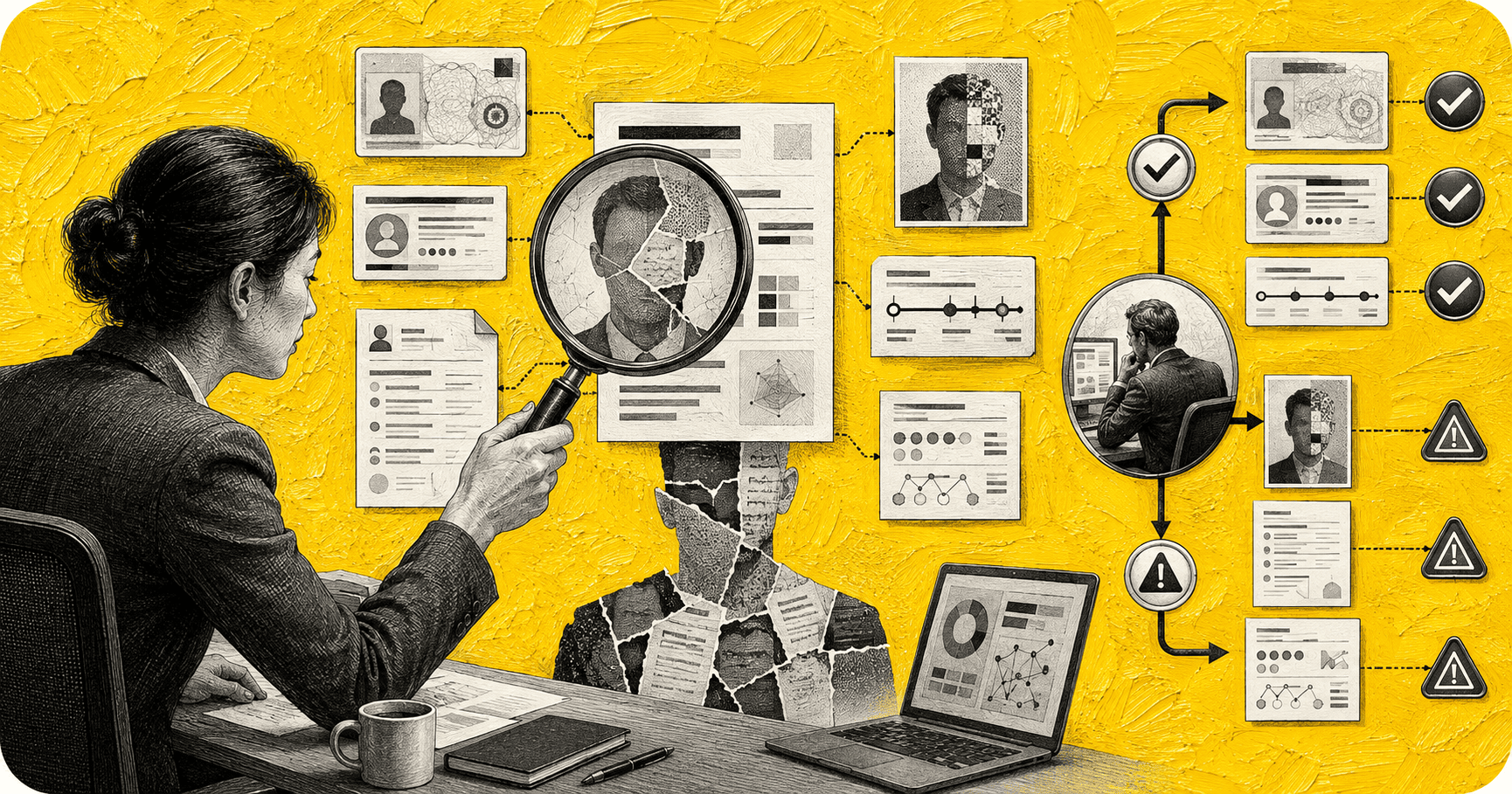
A synthetic candidate is a job applicant who does not exist as a single real person at all. The persona is assembled, usually by combining stolen or purchased personally identifiable information (PII) with an AI generated resume, an AI generated or composite photo, and an invented work history, into a package that looks, on paper […]

Hiring overqualified candidates is not automatically a mistake, but it is a decision that carries real, well documented risk if the role and the offer are not restructured around it. Recent survey data shows most employers already do this regularly: 70 percent of hiring managers say they typically consider candidates who are overqualified for the […]