Make talent quality your leading analytic with skills-based hiring solution.
Most hiring teams don’t struggle to find candidates; they struggle to tell which ones can actually do the job. That gap is exactly what good skills assessment tools are built to close. Instead of relying on a resume, a gut feeling, or a single interview, a structured assessment gives you evidence: how a candidate solves a real problem, communicates under pressure, and performs a task close to what the job actually requires.
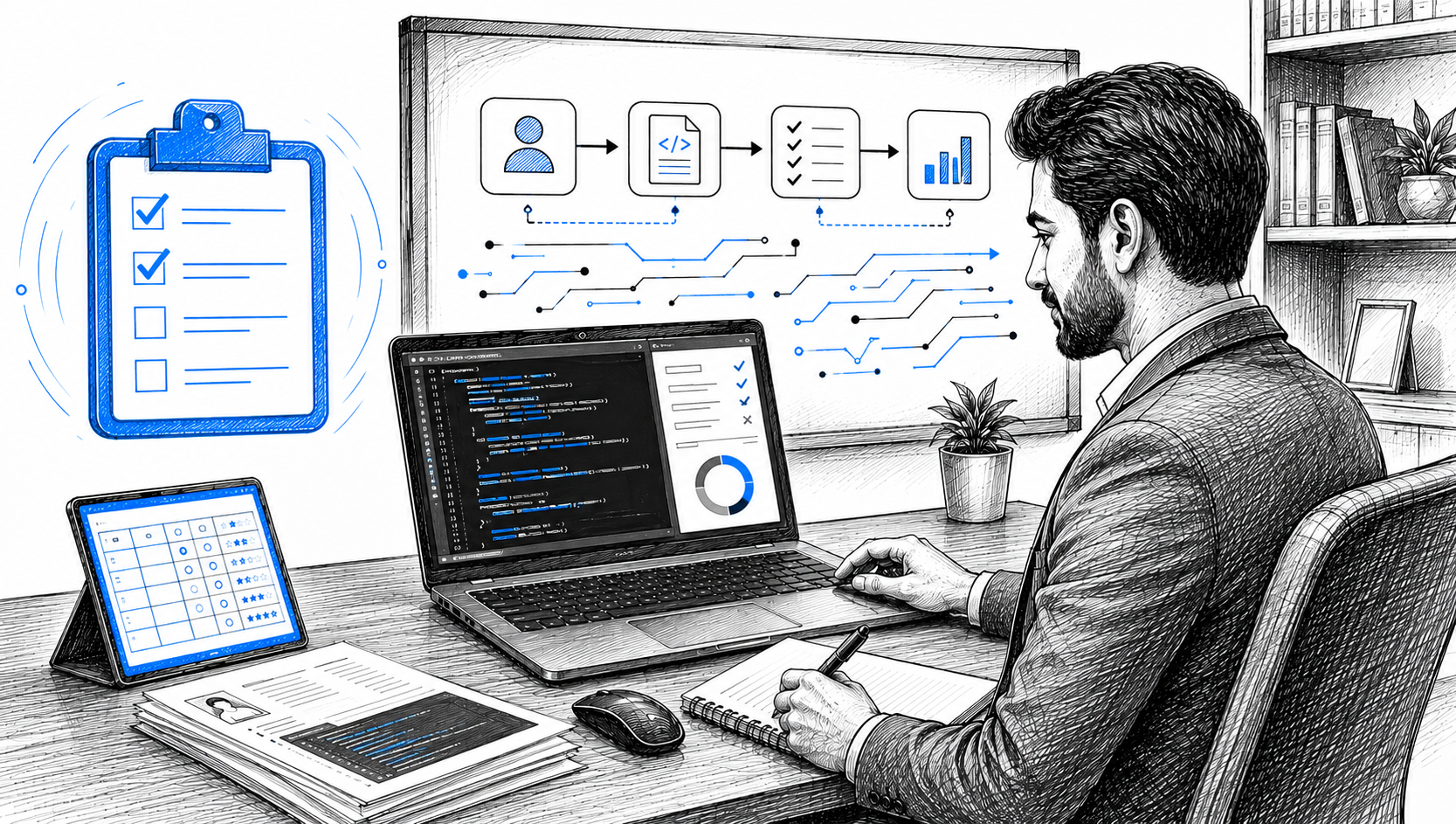
The Glider Assessment Suite brings the main categories of skills assessment tools together in one connected platform: technical assessments, an AI Assistant, behavioral tests, competency assessments, and coding simulations. This helps hiring teams avoid stitching together multiple point solutions. This guide walks through each component, what it measures, and how the suite works together to strengthen hiring decisions.
The Glider Assessment Suite consolidates the major evaluation methods recruiters typically need into one location, so teams can measure capability, confirm job readiness, and reduce uncertainty without switching tools mid-pipeline. Assessments are built around job-relevant skills and work scenarios, helping candidates demonstrate how they think, solve problems, and approach real tasks rather than only recalling information.
Technical assessments evaluate proficiency across software engineering, data, and IT roles. The assessment experience can be aligned to the role and required technical skills, helping hiring teams distinguish candidates who can apply knowledge to practical problems from those who may only perform well in conventional interviews.
For technical hiring, this gives recruiters a more job-relevant signal before moving candidates into later interview stages, especially when a role requires hands-on problem solving rather than theoretical knowledge alone.
The AI Assistant supports candidates during technical assessments and live coding interviews, offering task-level guidance while giving hiring teams visibility into how a candidate reasons through a problem and collaborates with AI. It shifts the evaluation from simply asking whether a candidate reached the right answer to understanding how they reached it.
Within a controlled assessment environment, candidates can ask clarifying questions, receive coding or debugging guidance, and show how effectively they interpret and apply AI-assisted feedback. That makes AI fluency and problem-solving behavior part of the evaluation rather than an invisible factor.
Behavioral tests reveal traits that a resume can’t, including work preferences, judgment patterns, and interpersonal capabilities. Structured, standardized behavioral assessment can also help reduce reliance on subjective impressions. One example discussed by Psicosmart describes how psychometric evaluation can support more consistent and less biased hiring decisions.
Behavioral results are most useful when considered alongside skills and competency evidence, giving hiring teams a broader view of how a candidate may approach work, collaboration, decision-making, and role expectations.
Competency assessments measure real-world job task performance through job-based exercises and practical evaluation formats. They help verify functional knowledge and decision-making in conditions that more closely resemble the actual role than a generic test environment.
This is particularly useful for non-technical and functional roles where job readiness depends on applying knowledge, communication, judgment, or process skills in realistic scenarios.
Coding simulations recreate the tools, workflows, and constraints a candidate may face after being hired. Instead of evaluating coding through isolated questions alone, simulations give candidates a practical environment in which to build, debug, and solve problems.
For engineering teams, that provides a stronger view of hands-on readiness and how candidates work through realistic technical tasks before a hiring decision is made.
Each component of the suite is built to answer a different question that a resume alone can’t. Technical assessments validate technical capability, competency assessments verify job-related performance, behavioral tests reveal work style and judgment, coding simulations confirm hands-on readiness, and the AI Assistant adds visibility into how a candidate thinks and collaborates with AI.
Used together as one connected set of skills assessment tools, rather than as disconnected point solutions, these methods create a more structured hiring process and give recruiters multiple job-relevant signals to support better-informed decisions.
The suite integrates with the ATS and HR tech platforms teams already use, allowing assessment results and candidate information to stay connected to the existing hiring workflow instead of living in a separate system.
The most effective skills assessment tools help hiring teams evaluate different dimensions of job readiness instead of relying on a single score or interview. By combining technical, behavioral, competency, coding, and AI-assisted evaluation in one suite, Glider AI gives teams a structured way to match the assessment method to the role and make hiring decisions using more relevant evidence.
Glider’s assessments focus on job-relevant skills and work scenarios rather than relying only on generic questionnaires or memory-based tests. This helps hiring teams evaluate how candidates apply skills in situations that are closer to the work they may perform on the job.
Yes. Recruiters can align assessments with job requirements, seniority levels, technical skills, and role-specific competencies so the evaluation reflects what matters for the position.
The platform uses structured assessment workflows, standardized scoring, and performance-based data to reduce reliance on subjective judgment and keep candidate evaluation more consistent across the hiring process.
Yes. The AI Assistant can provide task guidance and clarification in supported technical assessments and live coding interviews while allowing hiring teams to see how candidates reason, respond to feedback, and collaborate with AI.
Glider integrates with ATS and HR technology platforms so assessment information can stay connected to the hiring workflow rather than requiring teams to manage results in a separate process.
A skills assessment tool is software used during hiring to evaluate a candidate’s ability to perform job-related tasks. Depending on the role, this can include technical tests, coding simulations, behavioral evaluations, or competency-based exercises.
Pricing varies by vendor and can depend on assessment volume, the types of assessments required, integration needs, and enterprise features. Organizations should compare pricing based on their hiring volume and evaluation requirements.
Yes. While technical assessments and coding simulations are designed for engineering and IT use cases, behavioral and competency assessments can support non-technical and functional roles where judgment, communication, and real-world task performance matter.

Take home assignment outsourcing happens when a candidate has someone else, a freelancer, a friend, or a paid ghost writing service, complete their take home coding, design, or writing test for them. Because the assignment is done alone, on the candidate’s own schedule, and away from any interviewer or proctor, nothing about the format itself […]

Leaked interview questions are exact, or nearly exact, copies of a company’s real assessment or interview questions that have been collected, compiled, and shared, often for a price, so that later candidates can memorize the answer before they ever see the question live. This is a test bank leak: a candidate is not solving a […]

Technical skills assessments have become the foundation of modern engineering hiring. Yet just a few years ago, most technical hiring teams still relied heavily on resumes, recruiter screenings, and live whiteboard interviews to evaluate engineers. While common, these methods were often slow, inconsistent, and prone to favouring candidates who performed well in interviews rather than […]