


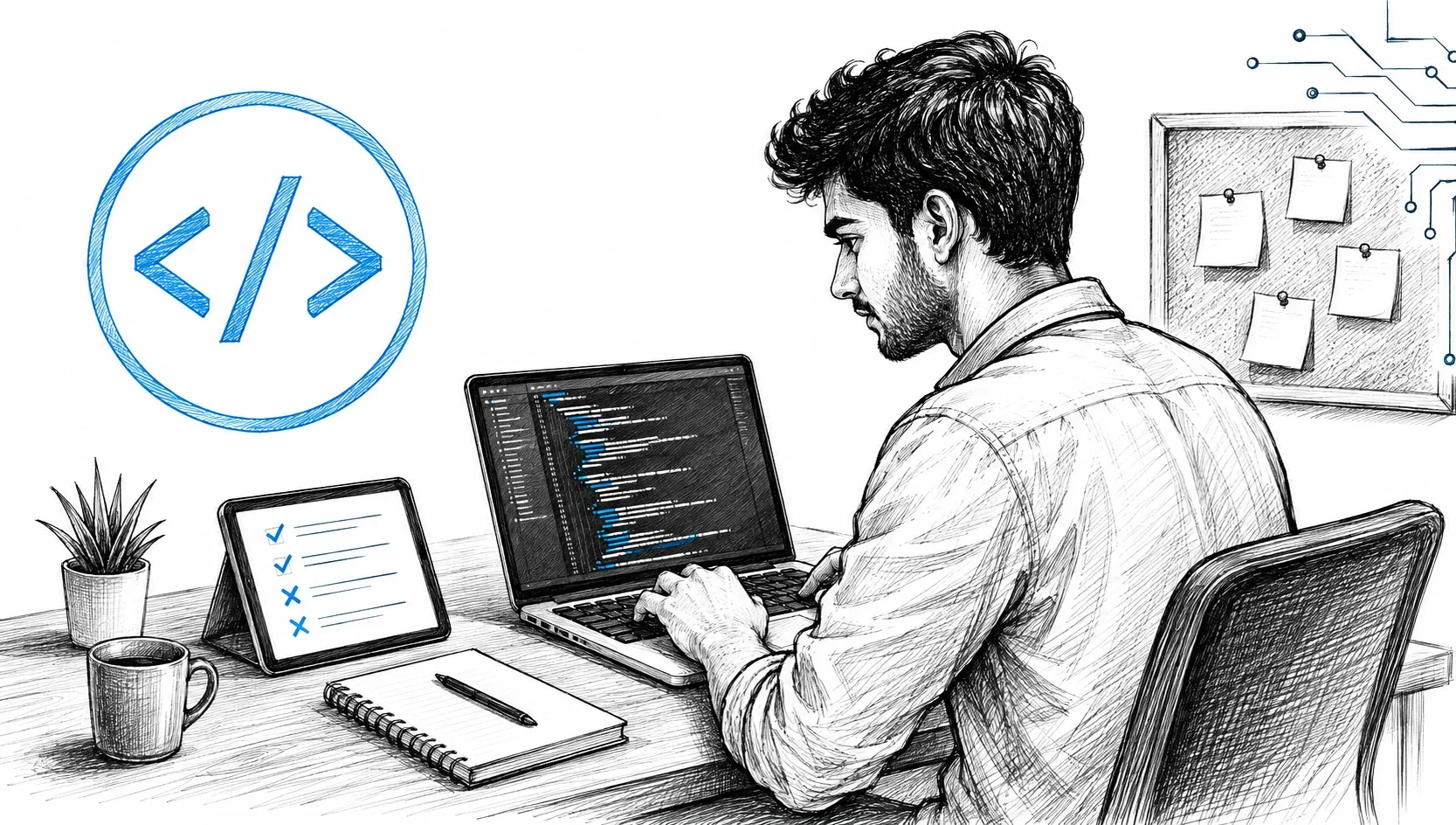
Coding interviews typically combine a mix of formats: structured questions asked live, a take home coding test, or a live coding interview conducted through a shared editor. Whichever format you use, the goal is the same, to see how a candidate approaches problem solving, not just whether they can recite syntax. Many teams now pair these questions with a proper coding assessment or coding simulation before the interview stage, so the live conversation can focus on reasoning and code review rather than basic screening.
Who You Are Hiring For
Before running a coding interview, it helps to define the qualifications, experience, and skills you are screening for. The demand for this kind of talent remains strong: according to the U.S. Bureau of Labor Statistics, employment of software developers, quality assurance analysts, and testers is projected to grow 15 percent from 2024 to 2034, much faster than the average for all occupations, adding roughly 287,900 new jobs over the decade. That level of demand makes a consistent, well structured interview process even more valuable.
Qualifications to look for
- Bachelor's or Master's degree in Computer Science or a related field
- Diploma or certification in Computer Science and Technology
- Equivalent experience through bootcamps or self taught portfolios, which is increasingly common and should not be automatically screened out
Experience to look for
- Relevant IT work experience for the seniority level you are hiring for
- Coding experience across the specific programming languages and frameworks your team uses
- Experience working in an agile or collaborative engineering environment
Skills to look for
- Analytical and structured problem solving
- Attention to detail and code quality
- Collaboration and clear communication with non technical stakeholders
- Adaptability and a habit of continuous learning
General Coding Interview Questions
These background and process questions work for almost any developer role and are a good way to open the conversation before moving into language specific technical interview questions.
- Explain the coding process you follow, from understanding requirements to final delivery of the end product.
- Can you debug a program while it is being used? Explain how.
- Which tools do you use to test the quality of your code?
- How do you make sure your code is readable by other developers?
- How do you review somebody else's code?
- Which is your favorite programming language and why?
- If you had to work on a project with colleagues outside the tech team, how would you collaborate?
- How do you keep yourself updated with the latest technology?
What a good answer looks like: for question 1, a strong candidate will describe a repeatable process, gathering requirements, planning, writing code, testing, and documenting, rather than jumping straight to "I just start coding." For question 4 and 5, look for specifics such as naming conventions, comments, version control practices, and how they give and receive feedback in a code review, since this reflects real world collaboration more than any single algorithm question can.
Java Interview Questions
- What is the difference between checked exceptions and runtime exceptions?
- In Java, is this possible: A extends B, C?
- What is the use of an object factory?
- How will you implement the singleton pattern?
- Explain the difference between String, StringBuffer, and StringBuilder.
A strong answer to the singleton pattern question should cover thread safety and lazy versus eager initialization, not just the basic structure, since this is a common area where junior and senior candidates differ noticeably.
Ruby Interview Questions
- What is the use of require and load?
- Describe a module. What is the difference between modules and classes?
- Mention some of your favorite gems.
- Explain the following operators: eql?, equal?, ==, ===.
Python Interview Questions
- Why are functions considered first class objects?
- Can you give an example of the filter and reduce functions over an iterable object?
- Explain potential problems with circular dependencies and some effective ways to avoid them.
- What are the uses and advantages of a generator?
Look for candidates who can explain generators in terms of memory efficiency and lazy evaluation, since this is a practical, on the job distinction rather than pure theory.
Dotnet Interview Questions
- Explain the WebSecurity class and its use.
- What is the best approach to pass configuration variables to ASP.NET applications?
- What is the most efficient way to use dotnet attributes as a method of associating declarative information using C# code?
- Is it possible to extend a class with extra methods? If yes, how?
PHP Interview Questions
- What method will you follow to generate random numbers in PHP?
- How do you develop and integrate plugins for PHP frameworks such as Yii and Laravel?
- What is the difference between require() and include()?
- How will you get the details of a web browser using PHP?
HTML and CSS Interview Questions
- What is the difference between block elements and inline elements?
- Explain the difference between margin and padding.
- Why is it a good practice to position JavaScript at the bottom of the page?
Making the Most of These Questions
A list of questions is only useful if you have a consistent way to score the answers. Many talent teams use a scorecard or rubric so that different interviewers evaluate candidates on the same criteria, which is especially important once you are running multiple technical interview rounds across a hiring funnel. Pairing these coding interview questions with a standardized skill assessment, an AI proctoring layer for remote screening, and structured interview scoring inside an ATS integration helps reduce bias and speeds up the path from application to offer. For additional, field tested examples of structured interview questions, SHRM's sample interview questions guide is a helpful reference when building out your own rubric.
If you need role specific phrasing for job postings to match, Glider's job description library is a useful companion resource to this list. Looking for more interview question guides? Browse them by role, or search the complete interview questions library for a specific title.